Centralized authentication session management service. More...
#include <auth_session_service.hpp>
Collaboration diagram for auth_session_service:
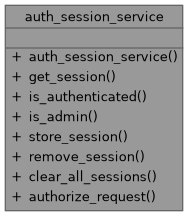
Public Member Functions | |
| std::optional< session_info > | get_session (const std::string &remote_address) const |
| Get session for a remote address. | |
| bool | is_authenticated (const std::string &remote_address) const |
| Check if a remote address has an authenticated session. | |
| bool | is_admin (const std::string &remote_address) const |
| Check if a remote address has an admin session. | |
| void | store_session (const std::string &remote_address, session_info info) |
| Store session for a remote address. | |
| void | remove_session (const std::string &remote_address) |
| Remove session for a remote address. | |
| void | clear_all_sessions () |
| Remove all sessions (e.g., on server shutdown). | |
| std::expected< void, messaging::error_code > | authorize_request (messaging::message_type type, const std::string &remote_address) const |
| Check if a request is authorized based on message type and session. | |
Detailed Description
Centralized authentication session management service.
Tracks authenticated sessions by remote address. This service is shared across all message handlers to provide consistent authorization checks.
Thread-safety: All public methods are thread-safe.
Member Function Documentation
◆ get_session()
| std::optional< session_info > get_session | ( | const std::string & | remote_address | ) | const |
Get session for a remote address.
- Parameters
-
remote_address The client's remote address
- Returns
- Session info if logged in, nullopt otherwise
Here is the caller graph for this function:

◆ is_authenticated()
| bool is_authenticated | ( | const std::string & | remote_address | ) | const |
Check if a remote address has an authenticated session.
- Parameters
-
remote_address The client's remote address
- Returns
- true if authenticated, false otherwise
◆ is_admin()
| bool is_admin | ( | const std::string & | remote_address | ) | const |
Check if a remote address has an admin session.
- Parameters
-
remote_address The client's remote address
- Returns
- true if authenticated as admin, false otherwise
◆ store_session()
| void store_session | ( | const std::string & | remote_address, |
| session_info | info | ||
| ) |
Store session for a remote address.
- Parameters
-
remote_address The client's remote address info Session information to store
◆ remove_session()
| void remove_session | ( | const std::string & | remote_address | ) |
Remove session for a remote address.
- Parameters
-
remote_address The client's remote address
◆ authorize_request()
| std::expected< void, messaging::error_code > authorize_request | ( | messaging::message_type | type, |
| const std::string & | remote_address | ||
| ) | const |
Check if a request is authorized based on message type and session.
Centralizes authorization logic for all message types:
- Some messages don't require authentication (login, bootstrap, heartbeat)
- Some messages require authentication
- Some messages require admin privileges
- Parameters
-
type The message type being requested remote_address The client's remote address
- Returns
- Empty expected on success, error_code on failure:
- authentication_failed if auth required but not logged in
- authorization_failed if admin required but not admin