ORES protocol client. More...
#include <client.hpp>
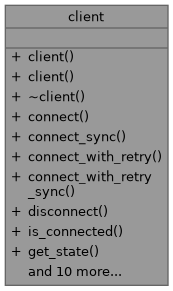
Public Member Functions | |
| client (client_options config, std::shared_ptr< eventing::service::event_bus > event_bus=nullptr) | |
| Construct client with configuration. | |
| client (client_options config, boost::asio::any_io_executor executor, std::shared_ptr< eventing::service::event_bus > event_bus=nullptr) | |
| Construct client with configuration and executor. | |
| ~client () | |
| Destructor. | |
| boost::asio::awaitable< void > | connect () |
| Connect to server and perform handshake (async version). | |
| void | connect_sync () |
| Connect to server and perform handshake (blocking version). | |
| boost::asio::awaitable< void > | connect_with_retry () |
| Connect to server with retry (async version). | |
| void | connect_with_retry_sync () |
| Connect to server with retry (blocking version). | |
| void | disconnect () |
| Disconnect from server. | |
| bool | is_connected () const |
| Check if client is connected. | |
| connection_state | get_state () const |
| Get the current connection state. | |
| void | set_disconnect_callback (disconnect_callback_t callback) |
| Set callback to be invoked when disconnect is detected. | |
| void | set_reconnecting_callback (reconnecting_callback_t callback) |
| Set callback to be invoked when reconnection starts. | |
| void | set_reconnected_callback (reconnected_callback_t callback) |
| Set callback to be invoked when reconnection succeeds. | |
| void | set_notification_callback (notification_callback_t callback) |
| Set callback to be invoked when a notification is received. | |
| boost::asio::awaitable< std::expected< messaging::frame, messaging::error_code > > | send_request (messaging::frame request_frame) |
| Send a request frame and receive response frame (async version). | |
| std::expected< messaging::frame, messaging::error_code > | send_request_sync (messaging::frame request_frame) |
| Send a request frame and receive response frame (blocking version). | |
| template<typename RequestType , typename ResponseType , messaging::message_type RequestMsgType> | |
| std::expected< ResponseType, messaging::error_code > | process_request (RequestType request) |
| Send typed request and receive typed response (blocking version). | |
| template<typename RequestType , typename ResponseType , messaging::message_type RequestMsgType> | |
| boost::asio::awaitable< std::expected< ResponseType, messaging::error_code > > | process_request_async (RequestType request) |
| Send typed request and receive typed response (async version). | |
| template<typename RequestType > requires messaging::has_message_traits<RequestType> | |
| std::expected< typename messaging::message_traits< RequestType >::response_type, messaging::error_code > | process_request (RequestType request) |
| Send typed request using message_traits (blocking version). | |
| template<typename RequestType > requires messaging::has_message_traits<RequestType> | |
| boost::asio::awaitable< std::expected< typename messaging::message_traits< RequestType >::response_type, messaging::error_code > > | process_request_async (RequestType request) |
| Send typed request using message_traits (async version). | |
Detailed Description
ORES protocol client.
Connects to server via SSL, performs handshake, and manages communication.
Constructor & Destructor Documentation
◆ client() [1/2]
|
explicit |
Construct client with configuration.
Creates its own io_context for synchronous operations.
- Parameters
-
config Client configuration options event_bus Optional event bus for publishing connection events
◆ client() [2/2]
|
explicit |
Construct client with configuration and executor.
- Parameters
-
config Client configuration options executor The executor to use for async operations event_bus Optional event bus for publishing connection events
◆ ~client()
| ~client | ( | ) |
Destructor.
Ensures proper cleanup order - strand and pending requests must be destroyed before the io_context they reference.
Member Function Documentation
◆ connect()
| boost::asio::awaitable< void > connect | ( | ) |
Connect to server and perform handshake (async version).
Single attempt connection without retries.
- Exceptions
-
connection_error if connection or handshake fails

◆ connect_sync()
| void connect_sync | ( | ) |
Connect to server and perform handshake (blocking version).
Single attempt connection without retries.
- Exceptions
-
connection_error if connection or handshake fails
◆ connect_with_retry()
| boost::asio::awaitable< void > connect_with_retry | ( | ) |
Connect to server with retry (async version).
Attempts connection with exponential backoff according to retry_options.
- Exceptions
-
connection_error if all retry attempts fail

◆ connect_with_retry_sync()
| void connect_with_retry_sync | ( | ) |
Connect to server with retry (blocking version).
Attempts connection with exponential backoff according to retry_options.
- Exceptions
-
connection_error if all retry attempts fail
◆ is_connected()
| bool is_connected | ( | ) | const |
Check if client is connected.
Returns true only when in the connected state, not during reconnection.
◆ set_disconnect_callback()
| void set_disconnect_callback | ( | disconnect_callback_t | callback | ) |
Set callback to be invoked when disconnect is detected.
The callback will be called from the heartbeat coroutine when a ping fails or times out. It should be thread-safe.
- Parameters
-
callback Function to call on disconnect (may be empty to disable)
◆ set_reconnecting_callback()
| void set_reconnecting_callback | ( | reconnecting_callback_t | callback | ) |
Set callback to be invoked when reconnection starts.
The callback will be called when auto-reconnect begins after connection loss. It should be thread-safe.
- Parameters
-
callback Function to call on reconnection start (may be empty to disable)
◆ set_reconnected_callback()
| void set_reconnected_callback | ( | reconnected_callback_t | callback | ) |
Set callback to be invoked when reconnection succeeds.
The callback will be called after auto-reconnect successfully restores the connection. It should be thread-safe.
- Parameters
-
callback Function to call on reconnection success (may be empty to disable)
◆ set_notification_callback()
| void set_notification_callback | ( | notification_callback_t | callback | ) |
Set callback to be invoked when a notification is received.
The callback will be called when the server pushes a notification for an event type the client is subscribed to. It should be thread-safe.
- Parameters
-
callback Function to call on notification (may be empty to disable)
◆ send_request()
| boost::asio::awaitable< std::expected< messaging::frame, messaging::error_code > > send_request | ( | messaging::frame | request_frame | ) |
Send a request frame and receive response frame (async version).
Generic method for sending any request and receiving response. Manages sequence numbers automatically.
- Parameters
-
request_frame The request frame to send
- Returns
- Expected containing response frame, or error_code

◆ send_request_sync()
| std::expected< messaging::frame, messaging::error_code > send_request_sync | ( | messaging::frame | request_frame | ) |
Send a request frame and receive response frame (blocking version).
Generic method for sending any request and receiving response. Manages sequence numbers automatically.
- Parameters
-
request_frame The request frame to send
- Returns
- Expected containing response frame, or error_code

◆ process_request() [1/2]
| std::expected< ResponseType, messaging::error_code > process_request | ( | RequestType | request | ) |
Send typed request and receive typed response (blocking version).
Handles serialization, framing, decompression, and deserialization.
- Template Parameters
-
RequestType Request message type (must have serialize() method) ResponseType Response message type (must have static deserialize() method) RequestMsgType The message_type enum value for this request
- Parameters
-
request The request to send
- Returns
- Expected containing deserialized response, or error_code

◆ process_request_async() [1/2]
| boost::asio::awaitable< std::expected< ResponseType, messaging::error_code > > process_request_async | ( | RequestType | request | ) |
Send typed request and receive typed response (async version).
Handles serialization, framing, decompression, and deserialization.
- Template Parameters
-
RequestType Request message type (must have serialize() method) ResponseType Response message type (must have static deserialize() method) RequestMsgType The message_type enum value for this request
- Parameters
-
request The request to send
- Returns
- Awaitable containing deserialized response, or error_code

◆ process_request() [2/2]
requires messaging::has_message_traits<RequestType>
| std::expected< typename messaging::message_traits< RequestType >::response_type, messaging::error_code > process_request | ( | RequestType | request | ) |
Send typed request using message_traits (blocking version).
Uses message_traits to automatically determine the response type and message_type enum value from the request type.
- Template Parameters
-
RequestType Request message type (must have message_traits)
- Parameters
-
request The request to send
- Returns
- Expected containing deserialized response, or error_code
◆ process_request_async() [2/2]
requires messaging::has_message_traits<RequestType>
| boost::asio::awaitable< std::expected< typename messaging::message_traits< RequestType >::response_type, messaging::error_code > > process_request_async | ( | RequestType | request | ) |
Send typed request using message_traits (async version).
Uses message_traits to automatically determine the response type and message_type enum value from the request type.
- Template Parameters
-
RequestType Request message type (must have message_traits)
- Parameters
-
request The request to send
- Returns
- Awaitable containing deserialized response, or error_code