Domain types for system variability. More...
Classes | |
| struct | feature_flags |
| Represents a feature flag in the domain layer. More... | |
| struct | system_flag_definition |
| Metadata for a system flag including its default state and description. More... | |
| struct | system_flags_cache |
| POD containing cached values of well-known system flags. More... | |
Enumerations | |
| enum class | system_flag { bootstrap_mode , user_signups , signup_requires_authorization , disable_password_validation } |
| Enumeration of well-known system flags. More... | |
Functions | |
| std::ostream & | operator<< (std::ostream &s, const feature_flags &v) |
| Dumps the feature flags object to a stream in JSON format. | |
| std::string | convert_to_table (const std::vector< feature_flags > &v) |
| Converts feature flags to table format. | |
| std::ostream & | operator<< (std::ostream &s, const std::vector< feature_flags > &v) |
| Dumps the feature flags object to a stream in table format. | |
| std::string | to_flag_name (system_flag flag) |
| Converts a system_flag enum value to its database name. | |
| std::optional< system_flag > | from_flag_name (std::string_view name) |
| Attempts to parse a database flag name to a system_flag enum. | |
| const system_flag_definition & | get_definition (system_flag flag) |
| Gets the definition for a system flag. | |
| std::ostream & | operator<< (std::ostream &os, system_flag flag) |
| Stream output operator for system_flag. | |
| void | print_feature_flags_table (std::ostream &s, const std::vector< feature_flags > &v) |
| std::string | convert_to_json (const feature_flags &v) |
| Dumps the feature flags object to a stream in JSON format. | |
| std::string | convert_to_json (const std::vector< feature_flags > &v) |
Variables | |
| constexpr std::array | system_flag_definitions |
| Compile-time manifest of all system flags with their defaults. | |
Detailed Description
Domain types for system variability.
Contains core entity types for feature flags and system configuration including feature_flag and system_flags types with JSON I/O support.
Enumeration Type Documentation
◆ system_flag
|
strong |
Enumeration of well-known system flags.
System flags are compile-time known feature flags that control core system behaviour. Unlike dynamic feature flags which can be created at runtime, system flags have predefined names, descriptions, and default values.
The flag names in the database use the "system." prefix followed by the snake_case enum name (e.g., system_flag::bootstrap_mode maps to "system.bootstrap_mode").
Function Documentation
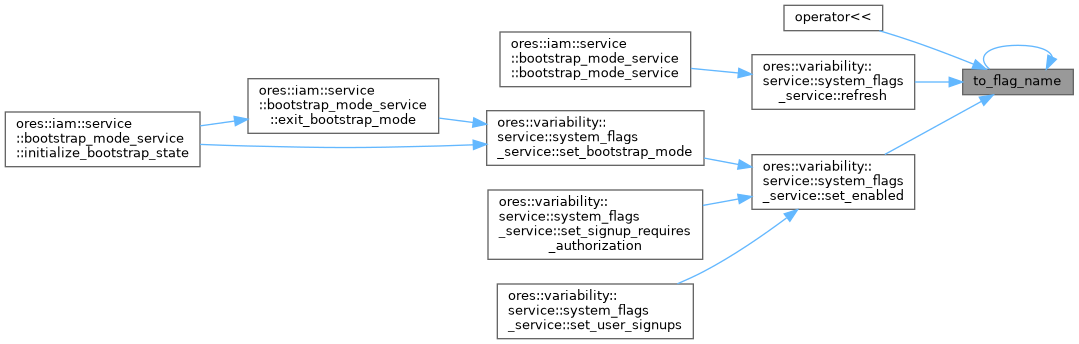
◆ to_flag_name()
| std::string to_flag_name | ( | system_flag | flag | ) |
Converts a system_flag enum value to its database name.
The database name uses the "system." prefix followed by the snake_case enum name.
- Parameters
-
flag The system flag enum value.
- Returns
- The database name string (e.g., "system.bootstrap_mode").
◆ from_flag_name()
| std::optional< system_flag > from_flag_name | ( | std::string_view | name | ) |
Attempts to parse a database flag name to a system_flag enum.
- Parameters
-
name The database name (e.g., "system.bootstrap_mode").
- Returns
- The system_flag if the name matches a known flag, std::nullopt otherwise.
◆ get_definition()
| const system_flag_definition & get_definition | ( | system_flag | flag | ) |
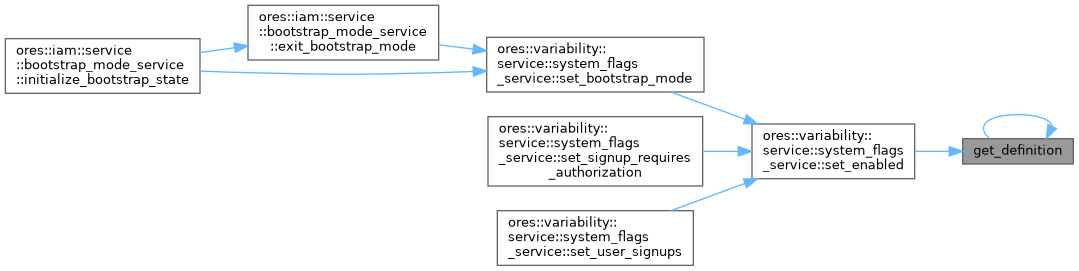
Gets the definition for a system flag.
- Parameters
-
flag The system flag to look up.
- Returns
- The flag definition containing default state and description.
◆ operator<<()
| std::ostream & operator<< | ( | std::ostream & | os, |
| system_flag | flag | ||
| ) |
Stream output operator for system_flag.
Outputs the flag name in a human-readable format.
Variable Documentation
◆ system_flag_definitions
|
constexpr |
Compile-time manifest of all system flags with their defaults.
This array defines all well-known system flags, their default enabled state, and human-readable descriptions. The system_flags_seeder service uses this manifest to ensure all system flags exist in the database at startup.