Client-side session manager providing auth-aware request handling. More...
#include <client_session.hpp>
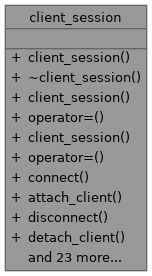
Public Member Functions | |
| client_session (const client_session &)=delete | |
| client_session & | operator= (const client_session &)=delete |
| client_session (client_session &&)=delete | |
| client_session & | operator= (client_session &&)=delete |
| std::expected< void, session_error > | connect (client_options options) |
| Connect to the server. | |
| std::expected< void, session_error > | attach_client (std::shared_ptr< client > external_client) |
| Attach an external client to this session. | |
| void | disconnect () |
| Disconnect from the server. | |
| void | detach_client () |
| Detach an externally-attached client. | |
| bool | is_connected () const noexcept |
| Check if connected to server. | |
| std::shared_ptr< client > | get_client () const noexcept |
| Get the underlying client. | |
| bool | is_logged_in () const noexcept |
| Check if logged in. | |
| void | set_session_info (client_session_info info) |
| Set session info after successful login. | |
| void | clear_session_info () noexcept |
| Clear session info on logout. | |
| const std::optional< client_session_info > & | session_info () const noexcept |
| Get current session info if logged in. | |
| std::string | username () const noexcept |
| Get the current username if logged in. | |
| std::string | email () const noexcept |
| Get the current email if logged in. | |
| void | set_email (const std::string &email) |
| Set the current email. | |
| std::optional< boost::uuids::uuid > | account_id () const noexcept |
| Get the account ID if logged in. | |
| template<Serializable RequestType, Deserializable ResponseType, messaging::message_type RequestMsgType> | |
| std::expected< ResponseType, session_error > | process_request (RequestType request) |
| Process a request that does not require authentication. | |
| template<Serializable RequestType, Deserializable ResponseType, messaging::message_type RequestMsgType> | |
| std::expected< ResponseType, session_error > | process_authenticated_request (RequestType request) |
| Process a request that requires authentication. | |
| template<Serializable RequestType, Deserializable ResponseType, messaging::message_type RequestMsgType> | |
| std::expected< ResponseType, session_error > | process_admin_request (RequestType request) |
| Process a request that requires admin privileges. | |
| template<typename RequestType > requires messaging::has_message_traits<RequestType> | |
| std::expected< typename messaging::message_traits< RequestType >::response_type, session_error > | process_request (RequestType request) |
| Process a request using message_traits (does not require auth). | |
| template<typename RequestType > requires messaging::has_message_traits<RequestType> | |
| std::expected< typename messaging::message_traits< RequestType >::response_type, session_error > | process_authenticated_request (RequestType request) |
| Process a request using message_traits (requires authentication). | |
| template<typename RequestType > requires messaging::has_message_traits<RequestType> | |
| std::expected< typename messaging::message_traits< RequestType >::response_type, session_error > | process_admin_request (RequestType request) |
| Process a request using message_traits (requires admin). | |
| bool | subscribe (const std::string &event_type) |
| Subscribe to notifications for an event type. | |
| bool | unsubscribe (const std::string &event_type) |
| Unsubscribe from notifications for an event type. | |
| bool | is_subscribed (const std::string &event_type) const |
| Check if currently subscribed to an event type. | |
| std::set< std::string > | get_subscriptions () const |
| Get the set of currently subscribed event types. | |
| std::vector< pending_notification > | take_pending_notifications () |
| Get all pending notifications and clear the queue. | |
| bool | has_pending_notifications () const |
| Check if there are any pending notifications. | |
| void | set_notification_callback (notification_callback_t callback) |
| Set an external notification callback. | |
Detailed Description
Client-side session manager providing auth-aware request handling.
This class wraps a net::client and provides:
- Connection lifecycle management
- Authentication state tracking
- Auth-aware request processing (checks login state before sending)
Designed to be shared between ores.comms.shell and ores.qt clients.
Member Function Documentation
◆ connect()
| std::expected< void, session_error > connect | ( | client_options | options | ) |
Connect to the server.
Creates a new client internally and connects. Use this for standalone usage (e.g., in ores.comms.shell).
- Parameters
-
options Connection options
- Returns
- Empty expected on success, error on failure

◆ attach_client()
| std::expected< void, session_error > attach_client | ( | std::shared_ptr< client > | external_client | ) |
Attach an external client to this session.
Use this when the client lifecycle is managed externally (e.g., in ores.qt where ClientManager owns the client). The session will use the provided client for requests but will not manage its lifecycle.
- Parameters
-
external_client The client to attach (must be connected)
- Returns
- Empty expected on success, error on failure
◆ disconnect()
| void disconnect | ( | ) |
Disconnect from the server.
For internally-created clients: disconnects and destroys the client. For externally-attached clients: detaches without disconnecting (caller is responsible for client lifecycle).

◆ detach_client()
| void detach_client | ( | ) |
Detach an externally-attached client.
Clears session state and event adapter, but does not disconnect the client. Use this when transferring client ownership or when the external client will be reused.

◆ get_client()
|
noexcept |
Get the underlying client.
Provides access to the client for advanced use cases like telemetry streaming. Returns nullptr if not connected.

◆ set_session_info()
| void set_session_info | ( | client_session_info | info | ) |
Set session info after successful login.
Called by the application layer after processing a login response.
- Parameters
-
info Session information from login response

◆ clear_session_info()
|
noexcept |
Clear session info on logout.
Called by the application layer after logout or disconnect.

◆ set_email()
| void set_email | ( | const std::string & | ) |
Set the current email.
Used after successful email update to keep local state in sync.

◆ process_request() [1/2]
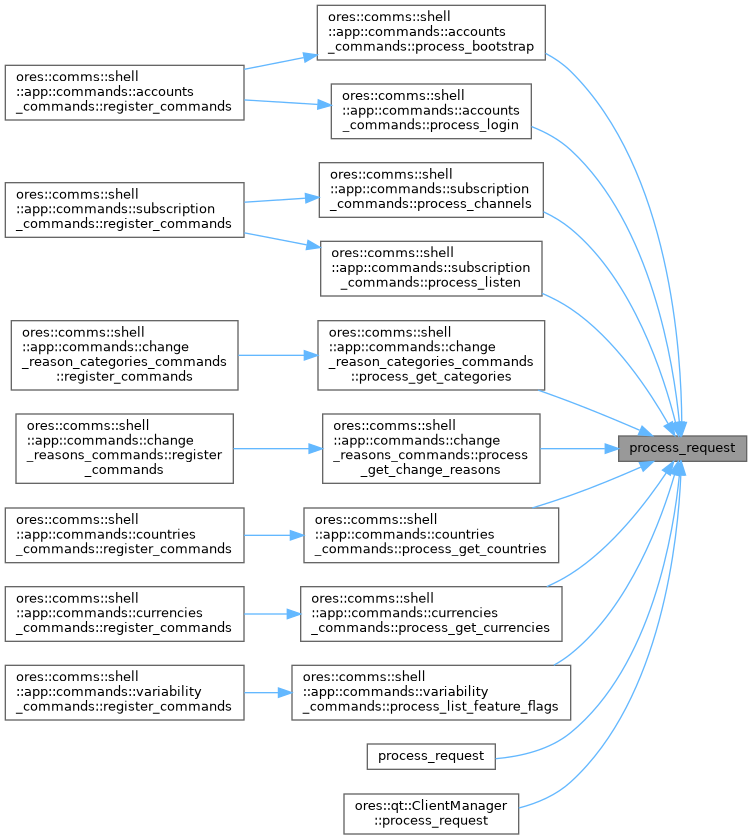
| std::expected< ResponseType, session_error > process_request | ( | RequestType | request | ) |
Process a request that does not require authentication.
Use this for messages like bootstrap_status_request that don't need login.
- Template Parameters
-
RequestType Request message type (must be Serializable) ResponseType Response message type (must be Deserializable) RequestMsgType The message_type enum value for the request
- Parameters
-
request The request to send
- Returns
- Response on success, error on failure
◆ process_authenticated_request() [1/2]
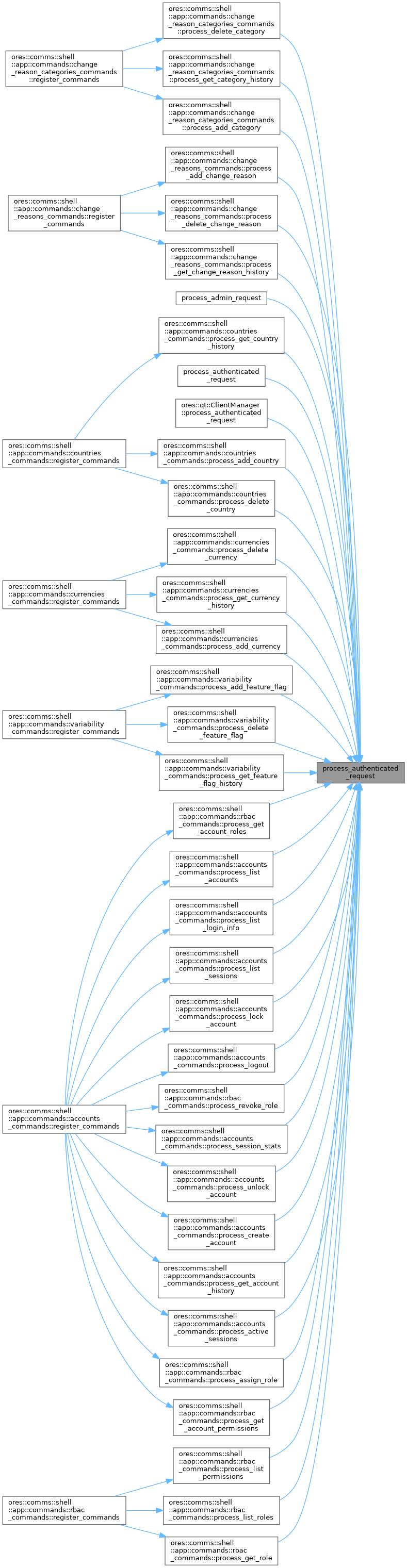
| std::expected< ResponseType, session_error > process_authenticated_request | ( | RequestType | request | ) |
Process a request that requires authentication.
Checks if logged in before sending. Use this for most requests.
- Template Parameters
-
RequestType Request message type (must be Serializable) ResponseType Response message type (must be Deserializable) RequestMsgType The message_type enum value for the request
- Parameters
-
request The request to send
- Returns
- Response on success, error on failure (including not_logged_in)
◆ process_admin_request() [1/2]
| std::expected< ResponseType, session_error > process_admin_request | ( | RequestType | request | ) |
Process a request that requires admin privileges.
- Deprecated:
- Permission checks are now performed server-side via RBAC. Use process_authenticated_request instead; the server will return a permission denied error if the user lacks the required permissions.
- Template Parameters
-
RequestType Request message type (must be Serializable) ResponseType Response message type (must be Deserializable) RequestMsgType The message_type enum value for the request
- Parameters
-
request The request to send
- Returns
- Response on success, error on failure (including not_logged_in)

◆ process_request() [2/2]
requires messaging::has_message_traits<RequestType>
| std::expected< typename messaging::message_traits< RequestType >::response_type, session_error > process_request | ( | RequestType | request | ) |
Process a request using message_traits (does not require auth).
Uses message_traits to automatically determine the response type and message_type enum value from the request type.
- Template Parameters
-
RequestType Request message type (must have message_traits)
- Parameters
-
request The request to send
- Returns
- Response on success, error on failure
◆ process_authenticated_request() [2/2]
requires messaging::has_message_traits<RequestType>
| std::expected< typename messaging::message_traits< RequestType >::response_type, session_error > process_authenticated_request | ( | RequestType | request | ) |
Process a request using message_traits (requires authentication).
- Template Parameters
-
RequestType Request message type (must have message_traits)
- Parameters
-
request The request to send
- Returns
- Response on success, error on failure
◆ process_admin_request() [2/2]
requires messaging::has_message_traits<RequestType>
| std::expected< typename messaging::message_traits< RequestType >::response_type, session_error > process_admin_request | ( | RequestType | request | ) |
Process a request using message_traits (requires admin).
- Deprecated:
- Permission checks are now performed server-side via RBAC. Use process_authenticated_request instead.
- Template Parameters
-
RequestType Request message type (must have message_traits)
- Parameters
-
request The request to send
- Returns
- Response on success, error on failure
◆ subscribe()
| bool subscribe | ( | const std::string & | event_type | ) |
Subscribe to notifications for an event type.
Delegates to remote_event_adapter to send a SUBSCRIBE protocol message. Received notifications are queued for retrieval via take_pending_notifications().
- Parameters
-
event_type The fully qualified event type name (e.g., "ores.refdata.currency_changed")
- Returns
- True if subscription succeeded, false otherwise

◆ unsubscribe()
| bool unsubscribe | ( | const std::string & | event_type | ) |
Unsubscribe from notifications for an event type.
Delegates to remote_event_adapter to send an UNSUBSCRIBE protocol message.
- Parameters
-
event_type The fully qualified event type name
- Returns
- True if unsubscription succeeded, false otherwise

◆ is_subscribed()
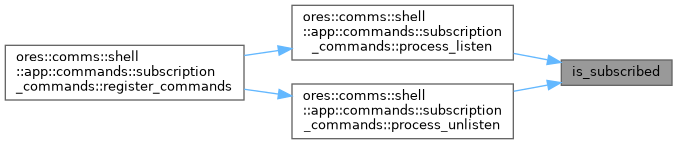
| bool is_subscribed | ( | const std::string & | event_type | ) | const |
Check if currently subscribed to an event type.
- Parameters
-
event_type The event type to check
- Returns
- True if subscribed, false otherwise
◆ get_subscriptions()
| std::set< std::string > get_subscriptions | ( | ) | const |
Get the set of currently subscribed event types.
- Returns
- Set of event type names

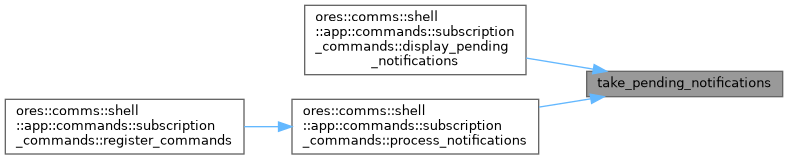
◆ take_pending_notifications()
| std::vector< pending_notification > take_pending_notifications | ( | ) |
Get all pending notifications and clear the queue.
Returns notifications in the order they were received. The internal queue is cleared after this call.
- Returns
- Vector of pending notifications
◆ has_pending_notifications()
| bool has_pending_notifications | ( | ) | const |
Check if there are any pending notifications.
- Returns
- True if there are pending notifications
◆ set_notification_callback()
| void set_notification_callback | ( | notification_callback_t | callback | ) |
Set an external notification callback.
When set, notifications will be delivered to this callback instead of being queued to pending_notifications_. This is useful for GUI clients that need to emit signals on notification receipt.
- Parameters
-
callback The callback to invoke on notification, or nullptr to revert to internal queuing