Session data owned by ores.comms for protocol-level session tracking. More...
#include <session_data.hpp>
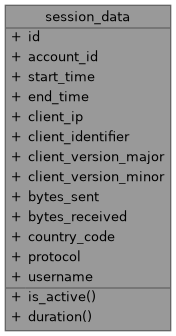
Public Member Functions | |
| bool | is_active () const |
| Checks if the session is still active. | |
| std::optional< std::chrono::seconds > | duration () const |
| Calculates the session duration. | |
Public Attributes | |
| boost::uuids::uuid | id |
| Unique identifier for this session. | |
| boost::uuids::uuid | account_id |
| Foreign key referencing the associated account. | |
| std::chrono::system_clock::time_point | start_time |
| Timestamp when the session started (login time). | |
| std::optional< std::chrono::system_clock::time_point > | end_time |
| Timestamp when the session ended (logout or disconnect). | |
| boost::asio::ip::address | client_ip |
| Client IP address. | |
| std::string | client_identifier |
| Client identifier string from handshake. | |
| std::uint16_t | client_version_major = 0 |
| Client protocol version major number. | |
| std::uint16_t | client_version_minor = 0 |
| Client protocol version minor number. | |
| std::uint64_t | bytes_sent = 0 |
| Total bytes sent to the client during this session. | |
| std::uint64_t | bytes_received = 0 |
| Total bytes received from the client during this session. | |
| std::string | country_code |
| ISO 3166-1 alpha-2 country code from geolocation. | |
| session_protocol | protocol = session_protocol::binary |
| Protocol used for this session (binary or HTTP). | |
| std::string | username |
| Username of the account that owns this session. | |
Detailed Description
Session data owned by ores.comms for protocol-level session tracking.
This struct exists to break the circular dependency between ores.comms and ores.iam. Previously, ores.comms depended on ores.iam for the session type, which created a cycle:
ores.comms -> ores.iam -> ores.variability -> ores.comms
By defining session data here in ores.comms, the dependency is inverted: ores.iam now depends on ores.comms (which it does anyway via variability), and provides conversion functions between this struct and its domain::session.
This is a plain data struct with no behavior beyond trivial helpers. The persistence layer (repository, mappers) remains in ores.iam.
Member Function Documentation
◆ duration()
| std::optional< std::chrono::seconds > duration | ( | ) | const |
Calculates the session duration.
- Returns
- Duration if session has ended, nullopt if still active.
Member Data Documentation
◆ end_time
| std::optional<std::chrono::system_clock::time_point> end_time |
Timestamp when the session ended (logout or disconnect).
Empty if session is still active.
◆ client_identifier
| std::string client_identifier |
Client identifier string from handshake.
Typically contains the client application name.
◆ country_code
| std::string country_code |
ISO 3166-1 alpha-2 country code from geolocation.
Empty if geolocation is not available or IP is private/localhost.
◆ username
| std::string username |
Username of the account that owns this session.
Cached here for efficient access without needing to look up the account. Set during login and immutable for the session lifetime.