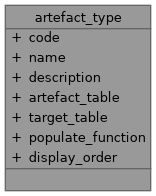
Maps artefact type codes to their population functions and tables. More...
#include <artefact_type.hpp>
Public Attributes | |
| std::string | code |
| Unique code identifying this artefact type. | |
| std::string | name |
| Human-readable name for display purposes. | |
| std::optional< std::string > | description |
| Detailed description of this artefact type. | |
| std::optional< std::string > | artefact_table |
| Name of the artefact (staging) table for this type. | |
| std::optional< std::string > | target_table |
| Name of the target (production) table for this type. | |
| std::optional< std::string > | populate_function |
| Name of the database function that populates the target table. | |
| int | display_order = 0 |
| Display order for UI sorting. | |
Detailed Description
Maps artefact type codes to their population functions and tables.
Artefact types define the mapping between dataset artefact codes and the database infrastructure needed to publish them:
- The artefact table where staging data is stored
- The target production table where data is published
- The populate function that performs the publication
This is static configuration data - no bitemporal support required.
Member Data Documentation
◆ code
| std::string code |
Unique code identifying this artefact type.
This is the natural key for the type. Examples: "countries", "currencies", "images".
◆ artefact_table
| std::optional<std::string> artefact_table |
Name of the artefact (staging) table for this type.
This is where data is staged before publication. Example: "dq_countries_artefact_tbl".
◆ target_table
| std::optional<std::string> target_table |
Name of the target (production) table for this type.
This is where data is published to. Example: "refdata_countries_tbl".
◆ populate_function
| std::optional<std::string> populate_function |
Name of the database function that populates the target table.
This function is called during publication to move data from the artefact table to the target table. Example: "dq_countries_publish_fn".