Represents a logical grouping of related datasets. More...
#include <catalog.hpp>
Collaboration diagram for catalog:
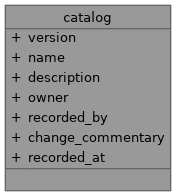
Public Attributes | |
| int | version = 0 |
| Version number for optimistic locking and change tracking. | |
| std::string | name |
| Unique name identifying this catalog. | |
| std::string | description |
| Human-readable description of the catalog's purpose. | |
| std::optional< std::string > | owner |
| Optional owner or responsible party for this catalog. | |
| std::string | recorded_by |
| Username of the person who last modified this catalog. | |
| std::string | change_commentary |
| Free-text commentary explaining the change. | |
| std::chrono::system_clock::time_point | recorded_at |
| Timestamp when this version of the record was recorded. | |
Detailed Description
Represents a logical grouping of related datasets.
Catalogs provide a way to organize datasets into logical collections, similar to how a library catalog organizes books. Examples include "ISO Standards", "Cryptocurrency", "FpML Standards".
Catalogs are optional for datasets but provide useful organizational structure for managing large numbers of datasets.
Member Data Documentation
◆ name
| std::string name |
Unique name identifying this catalog.
This is the natural key for the catalog. Examples: "ISO Standards", "Cryptocurrency", "FpML Standards".