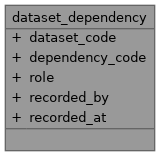
Declares a dependency between datasets using stable dataset codes. More...
#include <dataset_dependency.hpp>
Public Attributes | |
| std::string | dataset_code |
| The code of the dataset that has the dependency. | |
| std::string | dependency_code |
| The code of the dataset this depends on. | |
| std::string | role |
| The role/purpose of this dependency. | |
| std::string | recorded_by |
| Username of the person who recorded this dependency. | |
| std::chrono::system_clock::time_point | recorded_at |
| Timestamp when this dependency was recorded. | |
Detailed Description
Declares a dependency between datasets using stable dataset codes.
When a dataset is injected into the system, all its dependencies must be satisfied first. Dependencies are resolved by code at injection time, allowing for loose coupling between datasets.
This enables building a dependency graph where, for example, an "iso.countries" dataset can declare that it depends on "assets.country_flags" for visual display.
The dependency_code is intentionally NOT a foreign key - it's resolved at injection time. This allows:
- Declaring dependencies on datasets that may not exist yet
- Referencing datasets that live in external systems
- Loose coupling with validation at injection time
Member Data Documentation
◆ dataset_code
| std::string dataset_code |
The code of the dataset that has the dependency.
References dataset.code.
◆ dependency_code
| std::string dependency_code |
The code of the dataset this depends on.
This is NOT a foreign key - it's resolved at injection time. Allows referencing datasets that may not exist yet or that live in external systems.
◆ role
| std::string role |
The role/purpose of this dependency.
Examples: "visual_assets", "reference_data", "validation_source".