Represents a subdivision within a data domain. More...
#include <subject_area.hpp>
Collaboration diagram for subject_area:
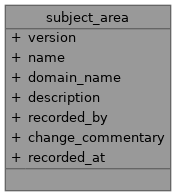
Public Attributes | |
| int | version = 0 |
| Version number for optimistic locking and change tracking. | |
| std::string | name |
| Name of this subject area within its domain. | |
| std::string | domain_name |
| Name of the data domain this subject area belongs to. | |
| std::string | description |
| Human-readable description of the subject area's purpose. | |
| std::string | recorded_by |
| Username of the person who last modified this subject area. | |
| std::string | change_commentary |
| Free-text commentary explaining the change. | |
| std::chrono::system_clock::time_point | recorded_at |
| Timestamp when this version of the record was recorded. | |
Detailed Description
Represents a subdivision within a data domain.
Subject areas provide finer-grained categorization within a data domain. For example, within "Reference Data" domain, subject areas might include "Currencies", "Countries", "Parties", etc.
Subject areas are uniquely identified by the combination of their name and the data domain they belong to (composite key).
Member Data Documentation
◆ name
| std::string name |
Name of this subject area within its domain.
Part of the composite key (name + domain_name). Examples: "Currencies", "Countries", "Parties".
◆ domain_name
| std::string domain_name |
Name of the data domain this subject area belongs to.
Part of the composite key. References data_domain.name (soft FK).