Represents a named collection of permissions that can be assigned to accounts. More...
#include <role.hpp>
Collaboration diagram for role:
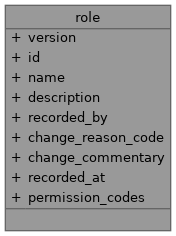
Public Attributes | |
| int | version = 0 |
| Version number for optimistic locking and change tracking. | |
| boost::uuids::uuid | id |
| Unique identifier for the role. | |
| std::string | name |
| Unique name for the role (e.g., "Trading", "Sales", "Admin"). | |
| std::string | description |
| Human-readable description of the role's purpose and scope. | |
| std::string | recorded_by |
| Username of the person who last modified this role. | |
| std::string | change_reason_code |
| Code identifying the reason for the change. | |
| std::string | change_commentary |
| Free-text commentary explaining the change. | |
| std::chrono::system_clock::time_point | recorded_at |
| Timestamp when this version of the record was recorded. | |
| std::vector< std::string > | permission_codes |
| Permission codes granted to this role. | |
Detailed Description
Represents a named collection of permissions that can be assigned to accounts.
Roles provide a way to group related permissions together for easier management. For example, a "Trading" role might include permissions to read and execute trades, while a "Support" role might have read-only access to most resources.
Member Data Documentation
◆ change_reason_code
| std::string change_reason_code |
Code identifying the reason for the change.
References change_reasons table (soft FK).
◆ permission_codes
| std::vector<std::string> permission_codes |
Permission codes granted to this role.
This is a denormalized list of permission codes for convenience. The authoritative source is the role_permissions junction table.