NATS transport layer — external message bus, cross-process connectivity. More...
Classes | |
| struct | message |
| A received NATS message. More... | |
Typedefs | |
| using | message_handler = std::function< void(message)> |
| Callback type for incoming NATS messages. | |
Functions | |
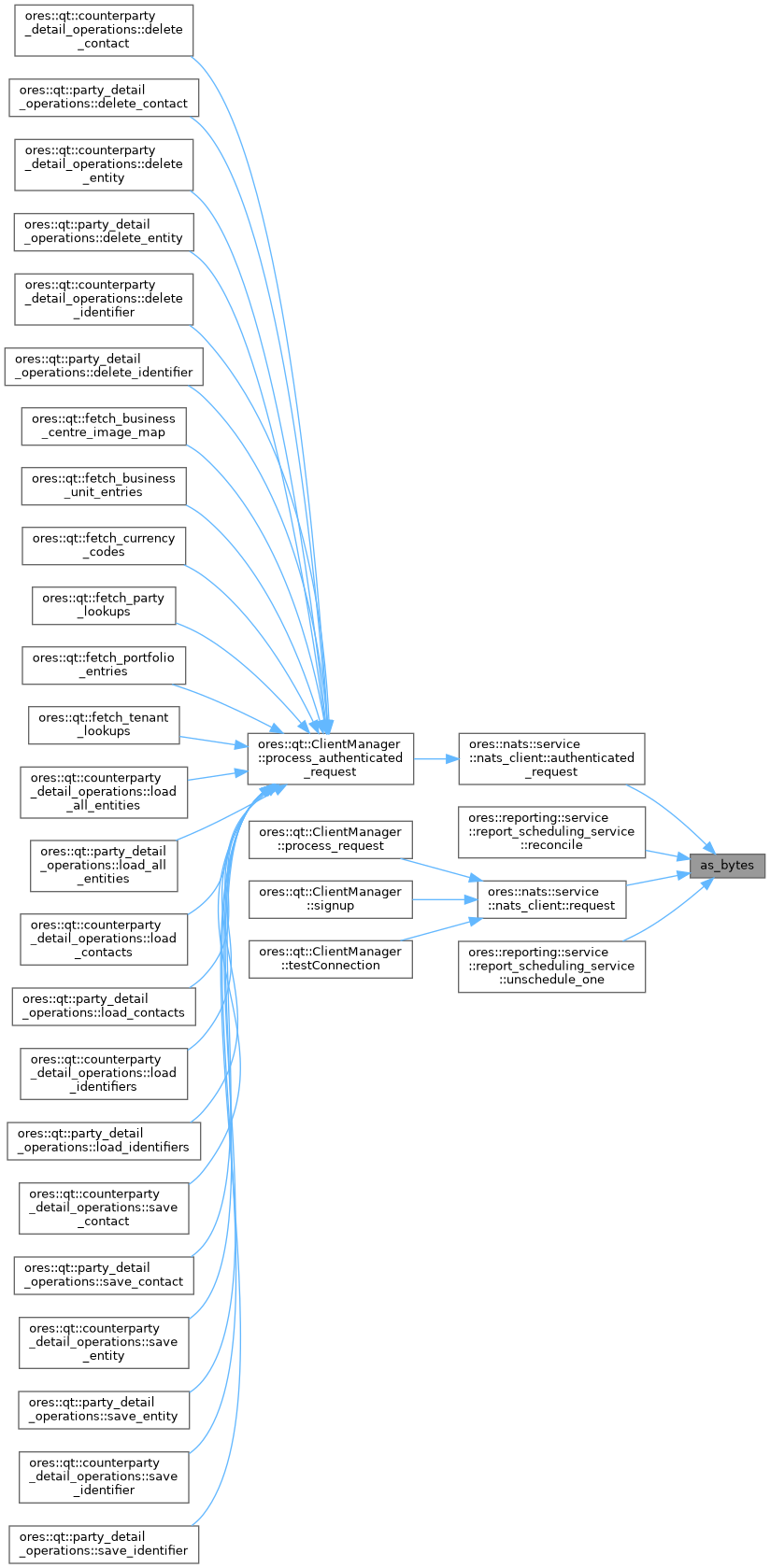
| std::span< const std::byte > | as_bytes (std::string_view s) noexcept |
| Reinterprets a string's character data as a read-only byte span. | |
| std::string_view | as_string_view (const std::vector< std::byte > &data) noexcept |
| Reinterprets a message's byte payload as a string_view. | |
Detailed Description
NATS transport layer — external message bus, cross-process connectivity.
Provides RAII wrappers around the cnats C library and higher-level facilities for domain services, the Qt client, and JetStream consumers. All components that communicate over NATS depend on this library rather than on cnats directly.
Subject naming conventions:
- Request/reply:
ores.<domain>.<operation> (e.g.ores.iam.login) - Pub/sub events:
<tenant_id>.ores.<domain>.<event_name> (e.g.499d2aaa.ores.refdata.currency_changed) - JetStream streams:
ores.<domain>.js.<stream> (e.g.ores.trading.js.trades)
Sub-namespaces (planned):
- connection: RAII wrappers for natsConnection and natsOptions; TLS configuration; connection lifecycle management.
- service: base class for domain microservices; binds a NATS subject and dispatches incoming requests to handler coroutines.
- client: Qt-side session; sends requests and receives replies via unique per-request _INBOX subjects (fully concurrent, no serialisation).
- messaging: typed request/reply message helpers built on top of the cnats publish/subscribe primitives.
- jetstream: JetStream consumer support; durable subscriptions for chart history replay and work-queue delivery to grid nodes.
Transport security: TLS (tls+tcp://) for encryption and server authentication; JWT RS256 tokens in message headers for client identity.
Contrast with ores.eventing (in-process pub/sub only, no network) and ores.mq (durable PostgreSQL-backed queues, persistent across restarts).
Function Documentation
◆ as_bytes()
|
noexcept |
Reinterprets a string's character data as a read-only byte span.
Use this when calling request_sync() or publish() with a JSON/text payload that is already held in a std::string or std::string_view, so callers do not need to scatter reinterpret_cast throughout service code.
◆ as_string_view()
|
noexcept |
Reinterprets a message's byte payload as a string_view.
Use this when deserialising a NATS reply payload with rfl::json::read or similar, so callers do not need to scatter reinterpret_cast throughout.