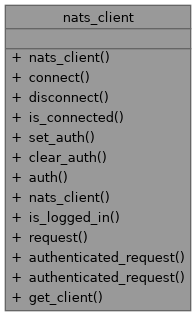
Authenticated NATS client for both interactive and service-to-service use. More...
#include <nats_client.hpp>
Classes | |
| struct | login_info |
| Login state for the interactive path. More... | |
Public Types | |
| using | token_provider = std::function< std::string(bool force)> |
| Callable that returns a current Bearer token. | |
Public Member Functions | |
| nats_client ()=default | |
| Default-construct for interactive use. Call connect() next. | |
| void | connect (config::nats_options opts) |
| Connect to NATS and take ownership of the connection. | |
| void | disconnect () |
| Disconnect and clear all auth state. | |
| bool | is_connected () const noexcept |
| void | set_auth (login_info info) |
| Store authentication info after a successful login. | |
| void | clear_auth () |
| Clear authentication info on logout. | |
| const login_info & | auth () const |
| Return current auth info. | |
| nats_client (client &nats, token_provider provider) | |
| Construct for service-to-service use. | |
| bool | is_logged_in () const noexcept |
| message | request (std::string_view subject, std::string_view json_body) |
| Unauthenticated synchronous request. | |
| message | authenticated_request (std::string_view subject, std::string_view json_body, std::chrono::milliseconds timeout=std::chrono::seconds(30)) |
| Authenticated synchronous request — string body overload. | |
| message | authenticated_request (std::string_view subject, std::span< const std::byte > body, std::chrono::milliseconds timeout=std::chrono::seconds(10)) |
| Authenticated synchronous request — byte-span overload. | |
| std::shared_ptr< client > | get_client () const |
| Return the underlying client (interactive path only). | |
Detailed Description
Authenticated NATS client for both interactive and service-to-service use.
Wraps a NATS connection with JWT-based authentication, supporting two usage paths:
Interactive path (shell, Qt): the caller manages the connection lifecycle and supplies the JWT externally after a successful login.
Token refresh is reactive: the client throws session_expired_error on token_expired or max_session_exceeded (X-Error header). The caller is responsible for re-authenticating and calling set_auth() with the new token.
Service path (backend services): a token_provider callback is injected at construction. The provider is responsible for acquiring and proactively refreshing the JWT; nats_client calls it before each authenticated request.
The two paths are mutually exclusive on a given instance.
Member Typedef Documentation
◆ token_provider
| using token_provider = std::function<std::string(bool force)> |
Callable that returns a current Bearer token.
Used by the service path. The provider owns all acquisition and proactive refresh logic; nats_client calls it before each request. When called with force=true the provider must discard any cached token and re-authenticate unconditionally (used after the server returns X-Error: token_expired to handle extreme clock-skew cases where the client's own expiry timer has not yet fired).
Constructor & Destructor Documentation
◆ nats_client()
| nats_client | ( | client & | nats, |
| token_provider | provider | ||
| ) |
Construct for service-to-service use.
- Parameters
-
nats Already-connected NATS client (not owned; must outlive this). provider Callable that returns a current Bearer token. The provider owns acquisition and proactive refresh.
Member Function Documentation
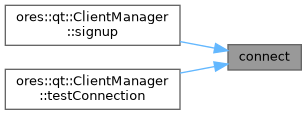
◆ connect()
| void connect | ( | config::nats_options | opts | ) |
Connect to NATS and take ownership of the connection.
- Exceptions
-
std::runtime_error if the connection fails.
◆ auth()
| const nats_client::login_info & auth | ( | ) | const |
Return current auth info.
- Exceptions
-
std::runtime_error if not logged in.

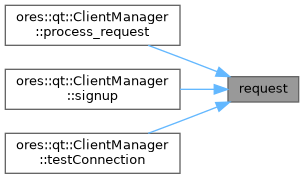
◆ request()
| message request | ( | std::string_view | subject, |
| std::string_view | json_body | ||
| ) |
Unauthenticated synchronous request.
Used for pre-login calls (login itself, JWKS fetch, bootstrap status).
◆ authenticated_request() [1/2]
| message authenticated_request | ( | std::string_view | subject, |
| std::string_view | json_body, | ||
| std::chrono::milliseconds | timeout = std::chrono::seconds(30) |
||
| ) |
Authenticated synchronous request — string body overload.
Convenience for callers that already have the payload as a string.
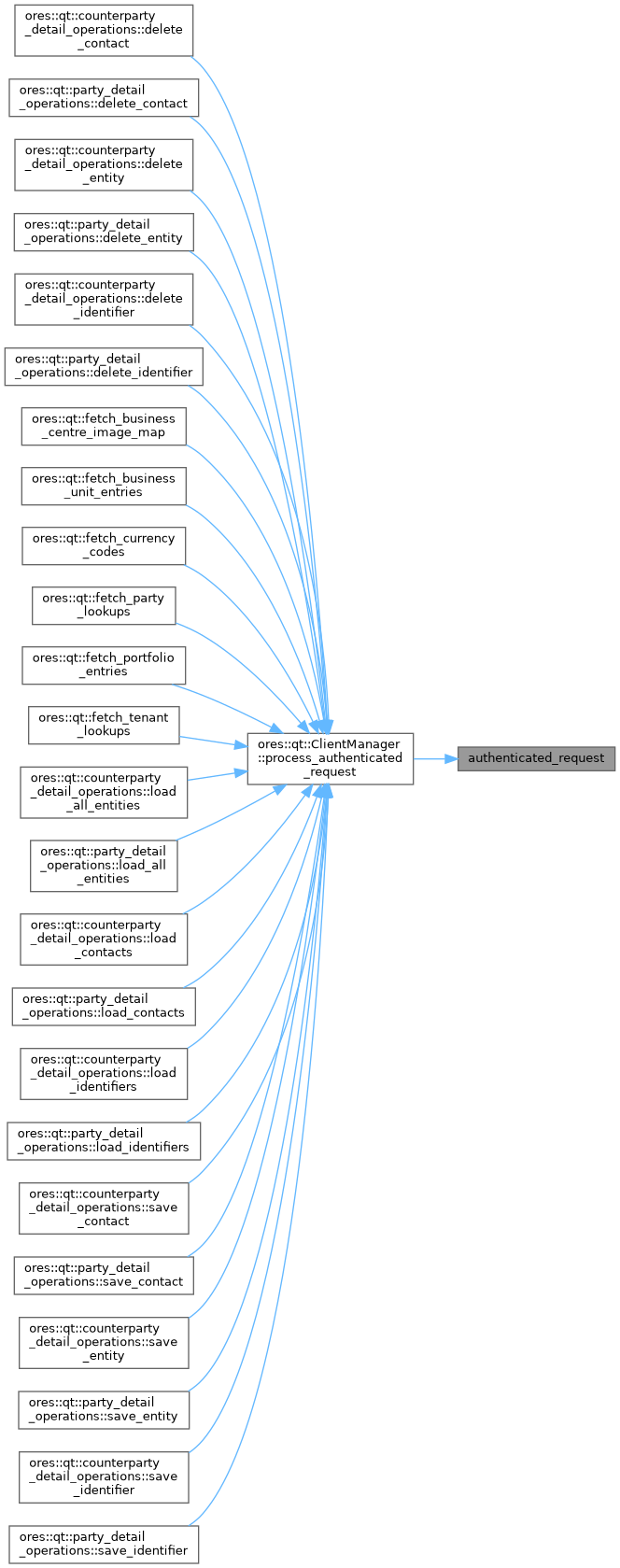
◆ authenticated_request() [2/2]
| message authenticated_request | ( | std::string_view | subject, |
| std::span< const std::byte > | body, | ||
| std::chrono::milliseconds | timeout = std::chrono::seconds(10) |
||
| ) |
Authenticated synchronous request — byte-span overload.
For callers that work with pre-serialised byte buffers.
◆ get_client()
| std::shared_ptr< client > get_client | ( | ) | const |
Return the underlying client (interactive path only).
Returns nullptr if constructed via the service path.