Historical realisation of an index on a specific fixing date. More...
#include <market_fixing.hpp>
Collaboration diagram for market_fixing:
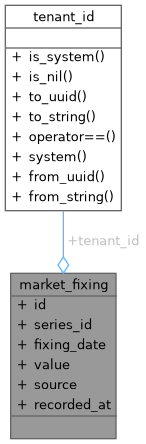
Public Attributes | |
| boost::uuids::uuid | id {} |
| Unique identifier for this fixing row. | |
| utility::uuid::tenant_id | tenant_id = utility::uuid::tenant_id::system() |
| Tenant identifier for multi-tenancy isolation. | |
| boost::uuids::uuid | series_id {} |
| Foreign key to the parent market_series (the index). | |
| std::chrono::year_month_day | fixing_date |
| The date on which the index fixing was published. | |
| std::string | value |
| The published fixing value as a string (e.g. "0.038940"). | |
| std::optional< std::string > | source |
| Optional data source identifier (e.g. "BLOOMBERG", "ECB"). | |
| std::chrono::system_clock::time_point | recorded_at |
| Transaction time: when this row was inserted into the system. | |
Detailed Description
Historical realisation of an index on a specific fixing date.
Fixings are the published historical values of floating rate indices (e.g. EURIBOR 3M on 2024-03-20 = 3.894%). They are modelled separately from forward-looking observations but share the same series catalog.
Stored in a TimescaleDB hypertable partitioned by fixing_date. Corrections are handled via the same soft-update insert trigger pattern as market_observation.
Member Data Documentation
◆ recorded_at
| std::chrono::system_clock::time_point recorded_at |
Transaction time: when this row was inserted into the system.
Maps to valid_from in the database; valid_to is managed internally.