Cross-platform time utilities. More...
#include <time_utils.hpp>
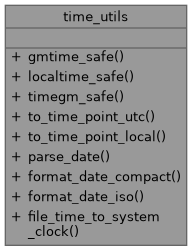
Static Public Member Functions | |
| static std::tm * | gmtime_safe (const std::time_t *time, std::tm *result) |
| Converts time_t to UTC tm struct (cross-platform). | |
| static std::tm * | localtime_safe (const std::time_t *time, std::tm *result) |
| Converts time_t to local tm struct (cross-platform). | |
| static std::time_t | timegm_safe (std::tm *tm) |
| Converts a UTC tm struct to time_t (cross-platform). | |
| static std::chrono::system_clock::time_point | to_time_point_utc (std::tm tm) |
| Converts a UTC tm struct directly to a system_clock::time_point. | |
| static std::chrono::system_clock::time_point | to_time_point_local (std::tm tm) |
| Converts a local-time tm struct directly to a system_clock::time_point. | |
| static std::chrono::year_month_day | parse_date (std::string_view s) |
| Parses a calendar date string in YYYYMMDD or YYYY-MM-DD format. | |
| static std::string | format_date_compact (std::chrono::year_month_day date) |
| Formats a calendar date as YYYYMMDD (e.g. "20160205"). | |
| static std::string | format_date_iso (std::chrono::year_month_day date) |
| Formats a calendar date as YYYY-MM-DD (ISO 8601, e.g. "2016-02-05"). | |
| static std::chrono::system_clock::time_point | file_time_to_system_clock (std::filesystem::file_time_type ft) |
| Converts a filesystem file_time_type to a system_clock::time_point. | |
Detailed Description
Cross-platform time utilities.
Member Function Documentation
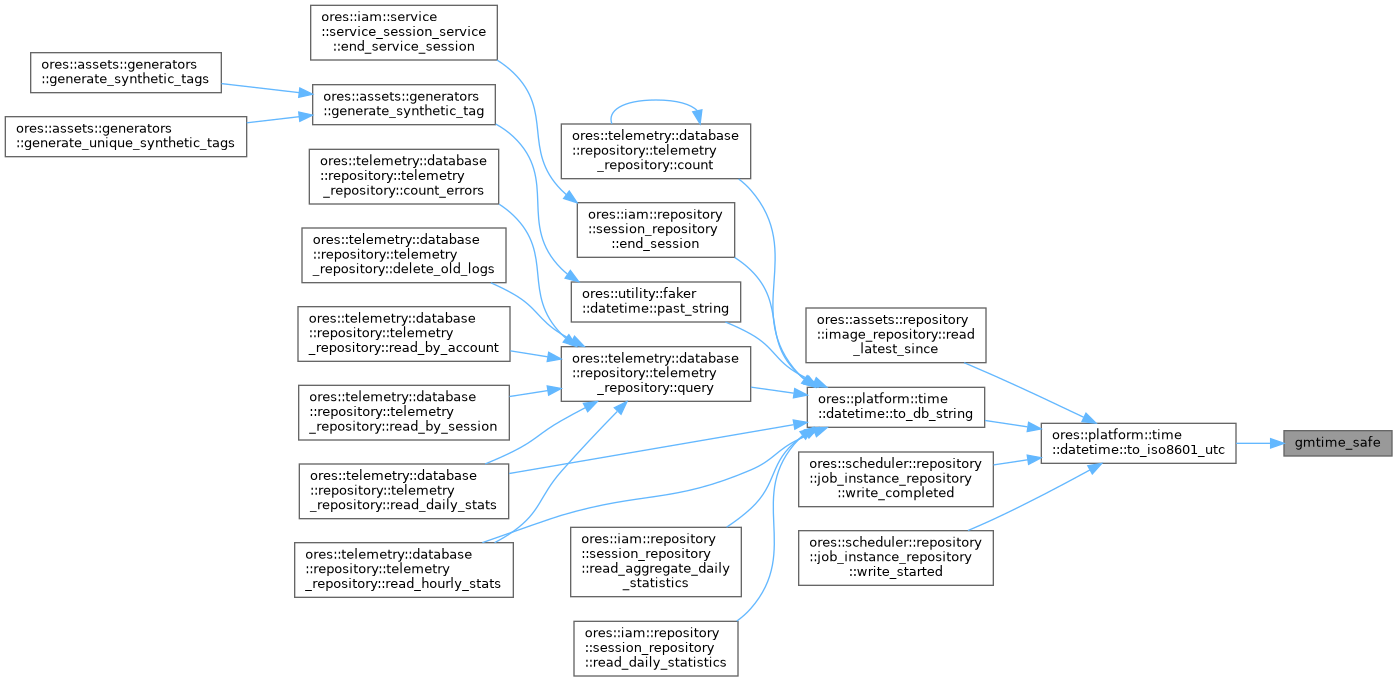
◆ gmtime_safe()
|
static |
Converts time_t to UTC tm struct (cross-platform).
This is a cross-platform wrapper around gmtime_r (POSIX) and gmtime_s (Windows).
- Parameters
-
time The time_t value to convert. result Pointer to tm struct to store the result.
- Returns
- Pointer to result on success, nullptr on failure.
◆ localtime_safe()
|
static |
Converts time_t to local tm struct (cross-platform).
This is a cross-platform wrapper around localtime_r (POSIX) and localtime_s (Windows).
- Parameters
-
time The time_t value to convert. result Pointer to tm struct to store the result.
- Returns
- Pointer to result on success, nullptr on failure.

◆ timegm_safe()
|
static |
Converts a UTC tm struct to time_t (cross-platform).
This is a cross-platform wrapper around timegm (POSIX) and _mkgmtime (Windows). Unlike std::mktime, this interprets the tm struct as UTC rather than local time.
- Parameters
-
tm Pointer to tm struct to convert (interpreted as UTC).
- Returns
- The corresponding time_t value.

◆ to_time_point_utc()
|
static |
Converts a UTC tm struct directly to a system_clock::time_point.
Interprets the tm fields as UTC. Use this when the source data is known to be in UTC (e.g. a value already normalised to UTC before storing in tm).
- Parameters
-
tm The tm struct to convert (interpreted as UTC, passed by value because timegm may normalise the fields).
- Returns
- The corresponding system_clock::time_point.

◆ to_time_point_local()
|
static |
Converts a local-time tm struct directly to a system_clock::time_point.
Interprets the tm fields as the process's local timezone (via std::mktime), then converts to UTC. Use this when the source data is in the session/system timezone — e.g. a timestamp returned by libpq whose offset has been stripped by rfl::Timestamp::strptime.
- Parameters
-
tm The tm struct to convert (passed by value because mktime may normalise DST and other fields).
- Returns
- The corresponding system_clock::time_point.
◆ parse_date()
|
static |
Parses a calendar date string in YYYYMMDD or YYYY-MM-DD format.
Uses std::from_chars for allocation-free, locale-independent parsing. Both formats are auto-detected from the string length and separators.
- Parameters
-
s The date string to parse.
- Returns
- The corresponding year_month_day.
- Exceptions
-
std::invalid_argument if the format is unrecognised or the resulting date is not a valid calendar date.
◆ format_date_compact()
|
static |
Formats a calendar date as YYYYMMDD (e.g. "20160205").
Uses manual integer formatting to avoid reliance on C++20 chrono format specifiers, which are not fully implemented on all platforms.
- Parameters
-
date The calendar date to format.
- Returns
- Eight-character string in YYYYMMDD format.
◆ format_date_iso()
|
static |
Formats a calendar date as YYYY-MM-DD (ISO 8601, e.g. "2016-02-05").
Uses manual integer formatting to avoid reliance on C++20 chrono format specifiers, which are not fully implemented on all platforms.
- Parameters
-
date The calendar date to format.
- Returns
- Ten-character string in YYYY-MM-DD format.
◆ file_time_to_system_clock()
|
static |
Converts a filesystem file_time_type to a system_clock::time_point.
std::chrono::clock_cast is the C++20 standard way to do this but is not implemented on all platforms (notably Apple libc++). This uses the now()-based portable alternative that works on all supported platforms without making epoch assumptions.
- Parameters
-
ft The file time to convert.
- Returns
- The equivalent system_clock::time_point.