URL path helpers for the generic object storage HTTP API. More...
#include <storage_paths.hpp>
Collaboration diagram for storage_paths:
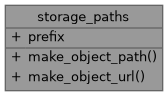
Static Public Member Functions | |
| static std::string | make_object_path (std::string_view bucket, std::string_view key) |
| Constructs the URL path for a storage object. | |
| static std::string | make_object_url (std::string_view base_url, std::string_view bucket, std::string_view key) |
| Constructs a full URL for a storage object. | |
Static Public Attributes | |
| static constexpr std::string_view | prefix = "/api/v1/storage" |
| API path prefix for all storage endpoints. | |
Detailed Description
URL path helpers for the generic object storage HTTP API.
The storage API follows a bucket/key model identical in shape to S3:
PUT /api/v1/storage/{bucket}/{key} upload (create or replace) GET /api/v1/storage/{bucket}/{key} download DELETE /api/v1/storage/{bucket}/{key} delete HEAD /api/v1/storage/{bucket}/{key} existence check / content-length
Use make_object_path to construct the path component, then prepend the HTTP base URL discovered via NATS (http-server.v1.info.get).
Member Function Documentation
◆ make_object_path()
|
static |
Constructs the URL path for a storage object.
- Parameters
-
bucket Bucket name (use bucketsconstants).key Object key; may contain slashes for hierarchical keys.
- Returns
- Path string, e.g. "/api/v1/storage/compute-packages/abc123".
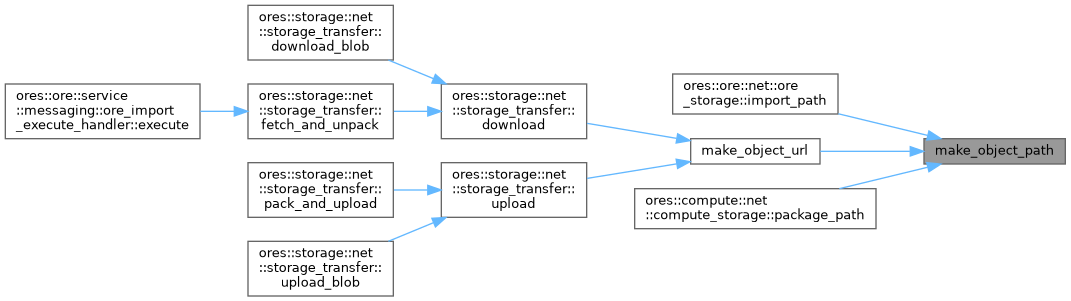
Here is the caller graph for this function:
◆ make_object_url()
|
static |
Constructs a full URL for a storage object.
- Parameters
-
base_url HTTP server base URL (e.g. "http://localhost:51000"). bucket Bucket name (use bucketsconstants).key Object key.
- Returns
- Full URL string.
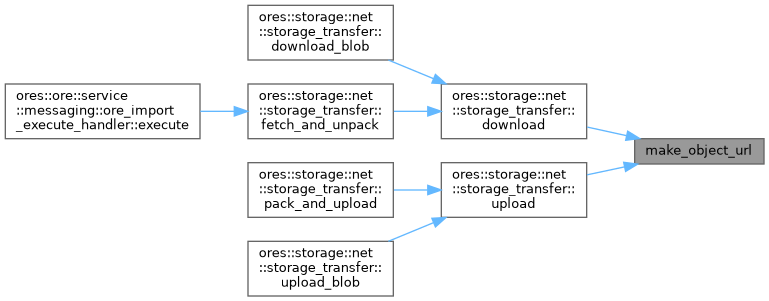
Here is the caller graph for this function: