Reads and writes catalogs to data storage. More...
#include <catalog_repository.hpp>
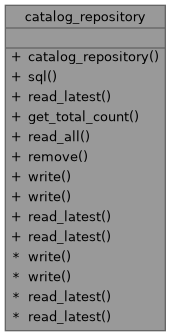
Collaboration diagram for catalog_repository:
Public Types | |
| using | context = ores::database::context |
Public Member Functions | |
| catalog_repository (context ctx) | |
| std::string | sql () |
| Returns the SQL created by sqlgen to construct the table. | |
| std::vector< domain::catalog > | read_latest (std::uint32_t offset, std::uint32_t limit) |
| Reads latest catalogs with pagination support. | |
| std::uint32_t | get_total_count () |
| Gets the total count of active catalogs. | |
| std::vector< domain::catalog > | read_all (const std::string &name) |
| Reads all historical versions of a catalog by name. | |
| void | remove (const std::string &name) |
| Deletes a catalog by closing its temporal validity. | |
| void | write (const domain::catalog &catalog) |
| Writes catalogs to database. | |
| void | write (const std::vector< domain::catalog > &catalogs) |
| std::vector< domain::catalog > | read_latest () |
| Reads latest catalogs, possibly filtered by name. | |
| std::vector< domain::catalog > | read_latest (const std::string &name) |
Detailed Description
Reads and writes catalogs to data storage.
Member Function Documentation
◆ read_latest()
| std::vector< domain::catalog > read_latest | ( | std::uint32_t | offset, |
| std::uint32_t | limit | ||
| ) |
Reads latest catalogs with pagination support.
- Parameters
-
offset Number of records to skip limit Maximum number of records to return
- Returns
- Vector of catalogs within the specified range
◆ get_total_count()
| std::uint32_t get_total_count | ( | ) |
Gets the total count of active catalogs.
- Returns
- Total number of catalogs with valid_to == max_timestamp
Here is the caller graph for this function:

◆ read_all()
| std::vector< domain::catalog > read_all | ( | const std::string & | name | ) |
Reads all historical versions of a catalog by name.
- Parameters
-
name The catalog name to look up
- Returns
- Vector of all versions, ordered by version descending
Here is the caller graph for this function: