ORE Studio Sprint 21 – Release Notes
Table of Contents
July 2026
Sprint 21 set out to commission the ores.refdata entity library —
closing out currency and country and starting the twelve entities
untouched since sprint 20 — while holding the line against new
tooling work that didn't directly unblock commissioning. The scope
expanded well beyond that mission as the sprint ran: a full
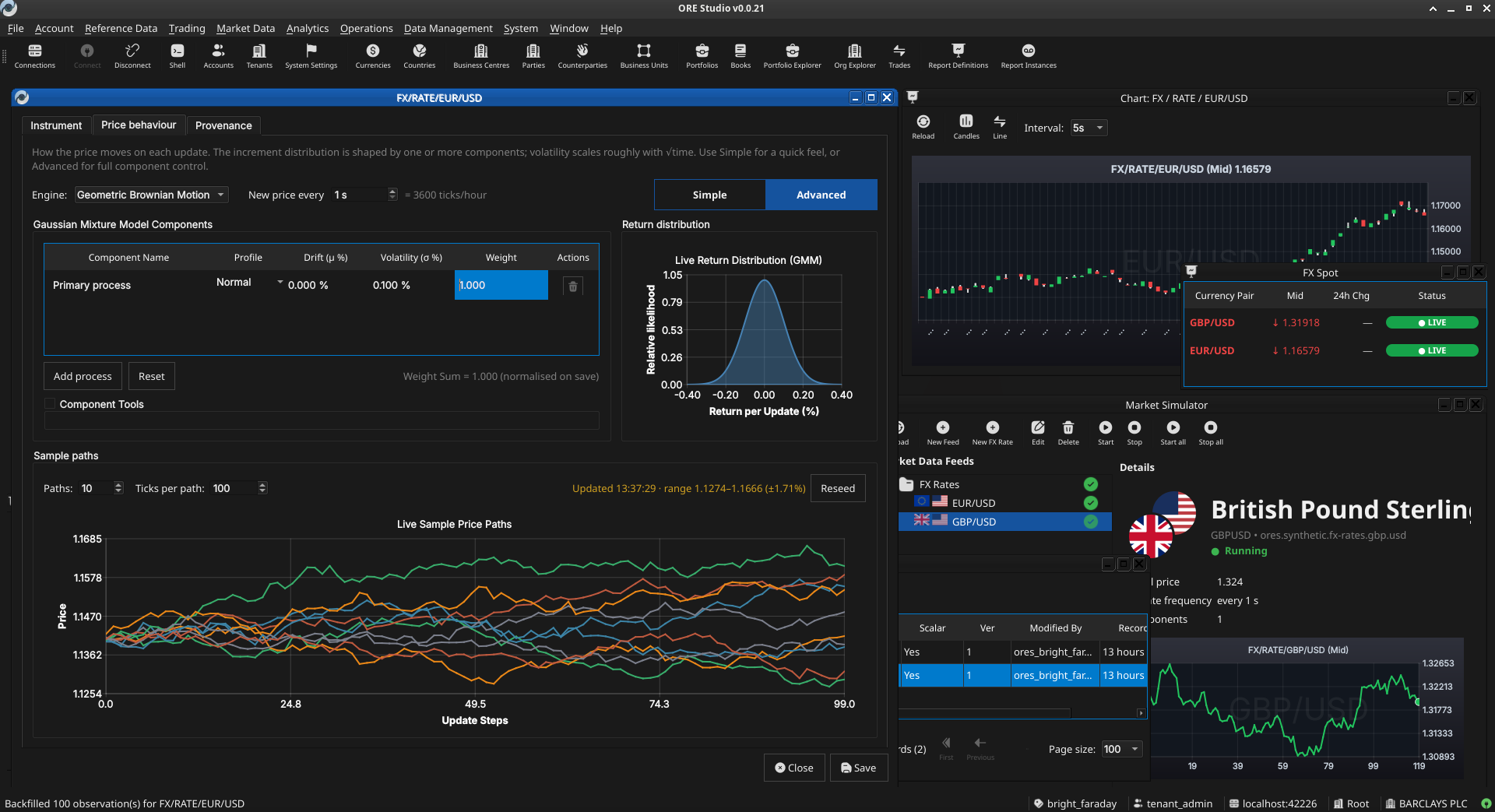
synthetic market data generation pipeline landed end to end, from
approach analysis through an FX spot proof of concept to
config-driven, per-tenant feed generation and a source-agnostic
ingestion/binding layer in ores.marketdata; compass gained a
round of quality-of-life fixes (bucketed search, blocked-dependency
visualisation, environment awareness); and five hotfixes kept CI
green across Windows, macOS, and codegen drift. The sprint ran three
weeks past its original one-week estimate — both mid-sprint and
close-out health reviews flagged it RED for scope creep — and closed
with 126 merged PRs across all planned stories.
1. ✅ Highlights
- All planned stories delivered.
2. 🛠️ Key Improvements
2.1. Financial Features
- Commission: country: Commission
countryacross all access layers: verify the Qt UI end-to-end post-NATS migration, verify existing shell and CLI commands, fix any regressions found, and add the entity chapter to the user manual. - Consistent synthetic market data generation: approach analysis: Establish a documented, developer-ready approach for generating a single consistent synthetic market data environment that covers all ORE-supported asset classes, can price all products in the ORE Examples suite, and can be evolved through time in a way that maintains cross-asset consistency.
- PoC: synthetic market data generation — FX spot vertical slice: Validate the approach developed in the sprint-21 analysis story by building a working vertical PoC limited to FX spot.
- Synthetic generation configuration and config-driven feeds: Replace the PoC's transient, boot-time, system-tenant generation with a proper producer: a persisted synthetic generation config in
ores.syntheticthat a user authors, and a service that generates from it autonomously and publishes on its own namespaced channel — stamping the config's tenant and source name so the data is correctly owned and traceable. - Config-driven synthetic feed generation (per-config series, lifecycle): A user can configure any FX spot rate in the Market Simulator and start a feed for it that generates correct, isolated synthetic market data — not just the single hard-wired EUR/USD PoC feed.
- Market data feed binding, ingestion and official stream: Make
ores.marketdatathe authority: a source-agnostic feed-config binding records which producer channel feeds each official series; an ingest loop subscribes to the bound producer channels, persists observations (tenant + source) and remaps them to the official tenant-scoped stream consumers use. - Source-agnostic market data control panel: A generic Qt control panel to manage market data feeds — list, start/stop, monitor — driven by the feed-config registry and a source-agnostic control contract, with no knowledge of what produces each feed.
- Hotfix: market_fixing entity carries audit columns absent from lean SQL schema: Restore the marketdata repository test suite by trimming
market_fixing's domain type, entity, mapper, generator, json_io, handler and service down to the columns that actually exist onores_marketdata_market_fixings_tbl— the table intentionally has no audit trail (version,modified_by,performed_by,change_reason_code,change_commentary) because fixing volume makes per-row audit impractical.
2.2. Service Architecture
- Refactor ores.codegen: merge generator.py into codegen/ package: Eliminate the structural coupling between
codegen/generate.pyand the top-levelgenerator.pymonolith.
2.3. Documentation & Tooling
- Open sprint 21: Scaffold sprint 21, move all 24 postponed stories from sprint_20/ to sprint_21/ (updating filetags and parent sprint references), wire the sprint into the version manifest and agile index, and update the vcpkg submodule to latest master.
- Knowledge graph housekeeping: Keep the org-roam knowledge graph navigable and internally consistent.
- Fix readme badges: readme.org badges are correct: Sprint badge shows the current sprint, PRs badge does not show a shields.io error.
2.4. Other
- Accumulate face dataset: Build the external/facestudio/ seed catalog; fix accumulation script; wire into seeder.
- Fix compass review workflow for Claude-based code reviews: Restore the compass PR review round workflow after the switch from Gemini to Claude as the automated code reviewer.
- Compass environment improvements: port auto-assignment and fleet env-type display: Improve compass env provision so it never collides with existing environments by scanning all ores_dev_* directories and picking the next available base port.
- Environment provisioning overhaul: GCP-style naming, genesis env, light env type, direct-emacs compass commands, env type through the stack, bootstrap docs.
- Hotfix: sccache wrapper breaks Windows builds: Restore green Windows CI by ensuring sccache_wrapper.sh is only used as a compiler launcher on platforms that can execute POSIX shell scripts.
- Hotfix: base32 alphabet uses string-literal paren-init rejected by Apple libc++: macOS CI compiles ores.utility without error.
- Hotfix: macOS debug CPack packaging fails with Xcode 16 strip regression: Restore the macOS debug CI build after it started failing during CPack Bundle packaging when Xcode 16 was selected (PR #1325).
- Fix Qt party_type build: request.type renamed to code/codes: Restore the
ores.qt.party.libbuild after the party_type messaging codegen sync renamed request fields, by updating the Qt party_type consumers to the new field names.
3. ⚠️ Known Issues & Postponed
- None — all stories completed.
4. 📈 Sprint Charts
4.1. PRs and Commits per Day
Dual-axis bar chart. PRs (left axis) and commits (right axis) per day. A high commits-to-PR ratio may indicate scope creep.

4.2. Daily Line Churn
Lines added (green) and deleted (red) per day. Building work produces mostly additions; refactoring produces a mix.

4.3. PR Cycle Time
Hours from PR open to merge, one bar per PR. Long bars indicate review bottlenecks.

4.4. Cumulative Stories Done
Line chart tracking stories marked DONE during the sprint. Steady upward slope is healthy; plateauing signals a stall.

5. 📊 Time Summary
- Total effort: not tracked
- PRs merged: 126 (since v0.0.20, 2026-06-12 to 2026-07-02)
- Sprint duration: 2026-06-11 → 2026-07-02
Next sprint: Sprint 22 continues commissioning the ores.refdata entity library and turns to correcting codegen C++ generation drift, carrying forward the stories postponed from Sprint 21.