ORE Studio Sprint 23 – Release Notes
Table of Contents
July 2026
Sprint 23 continued commissioning ores.refdata entities and correcting codegen C++ drift, and ran well over its planned scope: business_centre, contact_type, day_count_fraction_type, portfolio, and party / counterparty / party_status all reached full code generation commissioning, book's data model was cleaned up and migrated to composite-entity versioning, and the legacy codegen profile system was retired in favour of real junction C++ generation (validated end-to-end against tenor_convention_resolution). Two features pulled in from the product backlog shipped their mechanical foundations: the FX cross-rates matrix (driver/derived spanning-tree topology, no-arbitrage triangulation) in ores.marketdata, and interest-rate synthetic data generation (short-rate stochastic engine, Curve Template raw-instrument grids, tenor-collision validation). Both are genuinely foundational work rather than finished, demo-ready features — see Known Limitations below for what's still wrong with the numbers and why. Every ores.qt.refdata entity was migrated onto the generic HistoryDialog widget, and a mid-sprint System 2 health review flagged the sprint as running well past its commit and focus budgets — several stories with substantial work done (IR Rates, Compass improvements, and partial slices of others) were closed with their genuine remaining tails split into fresh product-backlog stories, rather than carried forward as half-finished sprint bookkeeping.
1. ✅ Highlights
- All planned stories delivered.
1.1. IR synthetic data generator
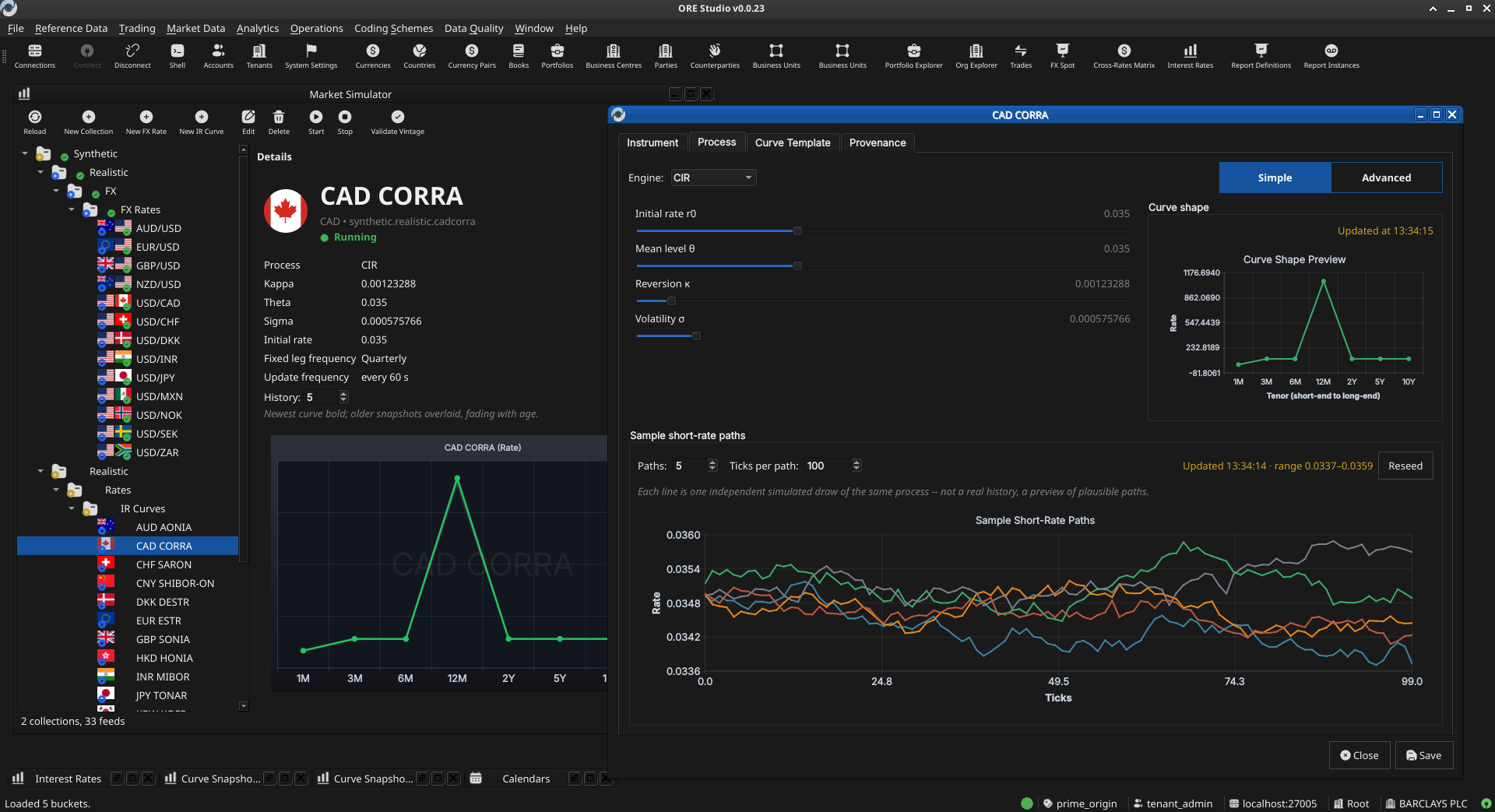
The Market Simulator's IR side end-to-end: a CIR short-rate process configured live (curve-shape preview, sample short-rate paths), feeding a running curve collection alongside the existing FX collections. The mechanics — configuration, ticking, publishing, curve-shape preview — all work; see Known Limitations below for why the published rate levels themselves are not yet trustworthy.
1.2. Interest rates and calendars
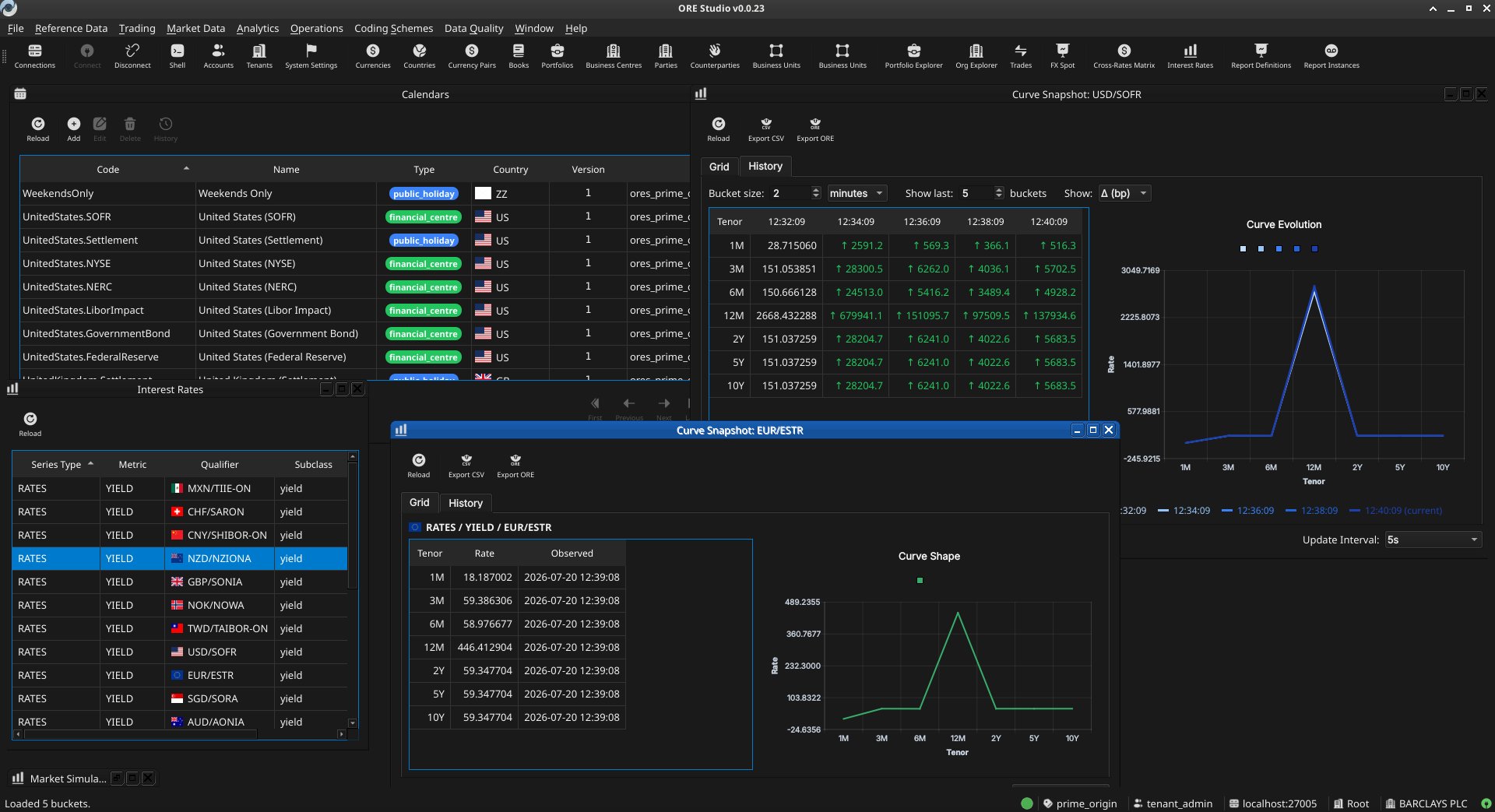
The new calendar reference-data entity (financial-centre and
public-holiday calendars) alongside the Interest Rates series browser
and live Curve Snapshot windows (grid + bucketed history + curve-shape
chart).
1.3. Cross-rates matrix
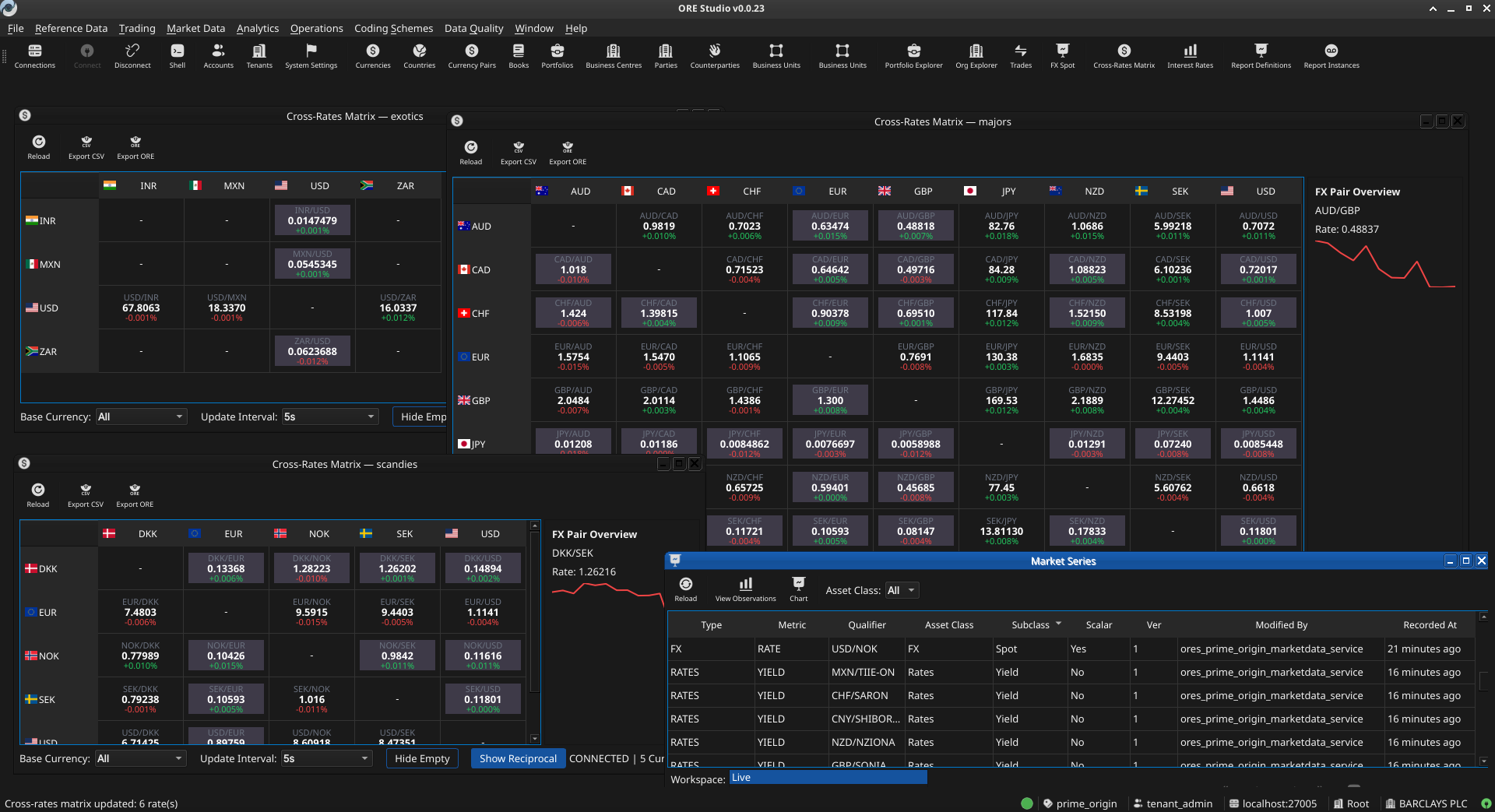
Live Cross-Rates Matrix windows (majors, scandies, exotics) plus the Market Series browser — derived rates computed from drivers and updating on a 5s interval, each with an FX Pair Overview sparkline.
1.4. Data Librarian accession card redesign
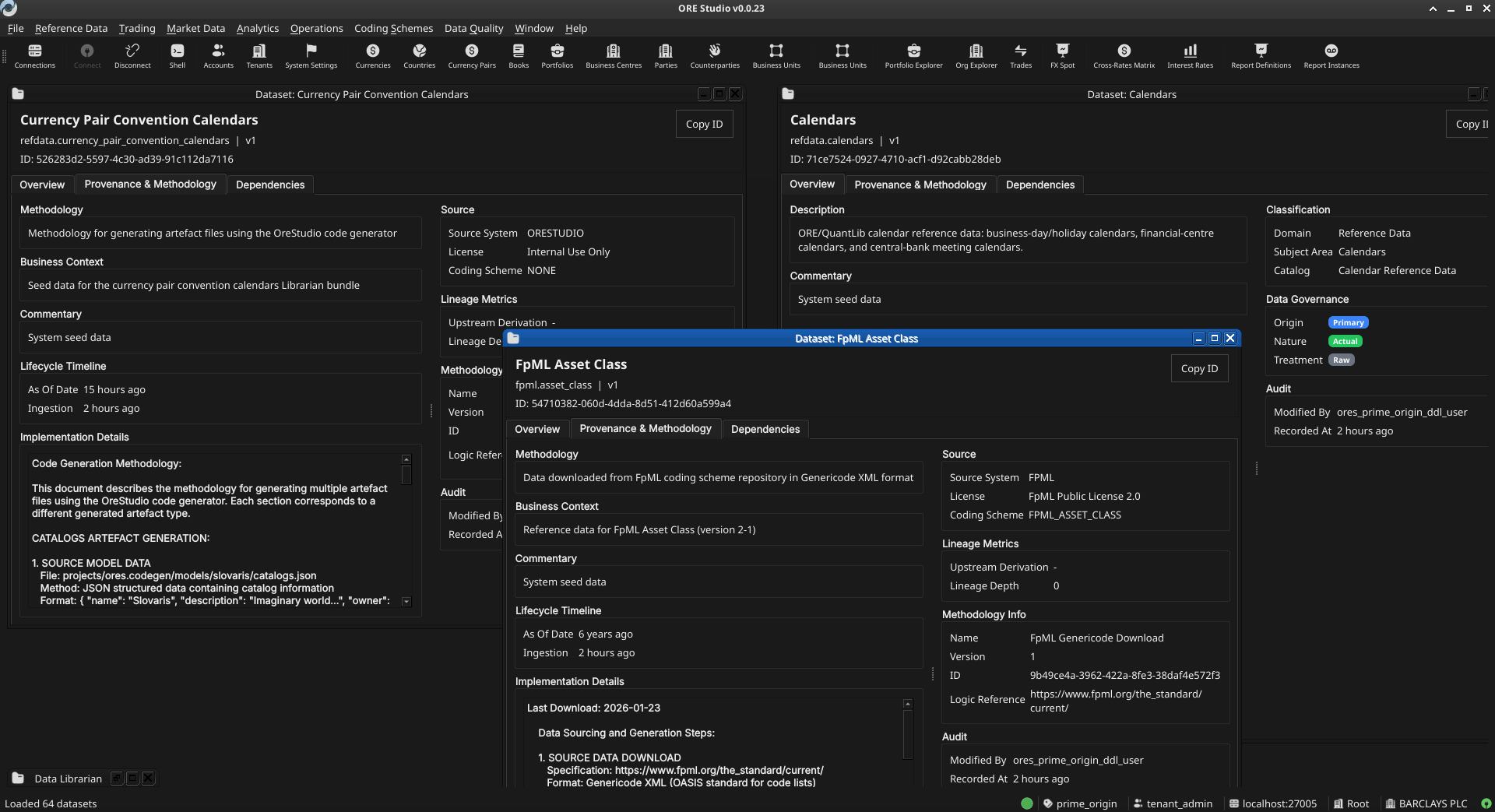
The Data Librarian's dataset detail dialog ("accession card") redesigned into a persistent-header, asymmetric two-column layout — Provenance & Methodology and Dependencies tabs, shown here across three datasets (Currency Pair Convention Calendars, Calendars, and FpML Asset Class).
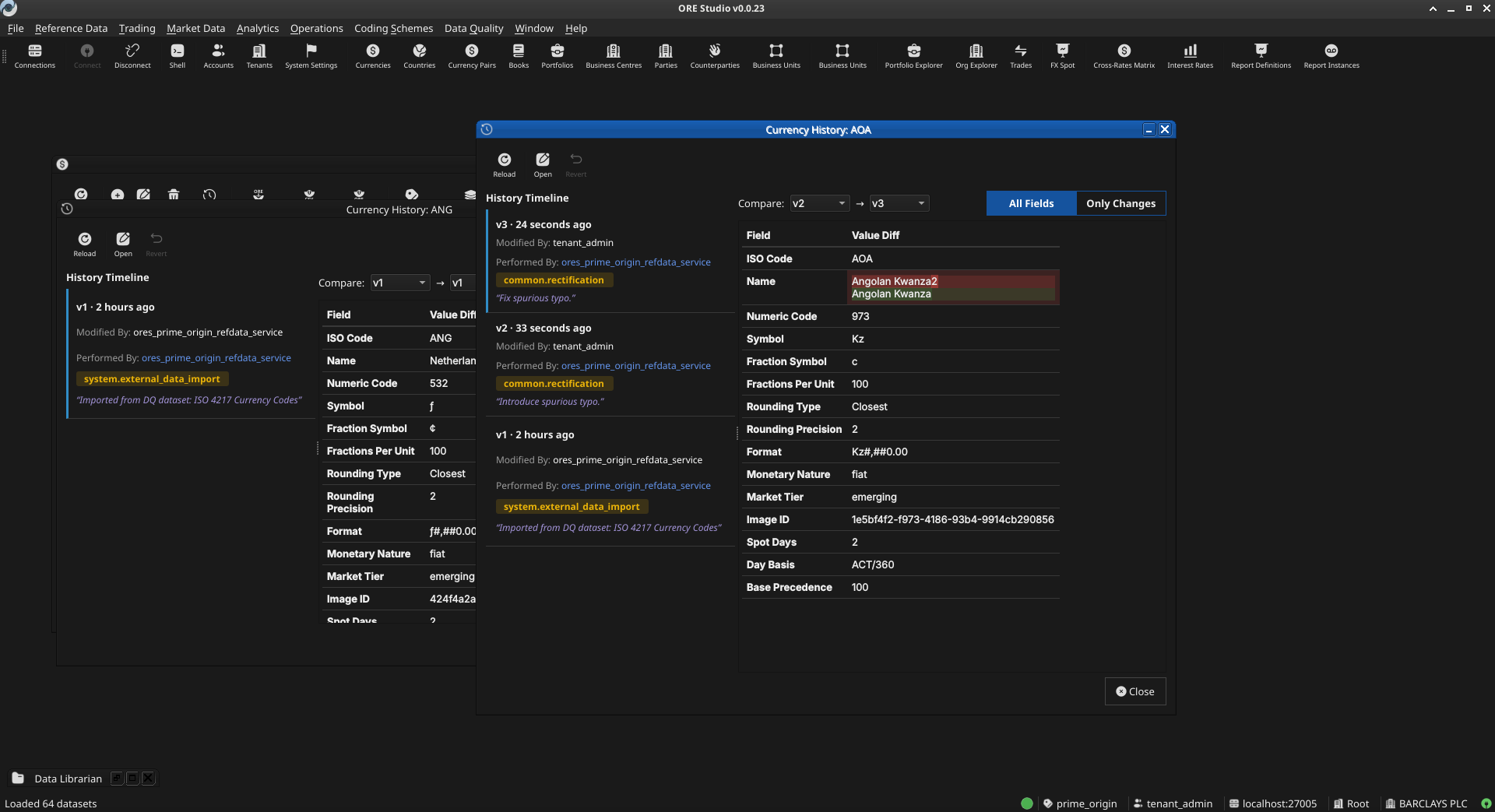
1.5. Generic history dialog with GitHub-style diff view
Every ores.qt.refdata entity now shares one HistoryDialog: a
version timeline plus a GitHub-style unified diff between any two
versions, with field-level highlighting. Shown here on Currency
history (ANG's DQ import lineage; AOA's v2=→=v3 "Angolan Kwanza2" →
"Angolan Kwanza" typo rectification).
2. ⚠️ Known Limitations
Both new features shown above are mechanically complete but not yet numerically trustworthy — this sprint built the pipeline (configure, generate, tick, publish, ingest, persist, display), not calibration or cross-domain consistency. Both are scoped for the next sprint's analysis, not carried forward as silent gaps.
2.1. IR synthetic rates: ticks are being treated as full trading days
The short-rate process update step assumes each tick represents one
full calendar day's worth of elapsed time (the day-scaled
kappa and sigma defaults are calibrated on that assumption), but ticks
actually fire every real-world update_frequency interval (e.g. 60
seconds in the screenshot above) — so a day's worth of mean-reversion
and volatility is injected into the curve roughly 1,000-1,400 times
faster than intended. In practice this produces rate swings on the
order of thousands of basis points within a few real-time minutes,
and was also observed independently in the seeded
synthetic.ir_curve_configs.basic dataset, where even day-scaled
parameters (kappa=0.5/365) still produced unrealistic (~150-250)
published rates over longer tick counts (a 2Y entry needs 730 daily
ticks) — consistent with the same missing scaling factor, not a
separate bug. The tick-batch pipeline itself (generation, batching,
publish, ingest, persistence) is proven correct via that dataset;
what's missing is a proper per-tick time-fraction (dt) that ties
real elapsed time to the process's annually-calibrated parameters,
rather than a fixed "1 tick = 1 day" assumption. Next sprint: derive
and apply the correct dt scaling (likely
dt = update_frequency_seconds / seconds_per_year, applied
consistently through the CIR/Vasicek/Hull-White discretisation), and
re-verify against both a live feed and the seeded datasets.
2.2. IR synthetic rates: single-curve only, not discount/projection dual-curve
Every seeded curve is a single, self-discounting curve — one process realisation prices every instrument on that curve, discount and projection alike. That is a deliberate, correct scope choice for the overnight RFR indices currently seeded (SOFR, ESTR, SONIA, etc.): an OIS swap referencing an overnight index genuinely is single-curve in real markets. It is not yet correct for IBOR-style term indices (EURIBOR, legacy LIBOR, term SOFR), which need a proper discounting/projection dual-curve model with a basis spread — those indices should not be added to the seeded universe until that follow-on work lands. Next sprint: extend the single self-discounting curve to a genuine dual-curve model, tracked in the IR Rates follow-on backlog story.
2.3. Cross-rates matrix has no interest-rate awareness
The CRM's driver/derived spanning-tree topology and no-arbitrage
triangulation operate purely on FX spot ratios — it has no concept of
interest-rate curves at all. Real FX conventions need one: forward
points and covered-interest-rate-parity relationships are driven by
the interest-rate differential between two currencies, and even spot
itself is not "today" — it is today + spot lag (typically T+2),
a currency-pair-specific convention the matrix currently has no way
to represent or apply. Next sprint: scope how the CRM should consume
IR curve data (once the scaling issue above is resolved) to compute
genuine forward/spot-lag-aware rates, rather than treating every rate
as an instantaneous spot cross.
3. 🛠️ Key Improvements
3.1. Financial Features
- Market data cleanup: retire dead duplicate tables and preserve hand-written overrides: Retire the dead pre-codegen marketdata tables (
ores_marketdata_series_tbl,ores_marketdata_observations_tbl,ores_marketdata_fixings_tbl) so the schema, RLS policies, ER diagram, and schema-validator ignore list only describe tables that are actually in use — and stop the codegen-managedmarket_observationrepository/service from silently losing its hand-writtenseries_idfilter and pagination logic every timecompass codegen regenerateruns. - IR Rates synthetic data generation: Extend synthetic market data generation from FX spot to interest-rate curves: a short-rate stochastic engine (Hull-White/CIR/Vasicek) drives a configurable "Curve Template" (short-end deposits, mid-curve FRAs/futures, long-end swaps) per currency+index, publishing tick batches of raw instrument observations. See Known Limitations above for a missing tick/day scaling factor that produces unrealistic published rates.
- Synthetic data collections: Basic and Realistic: Synthetic data librarian support: FX foundation gave every party a single synthetic FX collection (the
ore_analyticsdataset bundle). - Model calendars as proper ORE Studio reference data: Today, every place in ORE Studio that needs a holiday calendar (
fx_convention.advance_calendar, and thecurrency.holiday_calendar/currency_paircalendar fields proposed by Currency pair support in reference data) stores it as unvalidated free text — a name ORE/QuantLib resolves internally at pricing time (e.g. - Cross-rates matrix (CRM): Implement the FX cross-rates matrix in
ores.marketdataso derived rates are computed from drivers and the matrix is always arbitrage-free — the consistency engine the architecture relies on. See Known Limitations above: the matrix has no interest-rate awareness yet. - Stochastic tick arrival times for synthetic feeds: Today the synthetic FX spot feed emits a tick on a FIXED clock — a constant interval derived from
ticks_per_hour(fx_spot_feed::start,projects/ores.synthetic/service/src/fx_spot_feed.cpp:64-106), sleeping the full period before every publish including the first.
3.2. Codegen & Entity Commissioning
- Commission: day_count_fraction_type: Discovered while modelling fx_convention:
day_count_fraction_typelives inores.trading(ores.trading.day_count_fraction_type, since removed — see ores.refdata.day_count_fraction_type), with exactly one consumer (trading_swap_legs), while every*_conventionentity that would also need it (ibor_index_convention,zero_convention,fx_convention, etc.) lives inores.refdata. - Commission: business_centre: Commission
business_centreproperly through codegen: author/update its codegen entity model to match the entity's current hand-written structure, enable the correct variability knobs, regenerate every applicable profile, and reconcile the diffs – this is what fixes the SQL security-definer/ bootstrap-guard gaps and the wrong-plugin Qt CRUD location (ores.qt/partyinstead ofores.qt/refdata) found during appraisal, as regeneration output rather than hand edits. - Commission: contact_type:
ores.refdata.contact_type.org(the codegen model) predates several conventions the current templates assume — confirmed bycompass codegen entity generate <id> --address ores.cpp.qt --diffshowing every Qt output file as entirely new relative to what's committed, and by the committedContactTypeController.cpppassing an empty event name where current-template output passeseventing::domain::event_traits<...changed_event>::name. - Commission: party, counterparty, and party_status: Finish commissioning
party,counterparty, andparty_statusacross all access layers, superseding the three abandoned per-entity stories from Sprint 22 (Commission: party, Commission: counterparty, Commission: party_status) now that their shared blockers — composite child-entity/hierarchy Qt widgets and temporal composite entity versioning — are both DONE. - Commission: portfolio: Commission
portfolioacross the full stack: regenerate api/core/sql (and shell/cli/qt/wt/http where the codegen entity already supports them) from the current codegen templates againstores.refdata.portfolio.org, updating the model as needed; reconcile any codegen drift the same way book was remediated in Book codegen drift remediation (compass codegen entity showall-✅, no silently-dropped SQL validations); and add the entity chapter to the user manual, following the pattern of the book and counterparty chapters. - Commission ores.qt.dq — full-stack codegen for the DQ component: Every DQ entity ends up with a real
.orgcodegen model and standard generated core/service/handler/protocol/repository/Qt files – zero hand-written entity-specific code anywhere in the DQ stack (server or Qt).
3.3. Service Architecture
- Generic entity-mirror cache primitive + codegen facet (party as first consumer): Any entity that a consuming service needs to mirror in-process gets a thread-safe cache with almost no hand-written code, kept fresh via NATS eventing, with the subject binding checked at compile time (no hardcoded subject-name string that can drift from the publisher).
- Extract stochastic process math from ores.synthetic into ores.analytics.quant: ores.synthetic was originally built by mixing two concerns: the "pure" quant/maths content around stochastic processes and engines, and the synthetic-data-generation machinery that drives them.
- Retire legacy codegen profile system; add junction support to physical-space codegen: Two parallel codegen systems currently coexist, and one of them is dead code that nobody notices is dead because it silently no-ops instead of erroring.
- As-of lookup resolution codegen facet: Give any bitemporal reference/lookup entity a codegen-generated way to answer "what did code X mean as of timepoint t" — a point-in-time query (
valid_from <t and valid_to >= t=), distinct from and unrelated to composite parent-child version bumping. - Resolve codegen model unification blockers: The codegen model unification analysis identifies six concrete blockers that prevent merging the dual
domain_entity+tableorg files into a single entity file per entity. - Codegen developer experience improvements: Fix three interrelated friction points in the
codegen.sh regenerateworkflow that were observed repeatedly during sprint 21 currency auxiliary work. - Codegen: generate NATS subject constants per component: Every NATS subject in the codebase today is a raw string literal, independently typed in at least three places: the protocol struct's
nats_subjectconstant, the server-side registrar'squeue_subscribecall, and (for publish-from-dq subjects specifically) DQ metadata SQL that registers atarget_subjectfor an artefact type. - Codegen legacy-profile retirement follow-ups: Finish part of the codegen tech-debt tail that
Retire legacy codegen profile system; add junction support to physical-space codegendeliberately left BACKLOG once its own acceptance was met: retire the split-model backward-compatibility scaffolding. - DQ/Refdata service boundary cleanup:
ores.dqbundle publication currently writes directly toores_refdata_*tables, crossing the service boundary. - IAM/Refdata service boundary cleanup:
ores.iam.corecrosses the service boundary in two known places, reading/writingores_refdata_parties_tbldirectly instead of going throughores.refdata. - Refdata entity NATS event registrar audit: Every refdata entity with a
*_changed_eventtype (ores.refdata.api/eventing/) should have a working NATS event registrar (ores.refdata.service/messaging/*_event_registrar.cpp) wired intoevent_registrar.cpp, so downstream consumers (audit trail, cache invalidation, other services) reliably learn when the entity changes. - Audit refdata entities for composite (temporal-versioned) child relationships: Implement temporal composite entity versioning landed the mechanism (SQL touch-function so child writes bump the parent's version in the same transaction, the as-of window-join read-side composition query, and the codegen flags
:bump_parent_version:=/ =:list_by_as_of:) using party and counterparty as the reference case only —party_identifier=/=party_contact_informationand their counterparty equivalents. - Server-side UUID generation for all entities: Clients must never generate primary-key UUIDs.
- Book data model cleanup: Fix the data-modeling errors found by reviewing book.org against the Book domain knowledge cluster, and address the remaining domain-fit gaps it surfaced (classification flags, hierarchy semantics, legal entity/branch, rates centre, currency naming, allowed lists, manual enrichment).
- Move book to refdata: No cross-component leakage: Book, BookStatus, and RegulatoryBookType have their C++ backend correctly in
ores.refdataalready; get their Qt CRUD code and plugin wiring fully out ofores.qt/trading=/ =TradingPluginand intoores.qt/refdata=/=RefdataPlugintoo, before any further codegen-template drift work touches them again — avoids regenerating and manually re-testing an entity twice (once in the wrong plugin, once after relocation). - Book codegen drift remediation: Get book, book_status, and regulatory_book_type onto a clean, fully-regenerated, end-to-end-tested codegen baseline, then migrate book to composite-entity versioning and re-verify — so the new-work tasks parked in Book data model cleanup (book_purpose_type, ledger_feed_type, is_sweepable, Wash risk-book link, child-entity toolbar buttons) build on solid ground rather than compounding existing drift.
3.4. Qt UI
- Migrate ores.qt.refdata onto the generic HistoryDialog: Every
ores.qt.refdataentity's history view is the single genericHistoryDialogwidget (built in Consolidate history dialogs onto HistoryDialogBase's task 7D8659AB, currently wired for currency only) constructed with(entity_type, entity_id), with no remaining hand-rolled per-entity*HistoryDialogclass anywhere inores.qt.refdata. - Consolidate history dialogs onto HistoryDialogBase: Every entity history dialog derives from
HistoryDialogBaseand shares one implementation of the common machinery, so that fixes and UX changes land once instead of 67 times, and the per-dialog code shrinks to what is genuinely entity-specific (field comparisons and labels). - Improve badge colour scheme support: Analysis (task 2, done) found the badge system the story assumed didn't exist already does: a database-driven
badge_severity/code_domain/badge_definition/badge_mappingcatalogue inores.dq, a client-sideBadgeCache, and codegen support (badge_keycolumn annotation) that generates the delegate wiring automatically. - Improve Data Librarian accession card UI/UX: Redesign the Data Librarian's dataset detail dialog (
DatasetViewDialog, the "accession card") away from its current single-column, alternating-row property-sheet table toward a persistent-header, asymmetric two-column layout, per OreStudio Data Librarian UI/UX Review. - Clean up application menus: Redesign the application's menu structure from first principles so each top-level menu has a coherent, single purpose instead of today's organic grab-bags: -
System— app chrome only (Testing/QA runner, Reset System). - Add a default party per account with a quick-login checkbox: Add a
default_party_idto the account entity, and a "Log in to default party" checkbox on the login dialog.
3.5. Hotfixes
- Hotfix: ores.iam.core build fails, missing ores.eventing.core include dependency: Restore a green build for
ores.iam.core, broken by PR #1557 ("Migrate party to the generated nats-event-cache"): its generatedparty_cache.hppincludes a header fromores.eventing.corethat the component'sCMakeLists.txtnever declared a dependency on. - Hotfix: Windows Clang CI compiler-launcher wrapper: Restore the Windows Clang CI builds (
windows-clang-debug-ninjaandwindows-clang-release-ninja), which currently fail to configure withninja: fatal: CreateProcess: %1 is not a valid Win32 application.Root cause:CMakePresets.json's hiddenclangpreset setsCMAKE_C_COMPILER_LAUNCHER=/=CMAKE_CXX_COMPILER_LAUNCHERtobuild/scripts/compiler_cache_wrapper.shvia itsenvironmentblock. - Hotfix: ores.dq.core fails to build, missing ores.diff link: Restore the build on
main:ores.dq.corefails withfatal error: 'ores.diff/domain/field_value.hpp' file not foundbecause its CMakeLists never declares a dependency onores.diff.lib, even though its public headers includeores.difftypes. - Hotfix: Windows CI builds timing out / failing on header dependency scanning: Restore Windows CI: builds must complete within the workflow timeout instead of failing with spurious "file not found" errors or hanging for 6h and getting cancelled.
3.6. Agile & Process
- Open sprint 23: Sprint 23 is open and usable: scaffolded, wired into the version manifest and agile index, project version bumped, and vcpkg updated — the standing checklist a sprint-open task must clear before other work can be picked up against it.
- Sprint 23 planning session: Give sprint 23 a real starting backlog: work through the product backlog and past-sprint carry-overs, promoting well-specified captures into sprint 23 stories and pulling in stories that were misfiled (wrong bucket/sprint folder) or mislabeled (marked ABANDONED in a sprint table with no corresponding decision recorded), verifying each one's premise against the live codebase rather than trusting its own text.
- Sprint 22 leftover cleanup: Close out four standalone leftover tasks parked at sprint 22 close — each a genuinely single-task remainder from an otherwise-DONE story, not worth re-opening or carrying its whole parent.
- Sprint health review — System 2 analysis: Produce a structured System 2 health review of sprint 23 covering goal alignment, sprint load, PR velocity, focus signal, and story/task balance.
- Compass improvements: A home for small, cross-cutting compass enhancements that don't warrant their own dedicated story — surfaced drift warnings, convenience tooling — so this kind of work stays tracked without inflating the backlog with one-off stories.
4. ⚠️ Known Issues & Postponed
- DQ/Refdata service boundary cleanup (BACKLOG): deferred.
- IAM/Refdata service boundary cleanup (BACKLOG): deferred.
- Sprint 22 leftover cleanup (BACKLOG): deferred.
- Refdata entity NATS event registrar audit (BACKLOG): deferred.
- As-of lookup resolution codegen facet (BACKLOG): deferred.
- Codegen developer experience improvements (BACKLOG): deferred.
- Market data cleanup: retire dead duplicate tables and preserve hand-written overrides (BACKLOG): deferred.
- Stochastic tick arrival times for synthetic feeds (BACKLOG): deferred.
- Audit refdata entities for composite (temporal-versioned) child relationships (BACKLOG): deferred.
- Codegen: generate NATS subject constants per component (BACKLOG): deferred.
- Server-side UUID generation for all entities (BACKLOG): deferred.
5. 📈 Sprint Charts
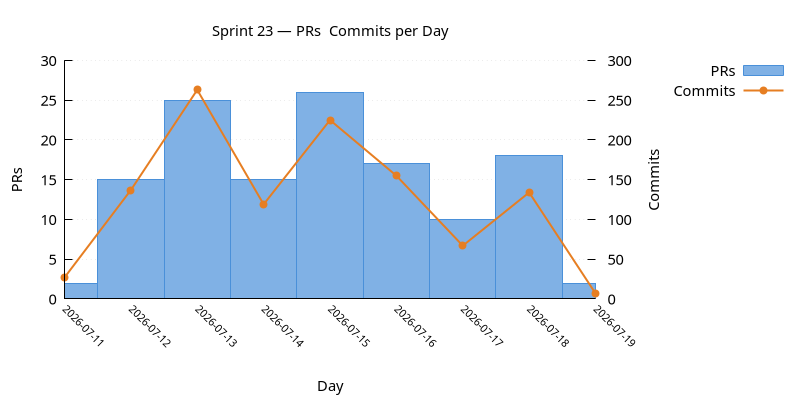
5.1. PRs and Commits per Day
Dual-axis bar chart. PRs (left axis) and commits (right axis) per day. A high commits-to-PR ratio may indicate scope creep.
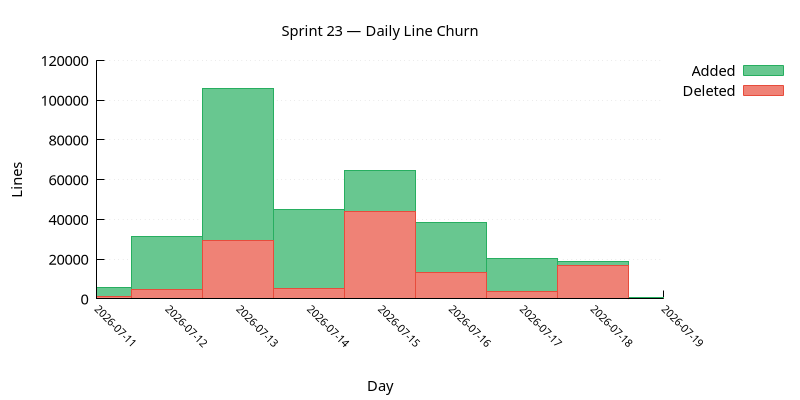
5.2. Daily Line Churn
Lines added (green) and deleted (red) per day. Building work produces mostly additions; refactoring produces a mix.
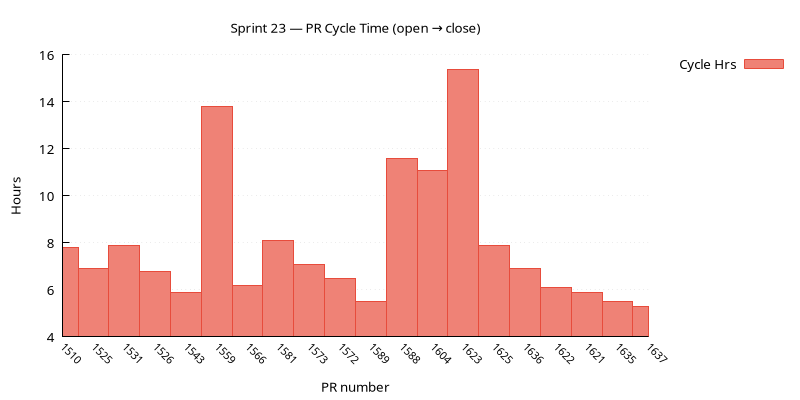
5.3. PR Cycle Time
Hours from PR open to merge, one bar per PR. Long bars indicate review bottlenecks.
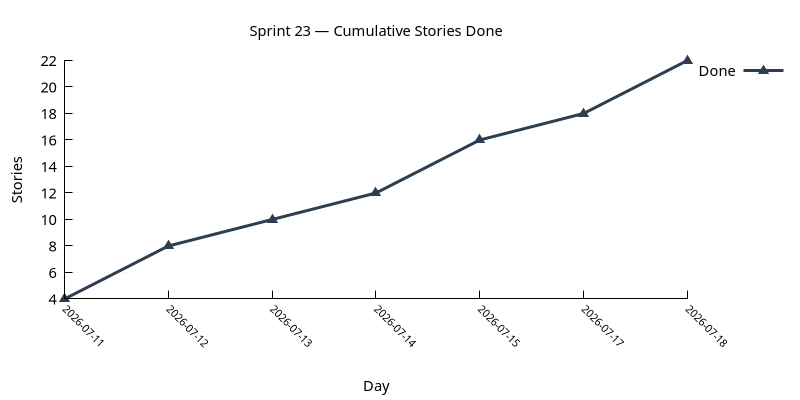
5.4. Cumulative Stories Done
Line chart tracking stories marked DONE during the sprint. Steady upward slope is healthy; plateauing signals a stall.
6. 📊 Time Summary
- Total effort: not tracked
- PRs merged: 152 (since v0.0.22, 2026-07-10 to 2026-07-20)
- Sprint duration: 2026-07-11 → 2026-07-20 (planned close 2026-07-18; ran 2 days over — see the health review)
Next sprint: finish Consolidate history dialogs onto HistoryDialogBase's Phase C rollout (~61 remaining dialogs) and Improve badge colour scheme support's fallback/self-badging/coverage-audit work — both still short of their own acceptance. Commission ores.qt.dq — full-stack codegen for the DQ component continues (subject_area is the last of five reference entities). The product backlog also picked up several fresh, well-scoped follow-on stories from this sprint's closures: IR Rates dataset seeding/index cleanup/dual-curve/quoting conventions, calendar entity date-picker/pagination-fix/QuantLib materialization, party/counterparty orchestration and short-code generation, portfolio display fixes, and the remaining codegen mustache-rename/junction-rollout tail.