ORE Studio Sprint 25 – Release Notes
Table of Contents
September 2026
Release notes for Sprint 25.
Sprint 25 was an experimental sprint. It set out to resolve codegen drift on as many components as possible and to progress the IR curves work, and it tried many different approaches to get there: safe drift per C++ component, profile binds, trading instruments ported to codegen, generated shell commands, a data-oriented trading model, protocol messages generated into C++ and TypeScript, the move from Qt to ores.web, and journey-first screens. Each approach taught something, and several shipped real results: five components are drift-free, the drift checks run in CI, oresmd covers every ORE quote type, the USD SOFR curve has an FOMC-dated short end, and ores.web replaced the Qt and Wt clients. At close, the sprint settled on the last approach: for each module, sync codegen and clear its drift, then analyse the user journeys, then build the UX. The other approaches closed with their reasons recorded (23 stories abandoned), so sprint 26 starts from that one method. The experiment was expensive: the sprint ran 52 days against a 7-day plan, and 23 of its 80 finished stories were hotfixes.
1. ✅ Highlights
- An experimental sprint: many approaches to the codegen and UI problems ran side by side. The sprint settled on the last one, which is the method for sprint 26: codegen sync and drift for each module, then user journeys, then UX.
- Five components are drift-free: ores.dq, ores.iam, ores.synthetic, ores.compute, and ores.analytics. ores.reporting has its bind merged. The codegen drift checks run in CI. ores.trading was listed here as a sixth; that claim is retracted, because a measurement on 2026-09-26 finds 1751 files of drift in it and the sprint 25 story itself said the component could not join the drift gate.
- The Qt and Wt clients left the repository. ores.web, a TypeScript client, replaces them.
- The NATS entity protocol has a canonical specification. IAM and refdata use it, and their C++ and TypeScript messages generate from one model.
- oresmd covers every ORE quote type, including the new inflation and correlation families and a volatility-surface sub-schema.
- The USD SOFR curve has an FOMC-dated short end, built on a calendar event model and flat-forward pillars.
- ores.shell drives the compute grid and the trading entities with no UI. A smoke test dispatches jobs across every online node.
- The feed control plane is asset-class agnostic: one producer seam, one controller, one ingest loop and one auto-start.
- The skills catalogue moved to the compass- namespace, with cybernetic levels, cited principles, ported methods and the compass-helm mode.
2. 🛠️ Key Improvements
2.1. Codegen and drift
- Drift baseline, per component: ores.dq, ores.iam, ores.synthetic, ores.compute, ores.analytics and ores.reporting bound to profiles, with zero-diff regeneration verified. ores.trading was listed here too; its regeneration was never drift-clean and the claim is retracted.
- Template fixes: history provenance fields, compound-key gating, pagination, junction templates, RLS policy emission and the history-provider registrar.
- Model hygiene: redundant explicit properties removed; the has_parent_id feature moved to the entity root so that profile bindings take effect.
- Checks: the populate reference drift check, the drift checks in CI, and the compiler warnings (-Wall, -Wextra) the code assumed.
- Protocol: IAM and refdata messages generate from one model into C++ and TypeScript.
2.2. Market data and quant
- oresmd: the legacy market_series qualifier and ore_key are gone, and every ORE quote type has an oresmd identifier.
- FOMC short end: calendar events, a unified tenor resolution (FOMC, IMM and tenor), and the bootstrap segment.
- Process engines: G2++ and Black-Karasinski are wired end to end. BDT, affine, HJM, LMM and Quadratic Gaussian engines exist, but they are not wired yet.
- Classification: asset classes and series subclasses are refdata catalogs, a series can belong to more than one asset class, and the classifier covers the whole ORE corpus.
- Feeds: one asset-class-agnostic control plane, and per-party consumption of the shared simulated market.
2.3. Acme Corporation and the holding company
- The holding company has FX and CRM visibility, a Group Treasury book, and a manual section.
- The ACME fit-for-purpose review fixed tenant scoping, a TimeZone-dependent bitemporal sentinel, and silent provisioning failures.
- Synthetic data has scope (system, tenant, party) and binding mode (bound, sandboxed).
2.4. Platform and tooling
- systemd: per-environment isolation and resource limits across the fleet, and a smaller database connection pool for each service.
- Remote WSL: compass deploys the runtime and a compute node to a remote host.
- Testing: an injectable environment provider, rerunnable test databases, and a hardened eventing chain.
- PR flow: GitHub CI no longer gates pull requests. Targeted local checks and a local review run before a PR is raised, and the PR body carries a mandatory Testing section.
- ores.shell: split into api and application parts.
- ORE: the examples and XSD are synced to v1.8.17.0, and the engine package is vendored beside v1.8.16.0.
2.5. Hotfixes
23 hotfix stories closed this sprint. 11 of them fixed Windows or MSVC builds, and two fixed gcc-only diagnostics. Continuous Windows was red from 2026-09-04 to 2026-09-17. Most of these defects compiled on Linux clang and failed on another compiler after the merge.
3. ⚠️ Known Issues & Postponed
At close, 23 stories were abandoned. Each one records why in its Result.
- Codegen approaches (12 stories): the C++ refactor, the drift stories for ores.marketdata, ores.database, ores.scheduler, ores.workflow and ores.workspace, and the codegen stories for instruments, shell commands, protocol, the JSON-to-org migration, the trading data model and the NATS protocol. Sprint 26 replaces them with one method: sync codegen and clear drift for each module.
- Web and journeys (3 stories): the IAM web entities, the IAM journeys and the trade entry prototype. The journey documents stay. Journey and UX stories start again after the codegen pass.
- IR (2 stories): IR Rates synthetic data and the new stochastic processes. The IR implementation needs a refactor before more features land. The deferred capture "Refactor the IR rates implementation before more IR features land" holds this work.
- Removed clients (2 stories): the Market Simulator client and the desktop UI verification. The Qt client they targeted is gone.
- Other (4 stories): ORE v17 (both engines in provisioning, and the seven new trade types), the NATS config passthrough, trade populations, and oresmd as the native market data identity.
- Skills: the catalogue story closed with 21 tasks. Its 28 open tasks are in the inbox story "Complete the LLM skills catalogue".
4. 🔎 Post Mortem
4.1. What worked
- High throughput: 316 PRs merged and 80 stories closed DONE.
- The drift method worked. Each component followed the same steps and reached zero drift.
- PRs merged fast, with a median of 1.9 hours from open to merge.
- The close reset recorded every abandoned story with a reason, so sprint 26 starts from a clean board.
4.2. What didn't work
- The sprint ran 52 days against a 7-day plan. It did not close at the lull, so a second full sprint of work went into the same document.
- The mission did not change when the work moved to ores.web and TypeScript. The mission then described less than half of the work.
- 31 stories were STARTED at the close review, 10 of them with every task done. The documents did not show the real work in progress.
- 23 hotfixes. Cross-compiler failures were found by the scheduled CI runs, after the merge.
- Many approaches to the codegen problem ran at the same time, and none of them finished.
4.3. Improve next sprint
- Close the sprint at day 7. A lull ends a sprint; it does not stretch it.
- Change the mission when the direction changes, or open a new sprint.
- Follow one order: codegen sync and drift for each module, then user journeys, then UX.
- Run a gcc or MSVC build before a merge that touches CMake, headers or compiler flags.
- Close a story when its last task closes.
5. 📈 Sprint Charts
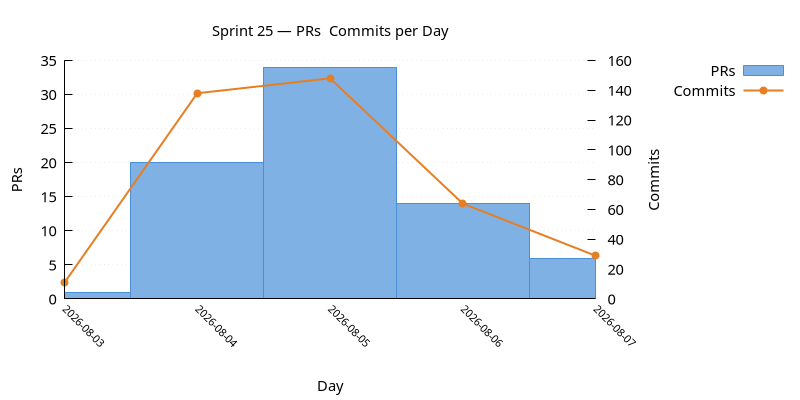
5.1. PRs and Commits per Day
Dual-axis bar chart. PRs (left axis) and commits (right axis) per day. A high commits-to-PR ratio may indicate scope creep.
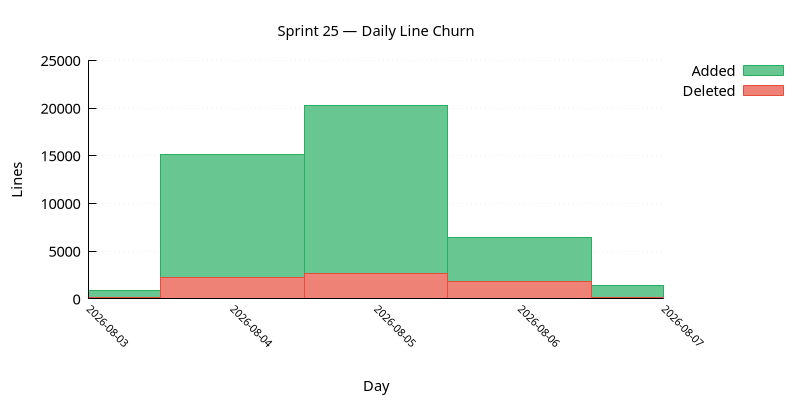
5.2. Daily Line Churn
Lines added (green) and deleted (red) per day. Building work produces mostly additions; refactoring produces a mix.
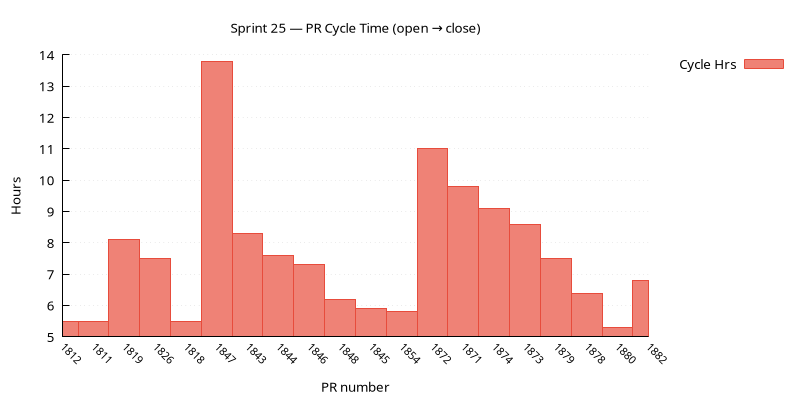
5.3. PR Cycle Time
Hours from PR open to merge, one bar per PR. Long bars indicate review bottlenecks.
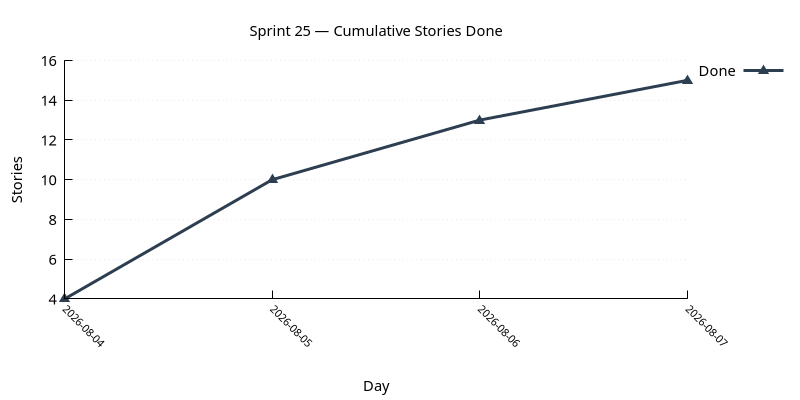
5.4. Cumulative Stories Done
Line chart tracking stories marked DONE during the sprint. Steady upward slope is healthy; plateauing signals a stall.
6. 📊 Time Summary
- Total effort: not tracked
- PRs merged: 316 (since v0.0.24, 2026-08-03 to 2026-09-23)
- Sprint duration: 2026-08-03 → 2026-09-23 (52 days)
Next sprint: sync codegen and clear drift for each module, starting with the modules that are not drift-free yet (ores.trading, ores.marketdata, ores.database, ores.scheduler, ores.workflow, ores.workspace). User journey analysis and UX follow the codegen pass.