ORE Studio Sprint 26 – Release Notes
Table of Contents
October 2026
Release notes for Sprint 26.
Sprint 26 ran the three-pass mission in order: sync codegen and clear the drift, analyse the user journeys, then build the UX. The sprint closed RED: it ran thirteen days against a seven-day plan, and it carried about four times the commit ceiling and five times the PR band. The work still shipped. Twenty-seven components came fully to the Component Clean Standard. The trade was redesigned on data-oriented principles, five journey groups run in ores.web on one shared journey runtime, and the HTTP surface is now generated end to end. Nineteen stories did not finish, and they moved to the product backlog inbox. Eleven stories closed at the scope they delivered, and each names a successor that carries the remainder. Sprint 27 opens from the product backlog.
1. ✅ Highlights
- The Component Clean Standard reached 27 components. Five carried to the backlog (ores.diff, ores.eventing, ores.history, ores.scheduler and ores.synthetic), ores.reporting and ores.dq closed at the work they delivered with the remainder split out, and ores.cli was decommissioned.
- The trade is data-oriented: an immutable anchor with component tables keyed by the trade, generated composite keys, netting agreements and sets, sandboxes and virtual books.
- Five journey groups — setup, entry, profile, credentials and access — run as ores.web screens on one shared journey runtime.
- The HTTP surface is generated end to end, and fifteen components have a generated shell surface or a hand-crafted command signed off with a reason.
- The marketdata grammar is a hand-written, typed codec, checked field by field against ORE's own parser.
2. 🛠️ Key Improvements
2.1. Build & Portability
- Remove the unused packages, extensions and Qt-named keys: The first passes took the weight the Qt retirement left behind: the setup no longer installs the X11 and GL headers the Qt client needed nor the
pg_cronandpgmqextensions, the Qt-named presentation keys and their helpers are gone, the removal is proved output-neutral —iamregenerates byte-identically — and the README, the icon inventory and the manual carry their corrections. - Stop the web typecheck racing the web tests: The two ores.web ctest entries never run at the same time, so the BFF tests never load the wire package's dist while tsc rewrites it.
2.2. Codegen
- Bring every component to the component clean standard: Every C++ component meets the Component Clean Standard, the checklist written from what
ores.iamandores.refdatadid in sprint 25: every wire type modelled and generated, every model on the current format and bound to a profile, no legacy or hand-written duplicate left, and every codegen gate green with the component under test. - Harden the gates the component clean standard rests on: A component clean-up passes or fails on what a gate can see.
- Make first-generation component scaffolding opt-in: A default-disabled codegen scaffold facet, so a normal regeneration can never recreate stub files or the umbrella header for an existing component.
- Roll the generator fixes out to the components outside the test list: Every component outside
COMPONENTS_UNDER_TESTcarries the four generator fixes the refdata clean-standard pass landed: a put response and a single-version response carry their row in astd::optional; a batch removal of an empty key list answers instead of rendering an emptyIN (; the protocol-dependency gate keeps theores.doc.shell-recipefamily alive, so each component's recipes regenerate; and each response shape's TypeScript twin matches its header. - Generate the shell surface of the clean components: Each component the clean standard has cleared has a shell surface that generation produces, with every hand-crafted command recorded and justified.
- Generate the shell surface of the remaining components: Each of diff, compute, telemetry, history, scheduler, ore, variability and workspace either renders the shell units generation produces or states, model by model, the reason it renders none, and every hand-written command that survives is recorded with its reason.
- Add a read-only entity profile: A named variability profile produces a read-only entity: the generated protocol carries
list,getandget_many, and no write verb and no version read. - Generate HTTP routes from the models: ores.http serves every component through routes generated from that component's models, with one uniform security model, and ores.assets is the first component landed through it.
- Generate literate HTTP recipes that tangle to runnable Hurl: Every HTTP route the models declare has a generated literate recipe, each recipe tangles to a runnable Hurl file, the harness replays a recipe group against the live gateway and reports a verdict for each recipe, and the inventory is gated in CI.
- Format the generated TypeScript with prettier: The TypeScript render emits a tree that no formatter owns, so the format check named in package.json has never passed and never run: there is no prettier configuration in the repository at all.
- Implement order and filter in the generated list contract: Finish the list contract the protocol specification already states, in the code generator, so every entity gets it from its model.
- Clean ores.platform to the component clean standard: ores.platform meets the Component Clean Standard: the items marked All pass, each item that does not apply is recorded with its reason, and ores.platform joins
COMPONENTS_UNDER_TEST. - Clean ores.logging to the component clean standard: ores.logging meets the Component Clean Standard: the items marked All pass, and each item that does not apply is recorded with its reason.
- Clean ores.utility to the component clean standard: ores.utility meets the Component Clean Standard: the items marked All pass, each item that does not apply is recorded with its reason, and ores.utility joins
COMPONENTS_UNDER_TEST. - Clean ores.orgmode to the component clean standard: ores.orgmode meets the Component Clean Standard: the items marked All pass, each item that does not apply is recorded with its reason, and ores.orgmode joins
COMPONENTS_UNDER_TEST. - Clean ores.storage to the component clean standard: ores.storage meets the Component Clean Standard: the items marked All pass, each item that does not apply is recorded with its reason, and ores.storage joins
COMPONENTS_UNDER_TEST. - Clean ores.security to the component clean standard: ores.security meets the Component Clean Standard: the items marked All pass, each item that does not apply is recorded with its reason, and ores.security joins
COMPONENTS_UNDER_TEST. - Clean ores.database to the component clean standard: ores.database meets the Component Clean Standard: every item: All, Protocol and Entity pass, each item that does not apply is recorded with its reason, and ores.database joins
COMPONENTS_UNDER_TEST. - Clean ores.nats to the component clean standard: ores.nats meets the Component Clean Standard: the items marked All pass, each item that does not apply is recorded with its reason, and ores.nats joins
COMPONENTS_UNDER_TEST. - Clean ores.connections to the component clean standard: ores.connections meets the Component Clean Standard: the items marked All pass, each item that does not apply is recorded with its reason, and ores.connections joins
COMPONENTS_UNDER_TEST. - Clean ores.service to the component clean standard: ores.service meets the Component Clean Standard: the items marked All and Protocol pass, each item that does not apply is recorded with its reason, and ores.service joins
COMPONENTS_UNDER_TEST. - Clean ores.telemetry to the component clean standard: ores.telemetry meets the Component Clean Standard: the items marked All and Protocol pass, each item that does not apply is recorded with its reason, and ores.telemetry joins
COMPONENTS_UNDER_TEST. - Clean ores.geo to the component clean standard: ores.geo meets the Component Clean Standard: the items marked All pass, each item that does not apply is recorded with its reason, and ores.geo joins
COMPONENTS_UNDER_TEST. - Clean ores.variability to the component clean standard: ores.variability meets the Component Clean Standard: the items marked All, Entity and Protocol pass, each item that does not apply is recorded with its reason, and ores.variability joins
COMPONENTS_UNDER_TEST. - Clean ores.fpml to the component clean standard: ores.fpml meets the Component Clean Standard: the items marked All pass, each item that does not apply is recorded with its reason, and ores.fpml joins
COMPONENTS_UNDER_TEST. - Clean ores.assets to the component clean standard: ores.assets meets the Component Clean Standard: the items marked All, Protocol and Entity pass, each item that does not apply is recorded with its reason, and ores.assets joins
COMPONENTS_UNDER_TEST. - Clean ores.http to the component clean standard: ores.http meets the Component Clean Standard: the items marked All and Protocol pass, each item that does not apply is recorded with its reason, and ores.http joins
COMPONENTS_UNDER_TEST. - Clean ores.workspace to the component clean standard: ores.workspace meets the Component Clean Standard: every item: All, Protocol and Entity pass, each item that does not apply is recorded with its reason, and ores.workspace joins
COMPONENTS_UNDER_TEST. - Clean ores.workflow to the component clean standard: ores.workflow meets the Component Clean Standard: every item: All, Protocol and Entity pass, each item that does not apply is recorded with its reason, and ores.workflow joins
COMPONENTS_UNDER_TEST. - Clean ores.iam to the component clean standard: ores.iam meets the Component Clean Standard: every item: All, Protocol and Entity pass, each item that does not apply is recorded with its reason, and ores.iam joins
COMPONENTS_UNDER_TEST. - Clean ores.refdata to the component clean standard: ores.refdata meets the Component Clean Standard: every item: All, Protocol and Entity pass, each item that does not apply is recorded with its reason, and ores.refdata joins
COMPONENTS_UNDER_TEST. - Clean ores.analytics to the component clean standard: ores.analytics meets the Component Clean Standard: every item: All, Protocol and Entity pass, each item that does not apply is recorded with its reason, and ores.analytics joins
COMPONENTS_UNDER_TEST. - Clean ores.compute to the component clean standard: ores.compute meets the Component Clean Standard: every item: All, Protocol and Entity pass, each item that does not apply is recorded with its reason, and ores.compute joins
COMPONENTS_UNDER_TEST. - Clean ores.reporting to the component clean standard: ores.reporting meets the Component Clean Standard: every item: All, Protocol and Entity pass, each item that does not apply is recorded with its reason, and ores.reporting joins
COMPONENTS_UNDER_TEST. - Clean ores.marketdata to the component clean standard: ores.marketdata meets the Component Clean Standard: every item: All, Protocol and Entity pass, each item that does not apply is recorded with its reason, and ores.marketdata joins
COMPONENTS_UNDER_TEST. - Clean ores.dq to the component clean standard: ores.dq meets the Component Clean Standard: every item: All, Protocol and Entity pass, each item that does not apply is recorded with its reason, and ores.dq joins
COMPONENTS_UNDER_TEST. - Clean ores.ore to the component clean standard: ores.ore meets the Component Clean Standard: every item: All, Protocol and Entity pass, each item that does not apply is recorded with its reason, and ores.ore joins
COMPONENTS_UNDER_TEST. - Clean ores.trading to the component clean standard: ores.trading meets the Component Clean Standard: every item: All, Protocol and Entity pass, each item that does not apply is recorded with its reason, and ores.trading joins
COMPONENTS_UNDER_TEST. - Clean ores.testing to the component clean standard: ores.testing meets the Component Clean Standard: the items marked All pass, each item that does not apply is recorded with its reason, and the one item that cannot pass is recorded as an exception with its proof.
- Clean ores.shell to the component clean standard: ores.shell meets the Component Clean Standard: the items marked All pass, each item that does not apply is recorded with its reason, and ores.shell joins
COMPONENTS_UNDER_TEST. - Decommission ores.cli: ores.cli and its round-trip dataset are gone.
- Clean up the ores.shell remnants: The shell holds no hand-written unit that generation supersedes, the three defects the clean-standard pass found are fixed rather than remembered, and every accepted exception that the menu-ownership change invalidated reads the way the code now behaves.
2.3. Financial Features
- Design the trade shape on data-oriented principles: Settle the target shape of the trade and everything joined to it — anchor, components, instruments, links, groups, activities, authorisation, agreement, structures, netting sets — before the instrument families are reworked, and record every decision with its reason.
- Teach the code generator the trade shape: Give the code generator the capabilities the netting-set and trade-split stories need first, so they generate their entities rather than hand-write them.
- Model netting agreements, netting sets and CSAs: Model the legal and credit grouping trades net under, as the Netting sets note analyses it: agreement, netting set and CSA as separate entities in ores.refdata.
- Add sandboxes and virtual books: Let users import and experiment without disturbing official data, as the Sandbox note describes, and within the regulatory boundary it checks.
- Split the trade into an anchor and its components: Implement sections 1 to 3, 6, 9, 10 and 13 of the trade shape investigation: the anchor, the booking, the state, identifiers, party roles and additional fields, with ORE import resolving to entities and export regenerating them.
- Model the ORE report configuration as entities: A report definition's configuration is a set of strongly typed entities rather than a flat row of switches: every one of the seventeen ORE configuration document kinds is identified, mapped to an owning component, seeded as a configuration type, and round tripped, import and export, through the entities over the vendored corpus.
- Make the oresmd URI grammar explicit and typed: Every oresmd URI states what it means without the reader knowing a default or a family's coordinate convention: each coordinate dimension is a named query key, every key the grammar defines is present, and every key is declared identity or coordinate so the series identity is a declaration rather than a special case.
- Rewrite the oresmd grammar as a hand-written codec checked against ORE: An ORE market data key read into ORE Studio means what ORE means by it, and it comes back out as the same key.
2.4. Service Architecture
- Move reporting's write path onto the storage protocol: The last consumer moves onto the bucket and key protocol, and the two consumers that already moved are verified again on the current tree.
- Give the workflow component a fixture it can run against itself: The workflow component is driven from ores.shell, against the live fleet and with no other component's data: the fixture runs the engine against itself, the engine acts across tenants, and its start, dispatch, success, warning, failure, compensation and recovery paths are each reachable and each asserted.
- Keep the ores.iam eventing tests idempotent:
ores.iam.core.testspasses twice in a row against the same database. - Close the object storage interface leftovers: Two leftovers of the interface story are closed.
- Mop up the storage leftovers the goal surfaced: Three leftovers the storage work surfaced are closed or accounted for.
- Act inside a tenant: A system administrator can enter one tenant on purpose, see on every screen that they are acting in it, read its data through the same reads its own members use, and leave.
- Give a person's token the permissions they hold: Make a person's token carry the permissions they hold, and stop the token check from passing an empty list.
- See an account's sign-ins: An administrator who opens an account reads what kind of account it is, whether it can sign in, and the sessions it has had, newest first.
- Build approval requests and notifications: One component, ores.inbox, holds the approval requests and the notifications as designed: a relational schema generated from codegen models, with the rules the schema can carry — the one-approval-per-person index, the failed-delivery reason check and the four-eyes trigger — and the notification models generated with it. The service answers the approval lifecycle and the notifications (PR #2652).
- Fix the self write refusal on a tenant with accounts: Every write lands on a tenant that holds accounts, including the write whose actor is the account written.
- Give object storage a NATS and HTTP interface with authentication: Object storage is reachable, and authenticated, on both interfaces the Object Storage target state names.
- Design the report pipeline and the run configuration: One report definition is designed to run end to end from the scheduler through the workflow to the compute grid and back.
- Remove the ores.web fleet workaround:
ores.webstarts the way every other component starts: the generated fleet, brought up bycompass services. - Log the fleet to the journal: The fleet logs to the console and systemd captures it into the user journal, so one interface reaches every service and no file is written.
- Refuse to start against a database built from other SQL: The code knows the schema it was built for and the database records the schema it was built from, as a fingerprint of the SQL scripts.
- A pattern language for service interaction: A person who designs a service interaction can say "use pattern X" and point at one page.
2.5. User Journeys
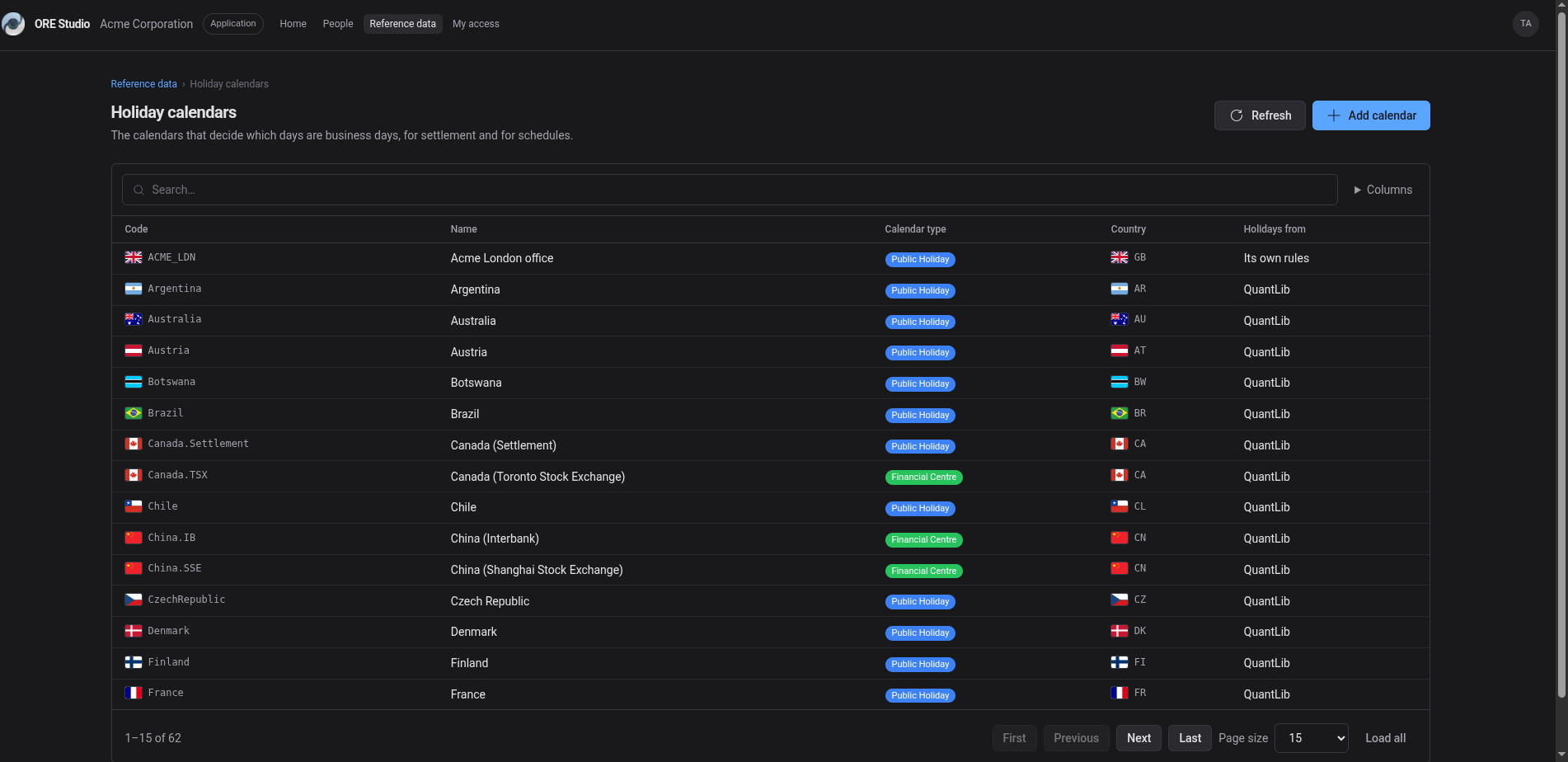
- Implement the refdata journeys in ores.web: The written ores.refdata journeys run in ores.web against the real server: a reference data administrator can maintain the classification lists, holiday calendars, currencies, currency pairs and desk groups from the screens the journey documents describe, instead of the deleted per-entity screens (PR #2644; the holiday calendar screen, PR #2646).
- Write the journey extraction standard and the ores.refdata journeys: The User Journey Extraction Standard is written, and its first run documents the ores.refdata journeys, with every action its Qt screens offered covered by a journey or recorded as dropped.
- Implement the setup journeys in ores.web: A browser pointed at an empty installation takes a person from nothing to a working installation, and then to as many tenants and parties as they need.
- Implement the entry journeys in ores.web: The two Entry journeys run in ores.web against the real server.
- Implement the profile journeys in ores.web: The three Profile journeys run in
ores.webagainst the real server. - Implement the credentials journeys in ores.web: The three Credentials journeys run in
ores.webagainst the real server: Protect my account — the member changes their own password and reads where the account is signed in; Rescue access — the tenant administrator resets one colleague's password and locks or unlocks the account; Audit sign-ins — the tenant administrator reviews the active sessions, the session activity and the failed attempts of the tenant. - Implement the access journeys in ores.web: The first three Access journeys run in
ores.webagainst the real server: Know what I may do — the member reads the roles they hold and the permissions those roles carry; Change someone's access — the tenant administrator grants and revokes a colleague's roles; Shape the role catalogue — the tenant administrator defines roles and the permissions each one bundles. - Document the operations journeys: Five journeys document the operator's view of a running installation: See the running services, Watch the compute grid, Watch the message bus, Read the telemetry logs, and Check the versions and the database.
2.6. Shell and Web UI
- Make the shell speak to people plainly: A person sees the work they can do, in their own words.
- Stop ores.shell menus from silently shadowing each other: The shell has one owner per menu and per verb.
- Make the tenant roster a working list: A system administrator finds a tenant among many and acts on it from the roster: they search by code, name or hostname, filter by type and status, page through the list with its total, open a tenant's detail, and reach the operations a tenant offers from its row.
- Send the filter with every web list request: Every list request the web client builds by hand states the filter, and its schema is held to the generated request type so a member the protocol adds fails the typecheck instead of the live read.
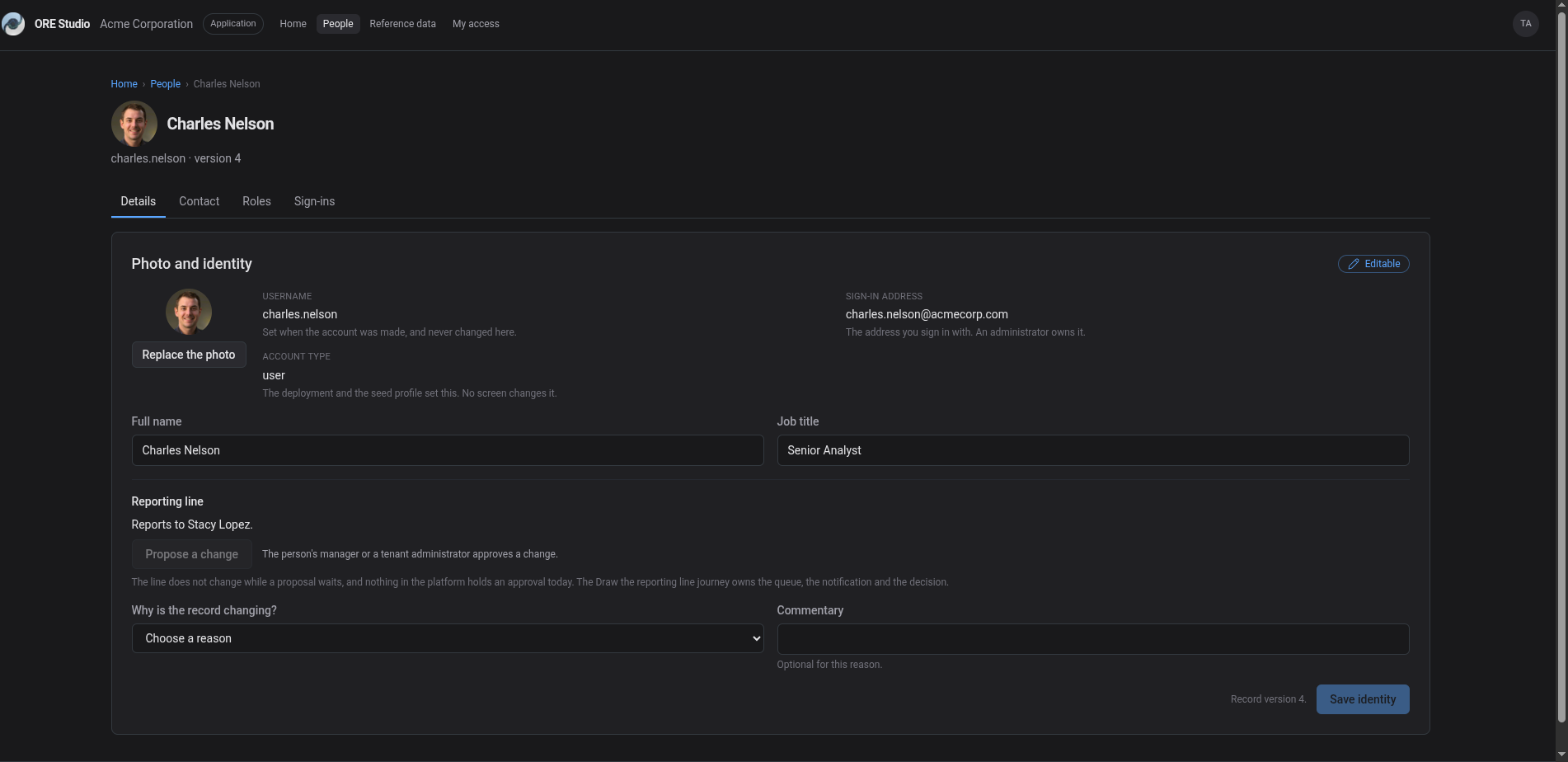
- Standardise the record screens: One standard defines the shape and behaviour of every screen in ores.web that lists and maintains records — lists and paging, the detail page, create, amend and delete, change reasons, history and revert, related records, icons, states, feedback, access and safety, naming, and exceptions — with the same scope the retired Qt entity standard had. Server paging through the shared Pager landed with the currency, desk group and currency pair screens (PR #2644); the People screens conformed, with my profile split from them (PR #2655), and the holiday calendar screen arrived at the standard (PR #2646).
2.7. Documentation & Tooling
- Show the current agile work item inside DSH: A DSH plugin that shows the sprint as a kanban board inside the DSH web session.
- Make compass site page the site check: An agent that checks documentation changes waits seconds, not minutes: the skills and recipes run
compass site page, and the full site build is only for the first build in a checkout. - Reach systemd from a sandboxed compass session: Four defects compound so that a compass session inside the sandbox reports a fleet state it cannot actually see or change.
- Show the environment inside DSH: A DSH plugin that shows the session's own checkout as a live environment: the environment name, when the database was last restored and how long ago, the schema drift against HEAD, and the state of every service unit.
2.8. Hotfixes
Hotfix: a Boost library landed without its vcpkg port: Every continuous Linux job is red, in all four configurations, at one translation unit:
projects/ores.utility/include/ores.utility/decimal/decimal.hpp:24:10: fatal error: 'boost/multiprecision/cpp_dec_float.hpp' file not found
The decimal amount type, which Decide how an exact decimal is represented in C++ settled and commit
466ea3109fthen added, gives the estate exact base-ten arithmetic withboost::multiprecision::cpp_dec_float_50, andvcpkg.jsonwas not told.Hotfix: a visibility macro on an enum breaks the Windows build: Every Windows clang-cl job is red at one declaration:
projects/ores.workflow/api/include/ores.workflow.api/service/ workflow_definition.hpp:149:17: error: '__dllimport__' attribute only applies to functions, variables, classes, and Objective-C interfaces [-Werror,-Wignored-attributes]
The offending line is the enum, not a struct:
enum class ORES_WORKFLOW_API_EXPORT failure_policy : std::uint8_t {
ORES_WORKFLOW_API_EXPORTexpands toBOOST_SYMBOL_IMPORTorBOOST_SYMBOL_EXPORT, which is__declspec(dllimport)or__declspec(dllexport)on the Microsoft ABI, and neither attribute applies to an enum.Hotfix: a library exports a type none of its units compiles: The Windows clang-cl build fails at the link step of the workflow core DLL:
lld-link: error: undefined symbol: __declspec(dllimport) public: __cdecl ores::workflow::service::workflow_registry::workflow_registry(void)
lld-link: error: undefined symbol: __declspec(dllimport) public: __cdecl ores::workflow::service::workflow_definition::workflow_definition(void)
ORES_WORKFLOW_API_EXPORTisBOOST_SYMBOL_IMPORTfor a consumer andBOOST_SYMBOL_EXPORTwhile the library itself is compiled.Hotfix: macOS cannot parse a floating point with std::from_chars: The macOS build stops on the credit simulation mapper:
projects/ores.ore/core/src/domain/credit_simulation_mapper.cpp:63:9: error: call to deleted function 'from_chars' 63 | std::from_chars(text.data(), text.data() + text.size(), value);
libc++ on Apple platforms does not implement the floating-point overload of
std::from_chars.Hotfix: the nightly Valgrind run reports uninitialised members and library leaks: The nightly memcheck run reports defects in four suites, and the outputs under
tmp/are the CDash pages for them:52/87 MemCheck: #55: ores.trading.api.tests ........... Defects: 4 58/87 MemCheck: #52: ores.refdata.core.tests .......... Defects: 3329 83/87 MemCheck: #69: ores.ore.core.tests .............. Defects: 99 85/87 MemCheck: #85: ores.analytics.core.tests ........ Defects: 214
The uninitialised values are generated struct members with no declared default, read by the write path that stringifies an entity for its INSERT; the refdata records are still-reachable allocations in the coverage runtime and its libraries, and the suppressions name each category.
- Hotfix: the marketdata core suite times out in CI:
ores.marketdata.core.testspasses inside the 600-second ctest limit on every CI platform again, with the whole-corpus import walk still in the default test set. - Hotfix: Restore every red build on main: Every continuous build on main is red.
Hotfix: three reporting tables carry a tenant and no row-level security: Every build that validates the SQL tree is red:
WARNING [RLS_001] create/reporting/reporting_analytic_types_create.sql:0 Table 'ores_reporting_analytic_types_tbl' has tenant_id but no ENABLE ROW LEVEL SECURITY found in any *_create.sql file
WARNING [RLS_001] create/reporting/reporting_report_analytics_create.sql:0
WARNING [RLS_001] create/reporting/reporting_report_run_setups_create.sql:0
Warnings: 3
The three tables arrived with the run document and analytics model, and their models declare a
tenant_idwithout the row-level security facet every other tenant-scoped reporting table declares.Hotfix: the workflow deadline watch uses a thread Apple's libc++ lacks: Both macOS legs are red at one declaration:
projects/ores.workflow/core/include/ores.workflow.core/service/workflow_engine.hpp:383:10:
  error: no type named 'jthread' in namespace 'std'; did you mean 'thread'?
Apple's libc++ implements the stop token but not
std::jthread, so a portablestoppable_threadjoinsores.platform.- Hotfix: the workflow deadline pass reads an entry it has freed: A step that outlives its deadline stops its run on every platform.
- Hotfix: The site build aborts on a read-only HOME: compass build –direct site publishes again on a cold checkout whose HOME is read-only, and no batch Emacs script manages a cache that belongs to the user.
Hotfix: the site build aborts on a POSIX class that reads as a link: The site build and the CDash site job abort on main while publishing
doc/agile/versions/v0/sprint_26/clean-dq/task_clean_dq.org:Build failed: Unable to resolve link: ":space:"
The page records the command that counted the dq NATS subjects.
- Hotfix: two macOS test failures that assert Linux-only facts: With the macOS build compiling again, its test phase runs and fails in two places, both of them facts about Linux that the tests assert rather than defects in the product:
filesystem_scoped_temp_file_tests.cppcomparessut.path().parent_path()withstd::filesystem::temp_directory_path()as strings, andsystemd_notify_tests.cppbinds an abstract unix socket, which macOS has no namespace for. Hotfix: Apple's libc++ has no C++20 stop machinery at all: The macOS legs are red again, one hour after the portable thread was added:
stoppable_thread.hpp:99:24: error: no type named 'stop_token' in namespace 'std'
stoppable_thread.hpp:113:10: error: no type named 'stop_source' in namespace 'std'
The earlier story assumed the gap was
std::jthreadalone, because the error named only that type and the engine's lambda took astd::stop_tokenwithout the compiler complaining.Hotfix: the recovery test fails when the database is busy: The recovery case fails on CI and passes on a quiet machine:
workflow_engine_tests.cpp:404: FAILED: after.size() == 2 for: 1 == 2
recover_in_progress()re-dispatches every in-progress instance the database holds.Hotfix: the ER diagram no longer matches the SQL tree: The
driftjob passes its first step and fails its second:Check generated output matches the models: No drift: regenerated output matches the checked-in tree. Check the ER diagram matches the SQL schema: ##[error]Process completed with exit code 1.
ores_schema.pumlis regenerated from the SQL tree, and the step passes again.Hotfix: the macOS parser refuses the smallest subnormal: The macOS test phase fails one assertion:
projects/ores.platform/tests/numeric_floating_point_tests.cpp:93: FAILED: parsed.has_value() for: false
The case formats each of a set of doubles with
std::to_charsand reads each back withores::platform::numeric::parse_double.- Hotfix: a service listener falls behind a burst of notifications: A service's PostgreSQL listener keeps up with a burst of notifications.
- Hotfix: Linux and Windows CI builds on main: Bring the Linux and Windows continuous builds on main back to green.
2.9. Agile & Process
- Open sprint 26: Sprint 26 exists as a proper agile artefact, with its mission set and wired into the version manifest and the agile index, and sprint 25 is closed.
- Sprint 26 closure: story cleanup and reset for sprint 27: Own the final steps of sprint 26: the close health review, a cleanup that leaves no half-finished story for sprint 27, the release notes and the retrospective.
3. ⚠️ Known Issues & Postponed
- Complete the LLM skills catalogue (ABANDONED): deferred.
- Clean ores.diff to the component clean standard (ABANDONED): deferred.
- Clean ores.eventing to the component clean standard (ABANDONED): deferred.
- Clean ores.history to the component clean standard (ABANDONED): deferred.
- Clean ores.scheduler to the component clean standard (ABANDONED): deferred.
- Clean ores.synthetic to the component clean standard (ABANDONED): deferred.
- Add proper curve support to ores.marketdata (ABANDONED): deferred.
- Record trade activities, their participants and trade links (ABANDONED): deferred.
- Model operational authorisation and the client-facing agreement (ABANDONED): deferred.
- Model trade structures (ABANDONED): deferred.
- Clean ores.cli to the component clean standard (ABANDONED): the component was decommissioned instead.
- Implement the user journeys in ores.web (ABANDONED): deferred.
- Observe a run while it works (ABANDONED): deferred.
- Complete the ORE report configuration (ABANDONED): deferred.
- Return marketdata to the clean-standard registry (ABANDONED): deferred.
- Land the role request journey (ABANDONED): deferred.
- Default the shell facet on at the profile level (ABANDONED): deferred.
- Run an example bundle through the compute grid from a report definition (ABANDONED): deferred.
- Remove workspaces from every component (ABANDONED): deferred.
- Implement the operations journeys in ores.web (ABANDONED): deferred.
4. 📈 Sprint Charts
4.1. PRs and Commits per Day
Dual-axis bar chart. PRs (left axis) and commits (right axis) per day. A high commits-to-PR ratio may indicate scope creep.

4.2. Daily Line Churn
Lines added (green) and deleted (red) per day. Building work produces mostly additions; refactoring produces a mix.

4.3. PR Cycle Time
Hours from PR open to merge, one bar per PR. Long bars indicate review bottlenecks.

4.4. Cumulative Stories Done
Line chart tracking stories marked DONE during the sprint. Steady upward slope is healthy; plateauing signals a stall.

5. 📊 Time Summary
- Total effort: not tracked
- PRs merged: 516 (since v0.0.25, 2026-09-23 to 2026-10-05)
- Sprint duration: 2026-09-23 → 2026-10-05