Data classifications: entity, list, family, bundle, package and artefact
Table of Contents
- 1. Summary
- 2. Detail
- 2.1. Two consistency scopes, not two data models
- 2.2. What happened, and what the gap was
- 2.3. The classifications at a glance
- 2.4. Entity
- 2.5. List
- 2.6. Family
- 2.7. Bundle
- 2.8. Package
- 2.9. Artefact (document-shaped)
- 2.10. The anti-type: the hand-written union**
- 2.11. The decision rule**
- 2.12. Compilation errors do not reclassify data
- 3. See also
1. Summary
There are two modes of operation, and they are two consistency scopes, not two data models. Most work is discrete: one entity, or a homogeneous list of one kind. Some work is a set of different types that only mean something together: a structure with its trades, instruments and legs, a portfolio destined for ORE XML, an environment export. The rows and the types are the same in both modes. What changes is what must hold at one instant, and therefore what a message may carry.
A set of several kinds composes for one of two reasons, and the two
give different artefacts. The kinds are related when an invariant
must hold over all of them at one instant, or when one operation must
apply all of them or none. Related kinds that one owner holds form a
bundle, and one unit_of_work applies it. Kinds that are merely
gathered — because they came from one system, one file or one export —
form a package: bytes carrying bundles and a manifest, with no
relatedness constraint and no atomicity of its own.
This page defines a small, closed set of data classifications. Each one states what it is, the sanction to use it, the sanctioned pattern, the wire shape, the atomicity scope, and the anti-pattern it replaces. Classify first; then choose the pattern for that classification. A data set that fits no classification is a finding to report, not a shape to invent.
The set is closed for the same reason the codegen patterns are: an invented classification is a second type system, and it fails where the first one is not looking. The MSVC build failure that motivated this page is recorded below. It was a symptom, not the fault.
2. Detail
2.1. Two consistency scopes, not two data models
The discrete scope is well covered today. One entity is one central row and its parts, with the entity protocol, one typed array per component and a transaction at the row. A homogeneous list is one kind of entity read with the list verbs, paged, filtered and ordered on the server. Both are ordinary work and need no new vocabulary.
The composed scope is the gap. A set of different types means something only together when one of these is true:
- A cross-type invariant must hold at one instant. A structure, its trades, its instruments and its legs must describe the same deal at the same instant, or the set is not a structure.
- One operation must apply the set or none of it. A portfolio-wide correction either lands whole or leaves nothing.
- A boundary format needs the set at once. A portfolio destined for ORE XML carries every instrument kind the book holds.
- An environment export reconstructs a working system from one snapshot: reference data, configuration and market data together.
The first two are relatedness, and relatedness is what makes a bundle. The last two are provenance: the set is gathered because one file or one export holds it, and nothing joins its members. A set gathered by provenance travels as a package, and its members are bundles that a package carries, not one atomic set.
The word scope is deliberate. A composed set is not a new kind of data. It is ordinary entities whose consistency requirement decides the message, and the number of owners that requirement reaches decides whether the message is a bundle or a package.
2.2. What happened, and what the gap was
A message carried every convention entity type in one aggregate, the ORE conventions document. On MSVC it did not compile: the reflection library's duplicate-name check was a constexpr check over reflected field names whose cost grows with the square of the name count, and the instantiation exceeded the compiler's limit. It compiles on clang and on gcc.
The compiler was not the design fault. The aggregate held every convention entity type, unrelated, because one ORE file contains them: every kind the document lists. File shape was mistaken for a consistency requirement.
The conventions have no cross-family invariant. A zero convention and a CDS convention never had to travel together; the document listed them side by side because the file does. Nothing in the durable documents gave a modeller a way to notice that. That is the gap this page closes.
2.3. The classifications at a glance
| Classification | Scope | Wire shape | Atomicity |
|---|---|---|---|
| Entity | one row and its parts | derived verbs, one typed array per part | the row |
| List | one entity kind, many rows | one typed array, a page and a total | per element |
| Family | one entity with parts written together | <family>_item and <family>_write |
one owner, one transaction |
| Bundle | a set of related families, one owner | the bundle's part records in a manifest | one owner, one unit_of_work: the largest atomic thing |
| Package | one or more bundles, any owners, plus a manifest | manifest plus part references | none as a whole: per bundle, per owner |
| Artefact | an interchange file at the boundary | none: bytes in object storage | none of its own: the conversion's writes carry it |
The six are exhaustive for the data this system moves. A set that needs two of them is two messages, not one shape. The bundle, the package and the artefact are often confused, so the difference is stated once here: a bundle is a set of families that are related, and relatedness is the definition; a package is a set of bundles that need not be related, and it is never atomic as a whole; an artefact is another system's format, and it carries neither.
2.4. Entity
What it is. One keyed row and its parts: one identity, one lifecycle, one owner. The parts change for their own reason, but the entity is the unit of reading and writing.
The sanction. Use it when the set is one thing the system keeps. It has one key, one owner, and parts that differ by access rather than by ownership.
The sanctioned pattern. The entity protocol and the entity pattern of Codegen patterns: choosing a model shape, with the composite pattern when the parts move on their own change reason. The target shape is in The atomised entity: a central row and its parts. The pages that choose and build the entity start at Entities.
The wire shape. The derived verbs, flat, with one typed array per part aligned over one page. A part's fields never appear as nested objects inside another part.
The atomicity scope. The row. One transaction writes the central row and the parts it changes, and bumps the central version so no instant exists at which they disagree.
The anti-pattern it replaces. One aggregate struct that holds the whole entity as nested members, or a read-time aggregate type that is treated as the entity. See Data-Oriented Design in ORE Studio.
2.5. List
What it is. A homogeneous collection of one entity kind: all currencies, all books of a party, all trades on one book. The caller wants many rows of one type, with filtering, ordering and paging.
The sanction. Use it when every element has the same type and no invariant joins the elements. A list asserts nothing about the set as a whole; it is a page of rows.
The sanctioned pattern. The list and read verbs of NATS entity protocol specification. The server keeps filtering, ordering, paging and the total.
The wire shape. One typed array, a page offset, and a total. A list of several kinds is not a list: it is a bundle, a package, or several lists.
The atomicity scope. Per element. A write to one element succeeds or fails on its own; there is no cross-element invariant, and a batch that claims one is a bundle or a family in disguise.
The anti-pattern it replaces. Reading a homogeneous set as one aggregate so that the aggregate can be saved whole; and a row-at-a-time callback where a page would do.
2.6. Family
What it is. One entity with parts that must be written together: one central row, one key, and one typed array per part. The parts are separate tables with their own change reason, and the family names the set of them that one write covers.
The sanction. Use it when a cross-type invariant holds at one instant and one owner holds every type. The invariant is internal to one entity: the central row and its parts must agree, and the absence of one part changes the meaning of the others.
The sanctioned pattern. The generated ores.codegen.family model. It
derives <family>_key (copied from the central entity's key record),
<family>_item (the key, the central row and one typed array per part)
and <family>_write (the central change and one typed array of part
changes per part), then the get, get_many, put and put_many
pairs. Each part is an entity model whose foreign key names the central
entity with :bump_parent_version:, :list_by:, :list_by_uuid: and
:list_by_as_of:. The syntax is in
Codegen input org-file schema reference.
The <family>_key restates the wire key the central entity's model
declares, and the item and the write address the family by exactly those
members, one positional per member; the declaration is in
Entity Addressing.
The wire shape. <family>_item for a read and <family>_write for a
write. The item holds the key, the central row and one typed array per
part. It is a container of typed arrays, not a nested object graph: each
part stays a type of its own and none of its fields is inlined into
another. The family plural owns the subjects, so they do not collide with
the central entity's own verbs.
The item is the one shape that looks like the aggregate Data-Oriented Design forbids, and it is not one. That rule forbids an aggregate whose members are another type's fields, which produces one wide type and one wide reflected literal. The item's members are a key, a central row and arrays, so each part keeps its own type, key and codec. It is a unit of one family's read and write, not a second copy of the parts' fields.
The atomicity scope. One owner, one transaction, over the central row
and every part the write names. The family put is a domain operation
because it spans several tables; its put_many is one transaction for
the batch, and the version precondition stays a property of each
element.
The anti-pattern it replaces. A hand-written struct that restates the family's shape, and a field group that nests the parts inside one C++ type to fake a family. See Codegen patterns and The atomised entity.
2.7. Bundle
What it is. A set of related families that one owner applies as one unit. The families are a family's central entity and its parts, each with a type, a key and a repository of its own; the bundle names the set of them that one operation writes. The set of families is open in number: a structure with its trades, its instruments and its legs is one bundle over trading's tables.
The relatedness test, which is the definition. The families in a bundle must share either (a) a data invariant that must hold at one instant, or (b) a single operation whose intent is all-or-nothing. Nothing else makes a bundle. Write the test as one sentence:
These families may not be written apart because __ must hold at one instant, or because one operation must apply all of them or none.
- If the blank needs a file, a screen, a workflow step or a boundary format to be true, the families are not related. The set is a package's contents, and each family is its own bundle.
- If the sentence names an invariant that covers only some of the families, the set is two or more bundles. Split it at the invariant.
- If the sentence covers every family and one owner holds them all, the
set is a bundle, and one
unit_of_workapplies it.
The sanction. Use it when the relatedness test passes and one owner holds every family. A bundle never spans two owners, because no transaction does: a set that several owners must write is a package carrying one bundle per owner, which is the next classification.
The sanctioned pattern. Each family is the generated
ores.codegen.family model, and the bundle is the operation that writes
them. A bundle served to another system is carried inside a package, as
one bundle record in the package manifest. The transport is in
Transporting a package.
The wire shape. Inside a package, the bundle's part records in the manifest: one record per family, each a reference. On the wire, the bundle's own verbs are its families' operations. The bundle's rows never sit in a message field.
The atomicity scope. One owner, one unit_of_work, over every family
the operation names. A bundle is the largest thing that can be atomic on
this platform: it is bounded by one owner's database and one
transaction, and no mechanism extends it across owners. A failure
halfway rolls the whole bundle back.
The anti-pattern it replaces. One struct with a typed array per kind, built because one file, screen or workflow step lists the kinds together. That struct is not a bundle: it has no relatedness and no owner's transaction.
2.8. Package
What it is. An artefact carrying one or more bundles plus a manifest, moved between systems as bytes. A package has no relatedness constraint: the bundles it carries need not be related to one another, may belong to different owners, and the package as a whole is never atomic. Relatedness is what makes a bundle a bundle; the absence of relatedness is what makes a package merely a package.
The sanction. Use it when bytes must move between systems and the set of bundles is decided by provenance — one export, one import, one backup, one report run — and not by an invariant. A package is sanctioned even when its bundles have nothing in common, because its purpose is carriage, not consistency.
The sanctioned pattern. A content-addressed artefact in object
storage, with a generated manifest that describes the bundles and their
parts. A coordinator reads only the manifest and dispatches one message
per bundle, to that bundle's owner. Each owner loads its bundle,
validates it, and applies it atomically in its own unit_of_work. The
full transport is in
Transporting a package.
The wire shape. The manifest, which is a modelled operation type, and one part-reference message per bundle. The package's data never sits in a message field.
The atomicity scope. None at the package level. Each bundle is atomic
in its owner's transaction; the package as a whole is never atomic
across bundles or owners, because no transaction spans two databases.
Consistency comes from sequencing, a stated as_of instant, and a
sandbox for examine-before-live. Progress and retry are per bundle.
The anti-pattern it replaces. An opaque self-describing archive carried as a message field; and a package treated as a data model, so that provenance becomes an invariant.
The worked contrast. A structure is a bundle: its trades and legs are
related by an invariant, one owner holds them, and one unit_of_work
writes them. An environment export is a package: refdata conventions,
trading trades and marketdata fixings are in it because they came from
one system, not because they are related, so no transaction joins them.
A conventions import is one operation, so its relatedness is that
operation's intent and not the file's contents: refdata owns every
family, the file is a package, and until the operation declares
all-or-nothing each family is applied on its own.
2.9. Artefact (document-shaped)
What it is. An interchange file at the stack boundary: ORE XML, an FpML document, an org file. The format is external, the stack does not own it, and it is transient.
The sanction. Use it only at a boundary where the bytes arrive or leave. The document is evidence of a format, not a data model.
The sanctioned pattern. A mapping layer converts the document to and
from the classifications above. An ORE XML input becomes per-family and
per-entity messages; an FpML trade becomes a trade and its instrument
entities; an org file parsed into a heading tree becomes the rows it
describes. Where the bytes must be kept, they go to
Object Storage as an
artefact with a key, not into a table and not into a message.
The wire shape. None. An artefact is never a durable wire type. A message field that holds encoded document bytes is forbidden: it defeats validation, routing, per-part retry, and the rule that no message field holds an encoded value.
The atomicity scope. None of its own. The conversion's writes carry the atomicity of the classifications they are converted into.
The anti-pattern it replaces. Treating the document tree as the model, so the file's element structure becomes the schema; and a field of self-describing archive bytes inside a message.
2.10. The anti-type: the hand-written union**
Name it, because it is what the missing classification produced. The anti-type is a hand-written union of unrelated entities presented as one struct: several typed arrays or optional members, one per entity kind, in a struct named after a file, a screen or a workflow step. The conventions document with one typed array per kind is one.
It is not a family, because no key joins its members and no single transaction gives them one meaning. It is not a bundle, because its members are not related by an invariant or by one all-or-nothing operation, and no owner's transaction covers them. It is not a package, because it has no manifest, no owner boundary and no instant: a package carries bundles, and this carries none. It is a second type system written by hand, and the generator cannot check it.
The test. Fill in this sentence without naming a file, a screen, a workflow step or a boundary format:
One member may not be written without the others because __ must hold at one instant.
- If the sentence needs a file, a screen, a workflow step or a format to be true, the set is an artefact's contents or a display concern, not a data type. Split it.
- If the sentence names an invariant that covers only some members, the set is two or more classifications. Split it at the invariant.
- If the sentence names an invariant, or one operation that must apply all or none, and one owner holds every member, the set is one Family or one Bundle.
- If the members are related but several owners hold them, no bundle spans them: they are a Package carrying one bundle per owner, and no transaction joins the bundles.
A union that answers none of these is refused. Do not carry it, and do not rename it.
The key test, and the rule it must not be confused with. Polymorphic payloads over NATS sanctions one typed array per concrete type in a message, joined by key. That rule is for a heterogeneous read of one subject, and the join is what makes it a read. A union's arrays carry no shared key: a zero convention and a CDS convention in the conventions document are not joined by anything, because each is an independent population. If the arrays cannot be joined on a key, the set is not a read; it is the anti-type.
2.11. The decision rule**
This is the spine of the data classification checklist.
- Does the set pass the relatedness test? Do its families share an
invariant that must hold at one instant, or one operation whose intent
is all-or-nothing?
- No. Split it into per-family or per-entity messages. A member of the set is an Entity, a List, or part of a Family. The members travel together only if a caller needs them at one instant, and that need is a read, not an invariant. If the bytes must still move as one artefact, that artefact is a Package, and each family in it is its own bundle.
- Yes, and one owner holds every family. A Bundle, applied in one
unit_of_work. - Yes, and several owners must write. No bundle spans them. A Package carries one bundle per owner, and the package as a whole is never atomic.
- A file's contents are not an invariant. A file is an artefact, and the artefact that moves bundles is a package. The document lists conventions because the format lists them. That is a fact about ORE XML, not about conventions.
- An aggregate list of entities in one struct is a second type system and is forbidden. The generator cannot see it, so it drifts, and the compiler pays for it in a diagnostic that names no field.
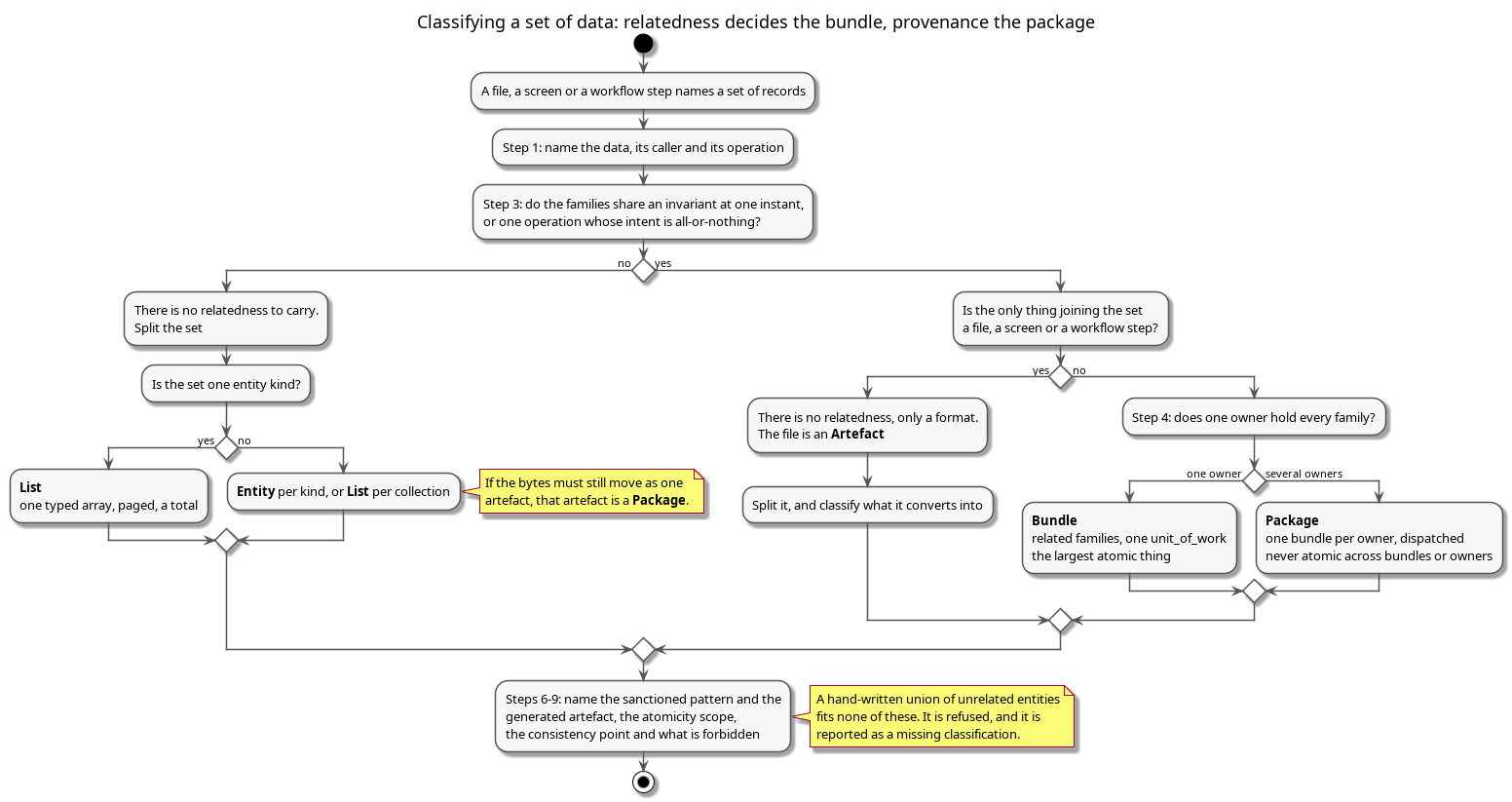
Figure 1: How to classify a data set. The first question is the only one that can sanction a set of different types travelling together; a file, a screen or a workflow step sanctions nothing.
Source: data_classification_decision_tree.puml. Regenerate with
plantuml -tpng doc/knowledge/architecture/data_classification_decision_tree.puml.
2.12. Compilation errors do not reclassify data
If a type that is correctly classified still fails to compile, that is a technical problem. Further denormalisation for technical reasons is acceptable: split a wide literal, write parts separately, lower the number of names one reflected literal reaches.
A compile error does not invalidate the modelling. It must not be used to reclassify the data. Fix the shape the compiler objects to, keep the classification, and record the technical step as a technical step.
There is no field-count rule and no measuring control. The count that matters depends on how a type is written, it moves with the compiler, and a threshold would license the same union under a different name. The control is the classification and the invariant, not a number.
3. See also
- Data classification — the structure note that orders this cluster: it is the first page in that reading order, and this page is where it starts.
- The data classification checklist — the numbered form a modeller fills in, with the worked examples.
- Transporting a package — the manifest, the coordinator and the per-bundle transaction that deliver the Package classification, with the Bundle as the atomic unit inside it.
- Data-Oriented Design in ORE Studio — the three regimes, the criterion that classification precedes pattern choice, and the C1202 ceiling.
- Codegen patterns: choosing a model shape — the pattern library a classification selects from.
- The atomised entity: a central row and its parts — the target shape behind the Entity classification.
- Entities — the hub that gathers the pages choosing and building an entity, from naming to the repository.
- Entity Addressing — the wire key a model declares once, and the key record a family item restates.
- NATS entity protocol specification — the verbs and envelopes the Entity and List classifications use.
- Polymorphic payloads over NATS — one typed array per concrete type, joined by key, and the rule that a hand-written aggregate of typed arrays is a second type system.
- Codegen input org-file schema reference — the syntax of
ores.codegen.familyand of every pattern named here. - Data storage — where the package artefact lives.
- Knowledge — the index this page belongs to.