Report execution substitution
Table of Contents
1. Summary
Two phases of a report run can be replaced. Pre-processing, which produces the engine's input, can be replaced by a step that resolves an input archive prepared in advance. Post-processing, which records the engine's results, can be replaced by a step that records only where the output is. In both cases the replacement is a step in the run's chain, not a flag inside the phase it replaces, and the phases around it cannot tell which was used.
The purpose is to be able to exercise the pipeline and the workflow around it while the trade and market data components — which pre-processing depends on — are still catching up. A run configured this way executes the real scheduler, the real workflow, the real compute grid and the real storage. It does not execute the phases that were replaced, and it proves nothing about them.
2. Detail
2.1. Substitution is a chain decision, not a phase behaviour
There are two ways to make a phase optional. The phase can take a flag telling it to do less, or the chain can invoke a different step instead. This design takes the second.
The reason is that the first makes every phase responsible for two behaviours and pushes the test configuration into production code, where it must be maintained and where it can be reached by accident. The second keeps each step single-purpose: the step that resolves a prepared archive only resolves, and the step that generates only generates. What chooses between them is the function that builds the run's chain, which is already the place where a run's shape is decided.
It also means the substitution is visible where it should be. A reader of a run's chain sees a step named for what it does; nobody has to know that a particular flag changes what a differently-named step means.
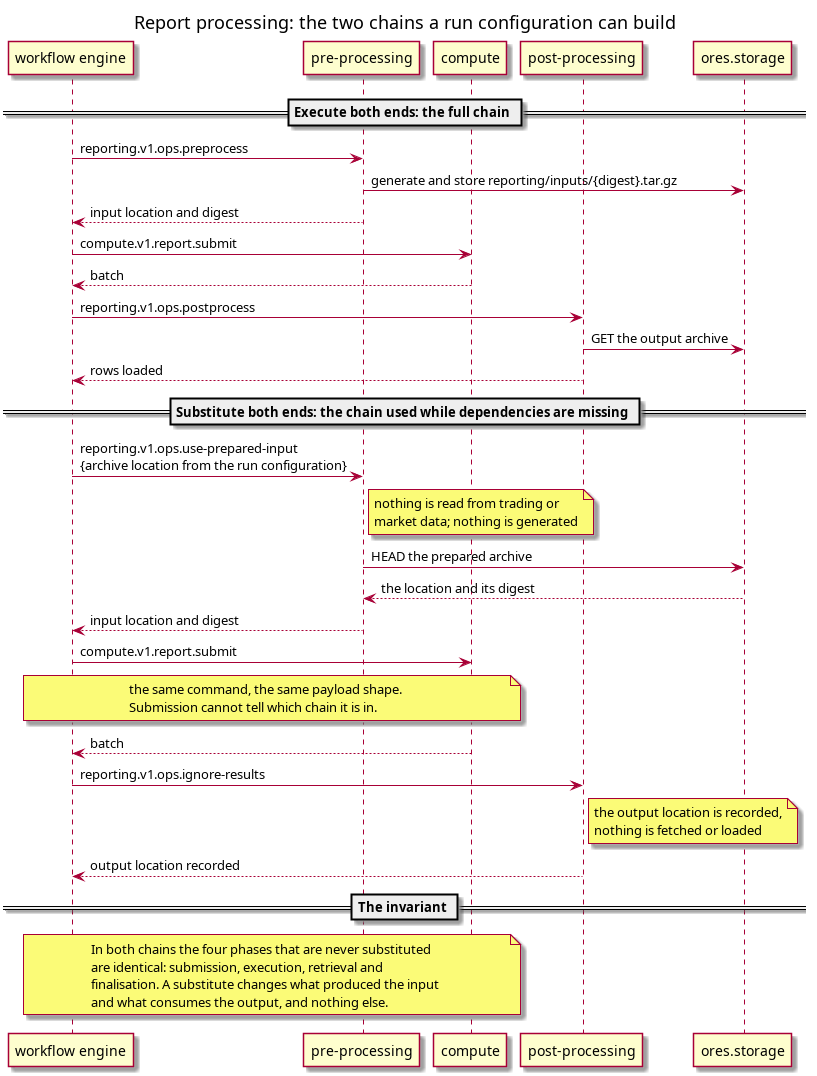
Figure 1: The two chains a run configuration can build: both ends executed, and both ends substituted. The middle is identical in each.
Source: report_execution_substitution.puml. Regenerate with
plantuml -tpng doc/knowledge/architecture/report_execution_substitution.puml.
2.2. The configuration
The run's configuration is stored with the definition, one entry per substitutable phase:
| Entry | Values | Meaning |
|---|---|---|
| pre-processing | execute, or substitute with an archive location | generate the input, or resolve a prepared one |
| post-processing | execute, or ignore | ingest the results, or record only where they are |
Storing it with the definition rather than in the environment is deliberate. A run must be reproducible from the database: an operator asking why a run produced no results should be able to read the answer from the run's definition and its instance, not from the environment the service happened to start in. It also means a definition that uses a substitute can be recognised as such before it runs, rather than only afterwards.
2.3. The pre-processing substitute
The step resolves an archive whose location the configuration names and answers with that location and its digest. Nothing is read from trading or market data and nothing is generated.
The archive must be a valid engine input. A substitute that the engine cannot run moves the failure from a missing component to a failing engine, which is a worse place to discover it, and it is the difference between a test that proves the pipeline and one that proves nothing at all.
2.4. The post-processing substitute
The step records the output location on the run and completes. The archive is not fetched, parsed or loaded.
The output must still be recorded. A run that ignores its results and does not name where they are loses them as soon as the archive expires, which converts an intentional omission into accidental data loss. Recording the location also means the substitution can be reversed later — the results are still there to be ingested by a subsequent run or by hand.
2.5. What a substitute must satisfy
- The same answer shape. The step that follows receives what it would have received from the real phase. It is not told which ran, and it must not need to be.
- The same failure behaviour. A substitute that cannot do its work fails the run in the same way the real phase would, so that the failure path is exercised too.
- Idempotence. A substitute is dispatched by the same engine and is subject to the same at-least-once delivery, so resolving the same archive twice must be the same as resolving it once.
2.6. What a substituted run proves, and what it does not
| Proves | Does not prove |
|---|---|
| the scheduler fires and the trigger arrives authenticated | that the scope is selected correctly |
| the chain built from the configuration is the chain that runs | that the trades and market data resolve |
| submission creates work the grid executes | that the engine's input is well formed |
| the engine runs and its output reaches storage | that the results are correct |
| the run reaches a terminal state through the state machine | that results can be ingested |
| a failure in any phase is compensated and recorded | — |
The right reading of a substituted run is that it tests the middle of the pipeline. The phases at the ends are exactly the ones it does not test, which is why the run must record that they were substituted.
2.7. Recording it
The instance records which phases executed and which were substituted, in the same record as the outcome. A completed instance that was substituted at both ends must never be mistaken for one that ran the whole pipeline — by an operator reading a dashboard, by a test asserting success, or by a later reader of the database.
This is the one place where the configuration affects correctness rather than convenience: without it, the mechanism that exists to test the pipeline becomes a way of reporting success for work that was never done.
2.8. What this is not
It is not a production feature. A substituted run produces no report. The configuration exists so that the pipeline can be developed and tested ahead of its dependencies, and it is expected to be used in that period and then rarely. Nothing in the design should depend on substitution to make a run work; a run that needs a substitute to complete is a run whose dependencies are missing.
3. See also
- Report Processing — the structure note that orders this cluster, and where to read this page in it.