The firing
Table of Contents
A firing is the record of one execution of a job. The scheduler writes the firing before it starts the action, so an execution that fails still has a row, and a row that cannot be written prevents the action from running. A firing has three states, and a failure stores its reason. The scheduler loop is the only writer of the firing table, and two read operations serve it: the execution list and the live status. This page defines the record, its states, and the two reads.
1. Detail
1.1. The record is written before the action
A firing stores the job it belongs to, the tenant the job runs for, the action type, the instant the firing was triggered, the instant the action started, the instant it ended, its duration, the state it reached, and the reason it failed when it failed.
The write order is deliberate. The row exists before the action runs, so the result updates a row that already exists rather than deciding whether a row exists. A reader can therefore distinguish an execution that failed from an execution that never happened: the second case is a missing row, not a row with a failure in it.
If the scheduler cannot write the row, it does not run the action. The scheduler does not run work it cannot record, and the job waits for its next occurrence.
1.2. The three states
A firing begins in starting and ends in succeeded or failed.
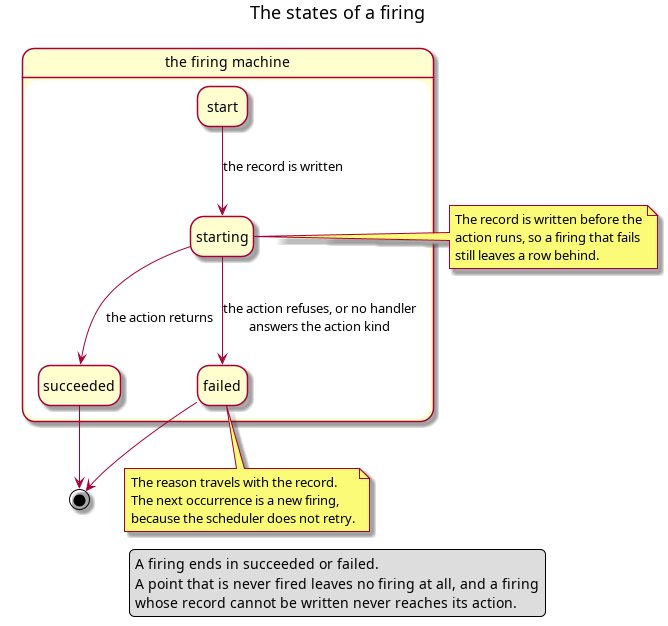
Figure 1: The states of a firing: the record is written before the action runs, and a failure stores its reason.
Source: scheduler_job_instance_states.puml. Regenerate
with plantuml -tpng doc/knowledge/architecture/scheduler_job_instance_states.puml.
starting is the state a firing holds while its action runs, and it is
the state the live status read counts as in flight. A failure stores its
reason. One failure is decided before any action is selected: a job whose
action type has no registered handler fails immediately, because the
scheduler was asked for work it cannot perform.
1.3. The record covers one execution, not the job
The job definition holds the schedule and the action; the firings hold the results. A job's execution history is its firings in chronological order, and the three states above describe one entry in that history. The loop never writes the job definition when a firing completes, so a schedule is not rewritten by its own executions.
1.4. What a firing is not
- It is not cancellable. No operation stops a firing that has begun, and the loop never revisits one. A firing ends when its action ends.
- It is not retried. A failed firing stands as recorded, and the job's next execution is the next occurrence its expression defines. The scheduler loop states why a retry would be a second firing rather than a repeat of the first.
- It does not record the result of the work. An action that starts work which outlives it is recorded by its own result, and the result of that work belongs to the component that owns it. Scheduling and workflows defines that boundary.
1.5. The two read operations
The scheduler serves two reads over the firings it has written, and they answer the two questions an operator asks of a schedule.
The execution list returns a page of firings, newest first, with the job's name and action type joined into each row. It answers what the scheduler has run, without a query per job.
The live status returns every job with its cron expression, its active flag, the time and state of its last firing, the time of its next occurrence, and the number of its firings in flight, together with the totals a monitor displays. It answers whether a schedule is in order. An inactive job has no next occurrence, and neither has an expression the evaluator cannot advance.
Both reads apply the tenant rule the record carries. A firing belongs to the tenant of its job, and the system's jobs, which serve every tenant, belong to none; a caller sees the firings of its own tenant and the firings of the system.
The firing table is an append-only execution log with a bounded retention window: older firings are dropped. It answers what the scheduler has run recently, and it is not a permanent audit record.
2. See also
- Scheduler — the structure note that orders this cluster, and where to read this page in it.
- The Open Group,
crontab— the notation that defines the instants a firing records.