The job definition
Table of Contents
A job definition is the configuration the scheduler holds: a name, a cron expression, an action type with its payload, an active flag, and the tenant and party the job runs for. The table is bitemporal. An update closes the current row and inserts the next version rather than overwriting it, and a delete closes the row without removing it. Every write states a precondition, which the store checks against the version the caller read. This page defines the fields, the write path, and how a change reaches the loop.
1. Detail
1.1. The fields
| field | meaning |
|---|---|
| job name | the natural key, unique within the tenant |
| cron expression | when the job runs |
| action type | which handler the firing selects |
| action payload | the material that handler reads |
| active | whether the job fires at all |
| tenant | the tenant the job runs for, or none for a system job |
| party | the party the job runs for, or none |
| description | free text for a reader of the job list |
The name and the tenant identify a job: the pair is unique among current rows, so a write that reuses a name updates that job rather than inserting a second one. The identifier is a UUID surrogate key, and a job with no tenant is a system job.
The store also holds the audit envelope every entity carries: the version, the account that made the change, the service that performed it, the change reason, and the interval during which the row was current.
1.2. The write path
The scheduler exposes the canonical entity protocol for job definitions.
| subject | operation |
|---|---|
scheduler.v1.job_definitions.put |
create or update one definition |
scheduler.v1.job_definitions.put_many |
create or update several in one write |
scheduler.v1.job_definitions.delete |
remove one definition |
scheduler.v1.job_definitions.delete_many |
remove several in one write |
scheduler.v1.job_definitions.list |
list the current definitions |
scheduler.v1.job_definitions.get |
read one definition by identifier |
scheduler.v1.job_definitions_versions.list |
list the stored versions of a definition |
scheduler.v1.job_definitions_versions.get |
read one stored version |
One operation creates and updates, and the precondition distinguishes them. A precondition is either "the row must not exist", which makes the write a create, or "the row must match this version", which makes it an update of the version the caller read. A change also states a change reason, which the store validates against the change-reason reference data, and the store records both the account that asked for the change and the service that performed it.
Reads and writes are tenant-scoped: the current definitions a caller lists are its own tenant's. A system job carries no tenant, and the system owns it.
1.3. Versioning and optimistic concurrency
A write does not overwrite a job definition. The store closes the current row by setting its end instant, and inserts a new row whose version is the previous version plus one and whose interval is open. The current version of a definition is therefore the single open row, and every earlier version remains stored.
The version is the concurrency control. A caller that states a version other than the current one has its write refused with a version conflict, and a caller that tries to create a row that already exists has the create refused. Two writers cannot silently overwrite each other, and a caller that reads a definition and then changes it must state the version it read.
The stored versions are readable through the version reads above, and
through the shared history read, which names the entity
ores.scheduler.job_definition. The version reads address a version by
number or by number range, and each stored version records the interval
during which it was current. Those intervals are enough to reconstruct
the definition as it stood at any instant, which is how a firing is
attributed to the definition it ran under: the firing stores the job's
identifier and the instant it was triggered, and the version whose
interval contains that instant is the one it ran under.
1.4. A delete closes the definition
A delete is a supersession with no successor: the store closes the current row and inserts nothing. The definition disappears from the current reads and its history remains.
Deleting a definition does not delete its firings. The execution record is a separate table with its own retention window, and the firings of a deleted job remain readable until that window passes.
1.5. How a change reaches the loop
The loop holds the job definitions in memory and does not poll the table. Each change is published as an event on the job-definition change subjects, one subject per action: created, updated and deleted. The loop subscribes to those events, and any of them re-reads the job set and re-arms the timer.
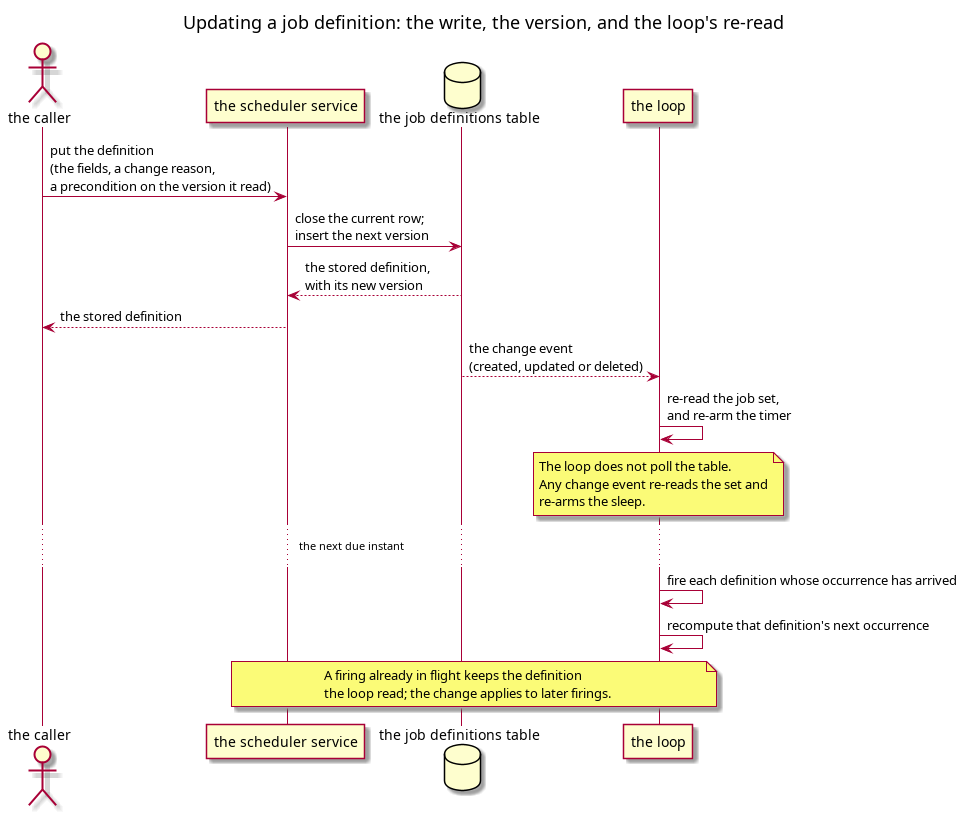
Figure 1: Updating a job definition: the write stores a new version, the change event re-reads the loop's job set, and the loop re-arms its timer.
Source: https://github.com/OreStudio/OreStudio/blob/main/doc/knowledge/architecture/scheduler_job_update_sequence.puml.
Regenerate with
plantuml -tpng doc/knowledge/architecture/scheduler_job_update_sequence.puml.
The loop re-reads the active definitions on that event and re-arms its timer, so a new or edited job is discovered at the instant it is next due rather than at a fixed grid point, and every write type travels the same path.
The loop holds a copy of each definition. A change does not affect a firing already in flight: that firing completes with the definition the loop read. The same holds for a delete, whose firing in flight still runs. The change applies to the firings that follow.
1.6. What an update changes, and what it does not
- The cron expression. The new expression applies from the job's last recorded firing, because the due condition is the next occurrence after that firing, evaluated with the current expression. A change whose next occurrence has already passed, which making a schedule more frequent can cause, makes the job due at once; the scheduler still fires it once and does not replay the occurrences it missed.
- The active flag. Setting the flag to false stops future firings. It is the only supported way to stop a job: no operation cancels a firing that has begun, and none removes a firing from the record.
- The action. A change to the action type or its payload applies to the firings that follow, and the firings already recorded keep the action type they ran under.
- The execution history. No update touches it. The firings of earlier versions stay as recorded, and the reference point for the due condition is a firing, not a field of the definition.
2. See also
- Scheduler — the structure note that orders this cluster, and where to read this page in it.
- The Open Group,
crontab— the notation the definition stores.