The tick ingest pipeline: freshness first
Table of Contents
- 1. Summary
- 2. Detail
- 2.1. The requirements
- 2.2. The pipeline
- 2.3. The broker
- 2.4. The store
- 2.5. One pipeline for every asset class
- 2.5.1. The words
- 2.5.2. The policy of a tick class
- 2.5.3. Two durability tiers
- 2.5.4. Derived data
- 2.5.5. Time
- 2.5.6. Lag and silence
- 2.5.7. Live ticks and bulk loads
- 2.5.8. Isolation and fairness
- 2.5.9. Memory
- 2.5.10. What a feed owes the pipeline
- 2.5.11. What the pipeline owes the feed
- 2.5.12. Scale beyond one process
- 2.5.13. How the design is tested
- 2.6. Tenant and party isolation of the tick table
- 3. See also
1. Summary
This note states the ingest pipeline for market ticks, the data plane of The data path. The measurements, the practice and the options behind it are in The tick ingest pipeline design record.
The pipeline puts freshness first. A tick that arrives late, while a newer tick waits, is worse than a tick that is lost. So the pipeline keeps the newest tick of each datum, it drops ticks that are too old, and it never lets a consumer wait for the store. Work is split into lanes. Each lane has one writer thread, a bounded ring buffer, a window of recent ticks in memory, and a batch write to the store. A chart or a late joiner makes one history call. The window answers the recent span from memory, and the store answers the rest. The design follows the LMAX Disruptor where that helps, and it sets the rest aside.
The target is tens of thousands of ticks each second, across every asset class and instrument: about 29,000 source ticks each second at one hundred thousand feeds, and four times that in an active market.
The pipeline is the base for all ticking data. A new feed in any asset class uses it without a change to its code. The section "One pipeline for every asset class" states what a feed owes the pipeline and what the pipeline owes the feed.
2. Detail
2.1. The requirements
- Freshness over completeness, for perishable ticks. A quote is perishable. A stale tick is worse than a missing tick. A tick that the queue loses is bad. A tick that the pipeline processes late, while newer ticks wait behind it, is worse.
- Volume. The pipeline holds tens of thousands of ticks each second, once every asset class and instrument ticks.
- The live view does not wait for the store. A chart reads the newest value at once, whatever the database does.
- Overload is visible. A lag of seconds shows on a gauge. A lag of 70 minutes cannot pass unseen.
- A fault stays in its lane. A slow or failing write for one series does not stop the others.
- No change signal for each row. A time series does not announce each new row. The live stream is the signal.
- Recent data without the store. A chart that opens, and a consumer that joins late, get recent values from memory. The store serves older data.
- A consumer receives what it watches. A consumer selects a class, a series or a datum on the broker. It does not receive every tick of its party and discard most.
2.2. The pipeline
The pipeline has a receive stage and a set of lanes. The receive stage decodes ticks and routes each one to a lane. A bounded ring buffer in each lane holds the ticks. A lane worker takes everything that has arrived and does three things with it. It publishes the newest value of each datum to live consumers, it adds the ticks to a window of recent ticks in memory, and it writes the batch to the store in one transaction.

Figure 1: The tick ingest pipeline: one path to live consumers that never waits for the store, and one batched path to the store.
Source: tick_ingest_pipeline.puml.
Regenerate with plantuml -tpng doc/knowledge/architecture/tick_ingest_pipeline.puml.
2.2.1. Receive
The NATS callback does four things and no input or output. It decodes the tick. It looks up the policy of the class of the tick. It checks the age of the tick. It writes the tick into the ring of its lane. A lane is chosen by a hash of the series key. A tick of one series always reaches the same lane, and so do all quotes of one curve. The order of a series holds without a lock, and an operation on a whole curve stays inside one lane.
Parsing an oresmd URI costs more than the rest of the receive stage. The receiver keeps a table that maps a URI string to its parsed datum, its series key and its class. The codec runs once for each datum, and a later tick of the datum costs one lookup.
2.2.2. The ring buffer
Each lane owns one ring buffer of fixed size. The slots are allocated once, and the ring is a power of two in size. A sequence number marks each slot, in the style of the Disruptor. The receiver claims the next slot and publishes it. The lane worker reads up to the newest published slot.
The ring never blocks the receiver. The receiver writes the next slot whether or not the worker has read the slot before it. The worker checks the sequence number of each slot that it reads. When the receiver has lapped the worker, the numbers show it. The worker skips to the oldest slot that is still valid, and it adds the number of skipped slots to a counter of dropped ticks. The newest tick always wins, and the writer never touches a slot that the worker is reading. A starting size is 65,536 slots for each lane. At 10,000 ticks each second in one lane, the ring holds about six seconds.
2.2.3. The age gate
Every tick has an age: the time now minus the observation_time of the tick. The
receiver drops a tick that is older than the limit of its class, and it counts the
drop. The lane worker checks again when it takes the tick from the ring. A starting
limit is 5 seconds for a live tick. The limit is a setting for each asset class.
The gate changes the order of service in one more way. A lane of a perishable class that is behind takes the newest ticks first and drops the old ones. It does not work through the old ticks.
2.2.4. Conflation and the live path
A lane worker keeps the newest tick of each datum in the batch it took. It publishes those ticks to the live consumers on the party subjects. The publish uses core NATS and waits for no acknowledgement. The live path ends here, and it never waits for the store.
The class sets a conflation interval. The lane publishes a datum at most once in each
interval, and the lane keeps the newest tick of the datum until the interval ends. The
lane publishes that last tick at the end of the interval even when no newer tick
arrives, so no value waits longer than the interval. A class with consistency of
series publishes the changed quotes of one series together at the end of a cycle.
2.2.5. The live subject
A consumer selects what it watches on the broker, so the live subject splits its tail into tokens:
marketdata.v1.ops.market_tick.<tenant>.<party>.<instrument_type>.<series_token>.<coordinate_token>
The series token is the percent-encoded series URI. The coordinate token is the
percent-encoded coordinates, or one fixed character for a series without any. A
consumer then subscribes to a class with ...<instrument_type>.>, to a series with
...<instrument_type>.<series_token>.>, or to one datum. A chart subscribes to the
series that it shows, and the broker sends nothing else.
The ingress subject is marketdata.v1.ingress.<adapter>.<id token>.
2.2.6. The recent window
Each lane keeps the recent ticks of its datums in memory. This is the real-time tier of a tickerplant system. A tick enters the window when the lane worker takes it from the ring, so the window is as fresh as the live path and does not wait for the store.
- What it holds. The last tick of every datum, always. For a datum that a consumer watches, it also holds a bounded run of recent ticks. A starting bound is the last 600 ticks or the last 10 minutes, whichever is smaller. A datum with no watcher keeps only its last tick, so the memory use follows the number of watched datums and not the number of all datums.
- Who reads it. The history call reads it. A chart that opens or reconnects, and a consumer that joins late, call for the ticks of a span that ends now. The lane that owns the datum answers the part of the span that the window covers from memory. The read checks the tenant and the party of the caller against the routes of the datum, as any read of the store does.
- How a read reaches it. The lane worker is the only writer of the window. A read is a request that the lane worker answers between two cycles from the window of its own lane. The reader never touches the window, so the single writer rule holds.
- Where it ends. A span older than the window comes from the store, and the history call joins the two in one reply. See The history call returns every tick of a range in one reply, or refuses the range.
- What it can differ on. The window holds every tick that the lane took, and the store may hold fewer when a lane is catching up or shedding. A reader that sees both prefers the window for the span that it covers.
- Restart. The window is empty after a restart and fills as ticks arrive. A chart reads the store for the span before that.
2.2.7. Batched persistence
The same cycle writes every tick that passed the age gate in one transaction, with a
multi-row insert or a COPY. One commit covers hundreds or thousands of rows.
The cost of the commit is shared by all of them.
- The series identity of each key comes from a cache in memory. A route event clears the cache. A series that does not exist yet is created on a slow path, outside the batch.
- The shape check and the manual point check run once for the batch.
- A batch that fails is split in two and tried again. The split continues until it isolates the row that the database refuses. The lane drops that row, counts it, and logs it.
- The size of a batch has a cap. A starting value is 5,000 rows.
2.2.8. The overload states
A lane measures its lag from the oldest tick that it processes. The lag selects one of three states.
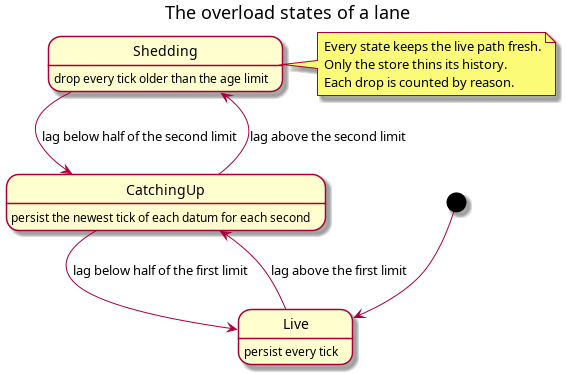
Figure 2: The overload states of a lane. The live path stays fresh in every state. Only the history in the store gets thinner.
Source: tick_ingest_overload_states.puml.
Regenerate with plantuml -tpng doc/knowledge/architecture/tick_ingest_overload_states.puml.
- Live. The lag is small. The lane writes every tick.
- Catching up. The lag is above the first limit. The lane writes only the newest tick of each datum for each second, or one bar for each datum for each second when its class keeps the extremes. The shape of the history stays, and the volume falls.
- Shedding. The lag is above the second limit. The lane drops every tick older than the age limit and counts each drop.
A store that does not answer counts as an infinite lag. The lane keeps its live path and its window. It holds a bounded number of batches, and after the second limit it sheds. It tries the connection again with a growing gap, and it writes the newest ticks first when the store returns. A shutdown flushes the open batch within a set time.
The lane goes back one state when the lag falls below half of the limit. The gap stops the lane from flipping between two states. Starting values are 5 seconds for the first limit and 30 seconds for the second. Tuning by measurement sets the final values.
2.2.9. The cycle of a lane
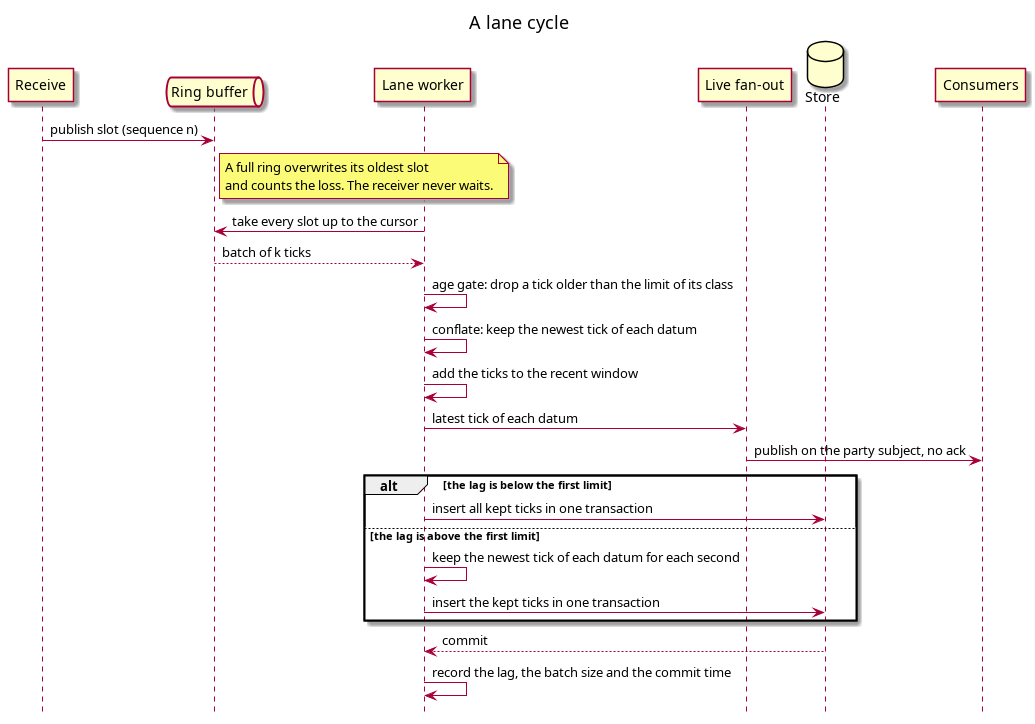
Figure 3: One cycle of a lane: take, gate, conflate, publish live, write the batch, report.
Source: tick_ingest_lane_cycle.puml.
Regenerate with plantuml -tpng doc/knowledge/architecture/tick_ingest_lane_cycle.puml.
2.2.10. Observability
Each lane reports these values to the status log and to telemetry.
- The depth of the ring and the age of its oldest slot.
- The lag from the tick time to the commit, and from the tick time to the live publish.
- The size of each batch and the time of each commit.
- The ticks dropped, by source and by reason: the ring was lapped, the tick was too old, the datum was thinned, or the database refused the row.
- The share of the time that the worker is busy, for each lane, so that an uneven split of series over lanes shows.
An alert fires when the lag is above the first limit for longer than a set time, so a lag of seconds shows within seconds.
2.3. The broker
- Perishable ticks use core NATS, on both subjects. A producer publishes a quote without waiting for an acknowledgement. The lane publishes the live tick without waiting. A producer that waits for an acknowledgement on each tick limits its own rate to the round trip of the broker, and a feed of tens of thousands of ticks each second cannot work that way.
- Perishable subjects have no stream. A stream that stored every tick would take about 170,000 writes each second at 30,000 ticks each second and 5.6 publishes for each tick, and about 100 billion messages in a week, for no consumer. The recent window of the lane serves the last value instead.
- Durable classes keep a stream. A durable class has its own stream and its own consumer, as the section on durability describes.
- Loss is counted. Core NATS drops a message for a slow client and reports it only through a callback. The receiver counts that callback. A per-source sequence number on the tick lets the receiver count the ticks that never arrived. Without both, a loss that the freshness rule allows cannot be told from a fault.
- More subjects. The tokenised live subject has one subject for each datum and party. The count of subjects is a cost in the memory of the broker and a limit to check.
2.4. The store
- No notification. A tick table has no row trigger that calls
pg_notify, and no event mapping republishes one. The change signal of the PostgreSQL architecture note tells a client to reload a copy of an entity that changes now and then. A series changes many times each second, no client can reload at that rate, and the live path already carries each new value. The model of the table sets theores.sql.schema.notify_triggerknob to false. A commit therefore never takes the notification lock, and the ingests of other databases on the same server do not wait for it. - One row for each tick. The ingest stores only the real tick. A close is a question for the reader, which asks for the latest tick at or before the end of the day. The export of ORE market data takes a valuation date and asks that question for that date, and keeps the history of the other dates. A value older than an age limit, 5 days by default, is not carried to the date, so a run does not take a stale quote for a current one. A series with no tick at or before the date has no line in the file. A development environment that needs quotes for a past date gets them from a seed or a backfill, not from the ingest.
- One row for each source. A tick is stored once, in the stream of its source, and parties read it through their series and their entitlement. See A source tick is stored once and entitled when it is read.
- A tick is an immutable fact. The observation table is bitemporal. Each row has a
valid_fromand avalid_to, and a trigger closes the previous row of the same key. That serves curated and manual points that people correct. It does not serve a tick, which nobody corrects. Ticks have their own append-only hypertable. It has no trigger and novalid_to. It has one index on the series and the time, and it stores the series and the coordinate as identifiers, not the URI text in each row. A view joins it with the observation table for a reader that wants both. - The volume. An append-only row takes 162 bytes uncompressed (The tick ingest pipeline design record). Thirty thousand source ticks each second, stored once, are about 2.6 billion rows each day. Raw ticks stay for a short window, such as a week, and a retention policy then drops the chunk. Bars of one second and one minute are kept longer. The class policy states the retention of each part.
- Compression. Closed chunks are compressed. The points carry no tenant and no row-level security, which compression requires, and the instance runs TimescaleDB under the Timescale licence, which compresses chunks and runs the policy jobs. See The tick store is bounded.
- A batch holds any stream. A point carries no tenant, so a lane writes the points of every stream it owns in one batch, and a lane's batch size follows the tick rate, not the number of tenants.
- A key is stored once. The point key (stream, time, coordinate) is unique, and a lane skips a key that is already stored, so a duplicate in a batch or a redelivered tick changes nothing. See Ticks reach the store through sharded binary COPY in bounded batches.
2.5. One pipeline for every asset class
The pipeline serves every asset class and every future feed. The rules below keep it so. The ingest sees only a source and an oresmd URI. It does not see the feed kind. So every per-class rule is keyed by what the URI names, which is the instrument type, and never by the kind of the feed.
2.5.1. The words
- A datum is one quote. Its URI names the instrument and every coordinate, such as the term of a swap.
- A series is the datum without its coordinates. The schema row of an instrument type says which fields are identity and which are coordinates. A curve whose pillars are coordinates is one series with many datums. A curve whose tenor is an identity field is many series.
- A lane key is the series. All quotes of a curve share a lane.
- Conflation, the recent window and thinning work on the datum. Ordering works on the series.
2.5.2. The policy of a tick class
A tick class is an instrument type, such as fx_spot or ir_swap. A policy table
holds one row for each class, and a default row covers every class without a row.
A lane reads the table as an immutable snapshot, and a change reaches the lane as a
message. The fields of a row are these.
| Field | Meaning | Default |
|---|---|---|
durability |
perishable or durable. See below. |
perishable |
age_limit |
The age after which a live tick is dropped. | 5 s |
conflation |
latest, none or a named reducer. |
latest |
conflation_interval |
The shortest gap between two live publishes of one datum. | 100 ms |
persistence |
all, last_per_second, bars or none. |
all, thinned when catching up |
window |
The recent ticks kept for a watched datum. | 600 ticks or 10 minutes |
overload_limits |
The two lags that change the state of a lane. | 5 s and 30 s |
consistency |
none or series. A series publishes as one consistent set. |
none |
retention |
How long raw ticks stay, and how long bars stay. | 7 days, bars for good |
silence_after |
The gap after which a source counts as silent. | 15 minutes |
A new asset class works with the default row. It needs a row only when a field
differs. That keeps the property that a new kind needs no change in the ingest. An
equity feed would set bars, because its high and low matter. An interest rate curve
would set a longer age_limit, because it ticks slowly, and consistency of series,
because a curve must not publish half old and half new quotes. A trade feed would
set durable and conflation of none.
2.5.3. Two durability tiers
A quote is perishable, and the rules above apply to it. Some ticks are not perishable.
A trade, an official fixing and a close must not be lost, and an old one is still
correct. A class of durable ticks changes the rules in four ways.
- The age gate does not apply.
- Conflation is
none. - The lane never sheds. A full ring makes the receiver wait, and the producer feels the back-pressure.
- The lane stores the batch before it publishes the batch to live consumers.
A durable tick never shares the receiver of the quotes. A full durable ring would make its receiver wait, and every quote behind it on the same thread would wait too. Durable ticks use their own entry: a JetStream consumer on its own thread that acknowledges a tick after the commit. The consumer feeds lanes of its own. Back-pressure reaches the producer through the acknowledgements, and a restart replays what the consumer did not acknowledge. Both tiers share the lane code, the batch writer and the gauges.
The first durable class is the fixing, which public sources publish once a day. A fixing skips the age check, takes a queue of its own that never sheds, and is stored in the fixings table, which keeps it for good. It does not yet take the JetStream entry above. See Public sources publish daily fixings through an adapter.
2.5.4. Derived data
Some consumers sit inside the service. The CRM bridge turns an FX spot rate into a driver update. Cross rates and blended rates are derived from observed rates. The pipeline serves them through taps.
- A tap is registered for an instrument type. It reads the conflated live output of the lanes, so it sees the newest value and never a backlog. The CRM bridge fits this. It keeps one rate and one observation time for each pair of each party, and it asks for no more.
- A tap runs outside the lanes, because a derived value can depend on inputs from several lanes.
- A derived value enters the pipeline again as a tick with its own source and
source kind
derived. It follows the same rules as any other tick.
2.5.5. Time
A tick has three times. The producer stamps the observation time. The receiver stamps the arrival time. The store records the commit time.
- The age of a tick is now minus the observation time. The age limit uses it.
- The transport lag is the arrival time minus the observation time. A large lag, or a negative one, points at clock skew between the producer and the service.
- A tick stamped in the future by more than a set allowance takes the arrival time as its observation time, and the lane counts it.
- A tick older than the newest tick of its datum is not published live. The store keeps it, because it is history.
2.5.6. Lag and silence
Two different conditions look alike to a consumer. A tick that is old is a lag. A
source that sends no tick is silence. The age limit handles the first. The second needs
its own rule. The pipeline keeps the time of the last tick of each source, and it
reports a source as silent after the silence_after of its class. Hedgr shows a
stale verdict, and the CRM bridge reports a rate as stale after 15 minutes and
disconnected after 60 minutes. Both are silence rules. They stay with their consumers.
The pipeline gives them the time of the last tick and the lag of the source, so they
need not guess.
2.5.7. Live ticks and bulk loads
The age gate and the shedding apply to live ticks only. An import of ORE market data and a backfill from a vendor are bulk loads. They use the batch writer through their own entry. They carry old observation times on purpose, and no gate drops them. The entry controls its own pace, so a bulk load does not starve the live lanes. A vendor snapshot that follows a reconnect is a live tick, with its own time.
2.5.8. Isolation and fairness
- A hot source cannot fill a ring for the others. The conflation interval limits the live rate of each datum. The lane counts drops for each source, so a hot source shows by name.
- A tick that fails to decode, or that names no datum, is counted and dropped at the receiver. It never reaches a lane.
- A lane catches an exception in a cycle, logs it, counts it, and goes on. A lane that stops is restarted, and its ring is kept.
- The tenants share lanes. A write that fails for one tenant is split off by the bisect step and does not fail the batch of the others.
2.5.9. Memory
The lane keeps one last tick for each datum. At a million datums and 100 bytes for each, that is about 100 MB, which is an estimate to check. Windows exist only for watched datums. The ring and the window are bounded, so the memory of a lane does not grow with the tick rate.
2.5.10. What a feed owes the pipeline
A producer follows these rules, whatever its asset class.
- Publish a
market_tickon the producer subject. Name the datum by its canonical oresmd URI. - Stamp the observation time from the clock of the source. Add a sequence number for each source, so that the receiver counts the ticks that it never saw.
- Publish a quote without waiting for an acknowledgement.
- Publish a series from one producer only, as the rule of series exclusivity says.
- Use an existing instrument type, or add one. A new instrument type works with the default policy row.
- Declare the expected rate and the number of datums, so that capacity is planned.
- State the durability tier. A quote needs no statement.
- Add a policy row only when a default field is wrong for the class.
2.5.11. What the pipeline owes the feed
A tick of any class reaches live consumers within the age limit of its class, or the pipeline counts it as dropped, by source and by reason. The newest tick of a datum is never behind an older one. A feed needs no code in the pipeline.
2.5.12. Scale beyond one process
One process holds many lanes. A single process has limits: one NATS delivery thread decodes every tick, and one database serves every lane. When these bind, run several ingest instances. Each takes a share of the sources, which a setting assigns, and the series key keeps one series in one instance. The lane design does not change.
2.5.13. How the design is tested
The core of a lane is a pure function of a batch, a policy and a clock. A test injects the clock and checks the rules without a broker: no tick older than its limit is published, the newest tick of a datum is never behind an older one, the memory stays bounded, and the states change at their limits. Failure injection covers a slow commit, a store that is down, a lane that throws, and a full ring. The tick injector is the load test. It becomes a tool in the repository, so that anyone can reproduce a lag.
2.6. Tenant and party isolation of the tick table
A tick belongs to a stream. A vendor's or a simulator's source stream is shared by the parties that subscribe to it. A derived or blended stream, such as a blended EURUSD made for one party from several inputs, belongs to that party. The series stays the party's own row: its key is the tenant, the party and the URI, under row-level security, and it points at a stream. The points themselves are the installation's and carry no tenant, and the unit of isolation is the series that a party reads through. See A source tick is stored once and entitled when it is read.
2.6.1. The design
- One append-only hypertable of points for each retention class. The columns are the
stream,
ts,coordandvalue. It has no tenant column, no trigger, novalid_to, a unique key on stream, time and coordinate, and no row-level security. Retention drops whole chunks by time, so a class with a different retention needs its own table. The number of tables follows the policy table and does not grow with the tenants. - Compression. Closed chunks are compressed, segmented by stream and ordered by time. See The tick store is bounded.
- Grants, not policies. Only the marketdata service's roles hold grants on the streams and the points. A tenant's session holds none.
- A writer role with
INSERTonly. It writes with binaryCOPYand has noSELECT. See Ticks reach the store through sharded binary COPY in bounded batches. - Readers check entitlement. The history read checks, in the party's tenant and under row-level security, that the party's series names the stream and that the party may read it, then reads the points with the service's own role.
- Hot reads skip the table. A chart and the latest value come from the recent window and the live subject. The subject has the tenant and the party.
- A derived series enters through the same door. The blending service reads its inputs on the live path, in the context of the party. It emits ticks for the party's derived stream into the same lane and the same writer.
3. See also
- The ingest loop and the one pipeline, the loop that runs this pipeline.
- The market tick, the type that the pipeline moves.
- Series and observation, what the store holds.
- A chart reads a series with one history call and one live subscription, how a client reads the window and the store.
- The history call returns every tick of a range in one reply, or refuses the range, the contract of that read.
- A party takes a provider's feeds through a subscription, the source of the fan-out.
- Market Data Architecture, the hub for this cluster.