The step protocol
Table of Contents
- 1. Detail
- 1.1. The caller opens an instance with one start message
- 1.2. What the component diagram shows
- 1.3. The definition declares the whole chain
- 1.4. The definition builds the step list from the request alone
- 1.5. The engine dispatches a command the handler can trust
- 1.6. The handler answers with a completion event
- 1.7. A later step reads the results of the steps before it
- 1.8. An instance ends when its last declared step completes
- 1.9. A failed step either compensates or stops for a retry
- 2. Patterns used
- 3. See also
A workflow is a two-message protocol: the caller publishes a start message, the handler publishes a completion event, and the workflow engine, as the process manager, derives every step command from a registered definition rather than from an executor written for one workflow type. This note states the design the engine honours: what the start message carries, what the definition declares, how the engine builds its step list, what the command tells the handler, the results a later step may read, and the positional end of the instance. See idempotency in a workflow step and failure, compensation and retry.
1. Detail
1.1. The caller opens an instance with one start message
The caller starts an instance by publishing start_workflow_message to
workflow.v1.ops.start_workflow. The message is fire-and-forget, and the fields it carries are
drawn below.
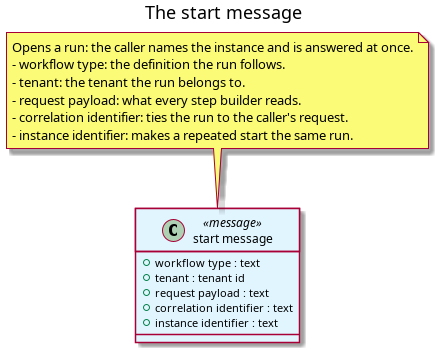
Figure 1: The start message and the fields that carry meaning: the workflow type, the tenant, the request payload, the correlation identifier and the optional instance identifier.
Source: workflow_start_message.puml. Regenerate with
plantuml -tpng doc/knowledge/architecture/workflow_start_message.puml.
The caller-supplied identifier is what makes a retried start the same run. A non-empty identifier becomes the instance uuid, and a second start bearing an identifier that is already known is that same instance, which the engine notes and leaves unchanged; an empty identifier gets a fresh uuid.
A start the design cannot use is refused: an unknown workflow type, a tenant that is not a uuid, a step list the definition fails to build, or an empty step list. An accepted start keeps the request, the correlation identifier and the step count, so that every later builder call works from the same material.
1.2. What the component diagram shows
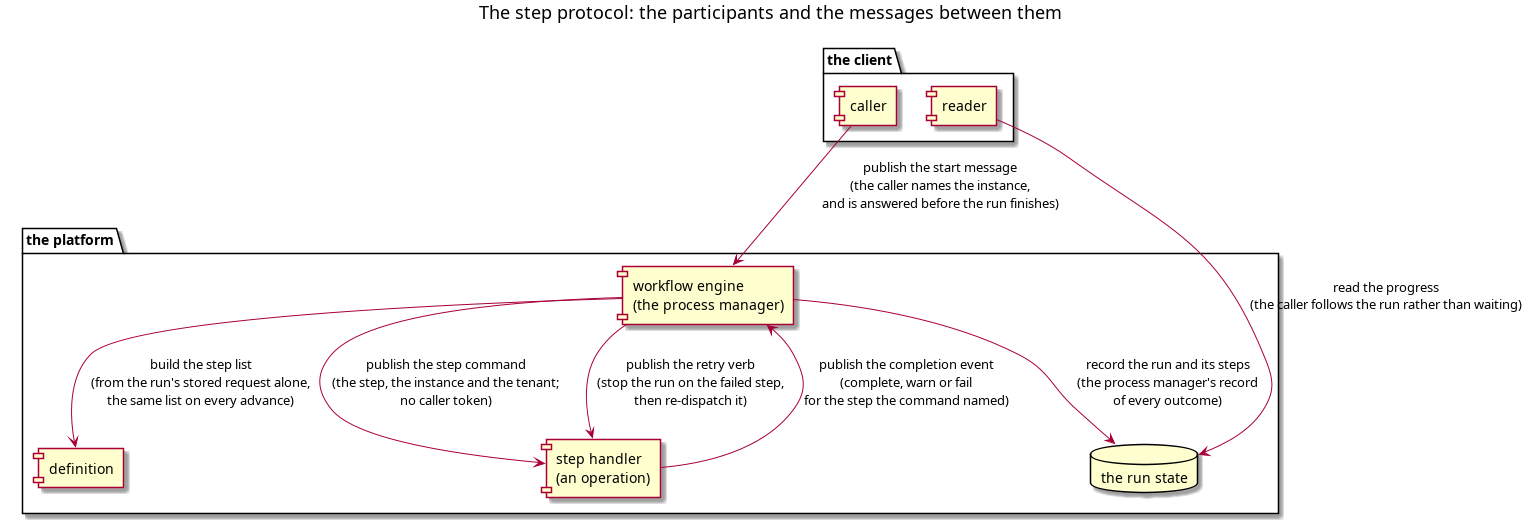
Figure 2: The step protocol: the caller, the process manager, the definition, the step handler, the run state the platform persists and the reader. Each connector carries the message it names and its objective.
Source: workflow_step_protocol.puml. Regenerate with
plantuml -tpng doc/knowledge/architecture/workflow_step_protocol.puml.
The diagram places the process manager at the centre of the protocol. The caller starts a run with one message and is answered at once; the definition supplies the ordered step list; the process manager stamps each step command with the three identifiers the handler needs; the handler reports one outcome; and the reader follows the run from the state the platform persists.
1.3. The definition declares the whole chain
A definition declares the workflow type its starts are matched against, a description, and the step list. Each declared step carries a name, the identity that addresses its result; a command subject; a compensation subject, absent when the step has no rollback; a builder for its command payload, which turns the request and the results so far into that payload; and a builder for its compensation payload, which turns the original command and the step's result into the rollback.
1.4. The definition builds the step list from the request alone
The engine, as the process manager, builds the step list at start and again on every advance, always from the instance's stored request, the tenant and the correlation identifier. The protocol admits nothing else, so no completed step's result reaches the builder. That is the guarantee the design demands: a definition cannot depend on anything the engine does not hold when it builds the list.
The list must be the same on every advance, because an advance dispatches the step at the next position out of the list just built. The engine guards that invariant by recording what the definition declared at start and comparing each rebuild against it, so a differing list is caught rather than obeyed.
1.5. The engine dispatches a command the handler can trust
The engine persists the step before it publishes, and sends the command to the subject the step declares, exactly as declared. The publish is fire-and-forget: it carries no reply inbox and no acknowledgement.
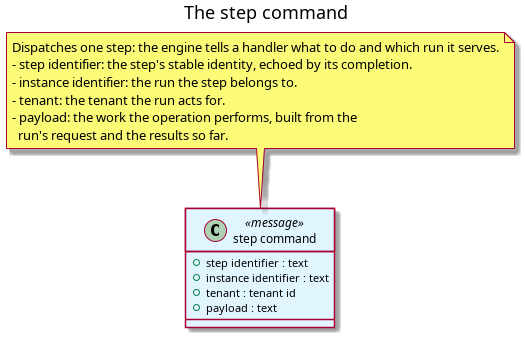
Figure 3: The step command and the fields that carry meaning: the three identifiers the engine stamps on the step, instance and tenant, and the payload the operation performs.
Source: workflow_step_command.puml. Regenerate with
plantuml -tpng doc/knowledge/architecture/workflow_step_command.puml.
The command carries the three identifiers of the step, the instance and the tenant. It carries no caller token, so the handler cannot authenticate as the caller, and the actor stays on the step's record as its last modifier.
1.6. The handler answers with a completion event
The handler publishes step_completed_event to workflow.v1.ops.step_completed,
and the step identifier it carries echoes the one on the command. The three headers
on the command tell it which run it serves and which step it answers for.
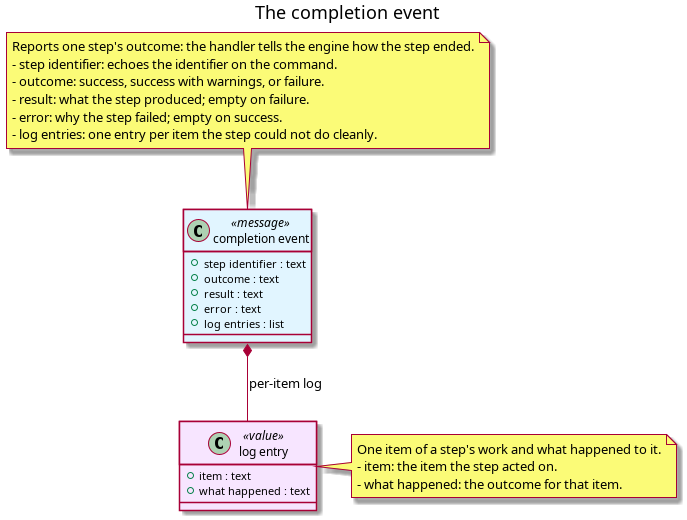
Figure 4: The completion event and the fields that carry meaning: the step identifier it echoes, the outcome, the result, the error, and one log entry per item the step could not do cleanly.
Source: workflow_step_completion.puml. Regenerate with
plantuml -tpng doc/knowledge/architecture/workflow_step_completion.puml.
The completion reports one of three outcomes: success with a result, success with warnings, which adds per-item log entries, or failure, which carries an error and an empty result. The engine treats success and success with warnings as success and dispatches the next step, while failure begins compensation. It drops a completion it cannot place — one for a step it does not know, and one for a step that is no longer in progress — so a duplicate or a late completion is harmless. See idempotency in a workflow step.
1.7. A later step reads the results of the steps before it
A step's command builder receives the instance's request and the results so far. Each result carries the name of the step that produced it and a response, and a later step addresses an earlier result by that name, never by position; a step that returns nothing contributes nothing, and a failed step is never built past.
1.8. An instance ends when its last declared step completes
An advance takes the step after the instance's current position; once that position passes the last stored step, the engine marks the instance complete with the last step's result and publishes a status event. Completion is therefore positional: the run stops because it exhausted the steps its definition declared, and no further step is dispatched.
There is no completion hook. A definition that must act at the end declares that work as a step and places it last. The states are catalogued in the instance and step states.
1.9. A failed step either compensates or stops for a retry
A definition declares the policy its failed step follows. Under the compensate policy the engine moves the run to compensating, walks the completed forward steps in reverse, and publishes each one's compensation subject until the run is compensated, so the run undoes its completed work. Under the stop-and-retry policy the engine parks the run on the failed step, keeps the completed steps, and waits for a retry verb, so the work that succeeded is not thrown away.
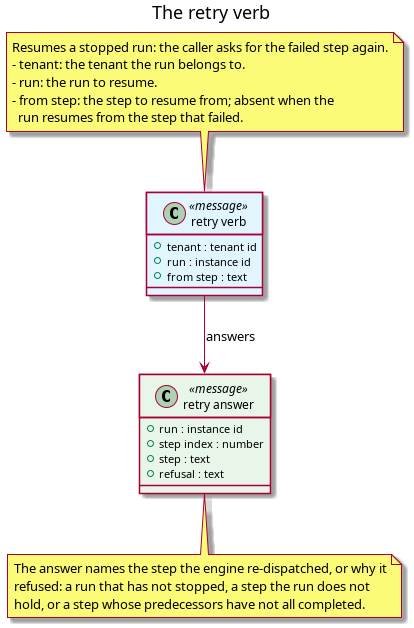
Figure 5: The retry verb and the fields that carry meaning: the tenant, the run to resume, and the optional step to resume from.
Source: workflow_retry_verb.puml. Regenerate with
plantuml -tpng doc/knowledge/architecture/workflow_retry_verb.puml.
A caller sends the retry verb to resume a stopped run. It names the run, and it may name the step to resume from. The run's state is the platform's record of what has already happened, so a retry resumes from that record rather than from the caller's memory of it. See failure, compensation and retry.
2. Patterns used
- Process Manager — the engine builds the step list from the request, dispatches each step and records each outcome.
3. See also
- Workflows — the structure note that orders this cluster, and where to read this page in it.