Currency Lifecycle
Table of Contents
1. Summary
A currency has a lifecycle of its own, at a level of abstraction above the individual banknotes and coins that circulate within it: it is "born" when created and put into circulation, "lives" while in general use, and "dies" when formally withdrawn, though transaction records made during its life must still be retained afterward. The pattern is fractal, repeating at the level of the currency itself, at the level of its denominations, and at the level of individual note/coin instances. It is tempting to treat this as too slow-moving to matter for a trading or booking system, but redenominations, currency replacements, and the forming or dissolving of monetary unions occur more often than expected and rarely leave time for careful operational planning, so a system that has not anticipated them can be significantly disrupted when one occurs.
2. Detail
2.1. Birth, life, and death of a currency
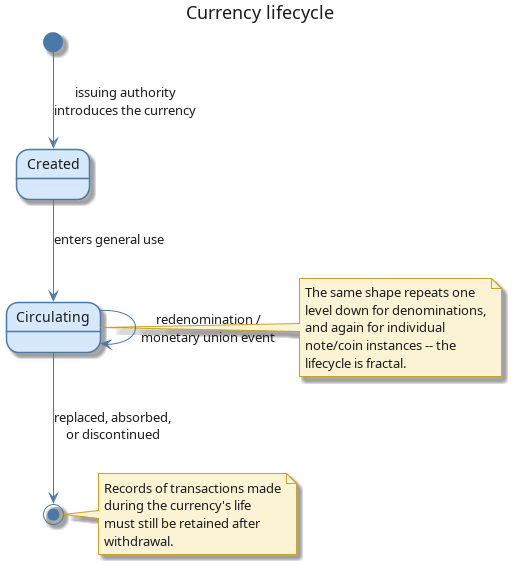
Figure 1: Currency lifecycle: creation, circulation (looping through redenomination and monetary-union events), and eventual withdrawal.
Source: currency_lifecycle.puml. Regenerate with
plantuml -tpng doc/knowledge/domain/currency_lifecycle.puml.
A currency is created and enters circulation, remains in general use for as long as its issuing authority and the public that accepts it sustain the underlying convention described in Money, and is eventually withdrawn – whether replaced by a successor currency, absorbed into a monetary union, or simply discontinued. Unlike the practical, day-to-day questions Currency's other spokes address (which currency a book revalues in, which currency an option premium is paid in), this lifecycle operates at the level of the currency as a whole rather than any single position denominated in it – yet its consequences reach every position outstanding at the moment of transition.
2.2. A fractal pattern
The same birth-life-death shape recurs at three nested levels: the currency itself (introduced, circulated, withdrawn), its denominations (a given note or coin value introduced or discontinued independently of the currency surviving), and individual physical instances (a specific note or coin entering circulation, changing hands, and eventually being retired or destroyed). Recognising the pattern as fractal is what keeps "currency lifecycle" from being mistaken for a single, currency-wide, all-or-nothing event – a currency can retire one denomination while continuing to exist, just as it can survive a redenomination that changes every denomination at once.
2.3. Why this matters operationally
Currency-lifecycle events are easy to dismiss as too rare and too slow-moving to warrant deliberate handling in a trading or accounting system, but redenominations, currency replacements, and monetary unions forming or dissolving happen with more regularity than that dismissal assumes, and they rarely come with enough advance notice for careful operational planning. A system not designed to anticipate such an event – positions, reference data, and historical records all still keyed to a currency code that has just been withdrawn or redefined – can be significantly disrupted precisely when it occurs. The comparison worth holding onto is the book lifecycle: both a currency and a book move through an open/active/closed-or-retired progression, but at very different levels of the domain – one describing an accounting entity's life, the other describing the life of the unit of value that entity's records are expressed in.
3. See also
- Currency – hub note.
- Money – the underlying convention that a currency's "life" depends on staying credible.
- ISO 4217 Currency Codes – the standard whose code assignments this lifecycle can outlive or invalidate.
- Book lifecycle – the parallel open/active/closed progression at the level of a trading book rather than a currency.