Operational Authorisation Queue
Table of Contents
1. Summary
The operational authorisation queue is the screen on which Operations works. Every trade passes through it, and operational authorisation covers what the control is and why it exists.
It is a deal queue specifically. Other authorisation queues exist elsewhere in the system, the fixing manager being the clearest, and they are not this one.
2. How the queue is organised
The primary division is by complexity, because the two halves are worked differently.
| Class | Contents |
|---|---|
| Flow | Spot, forward, cash, vanillas, interest rate swaps |
| Non-flow | Everything more complex |
Within each, deals are grouped by their state: awaiting authorisation, held over, amendments, new, authorised and denied, with an all-trades view alongside.
Ordering is by recency, with one override: a non-exercised trade approaching expiry appears at the top, in red. The queue prioritises by urgency rather than by arrival alone, because an option that expires unexercised while sitting in a queue is a loss that the queue caused.
3. The operational authorisation lifecycle
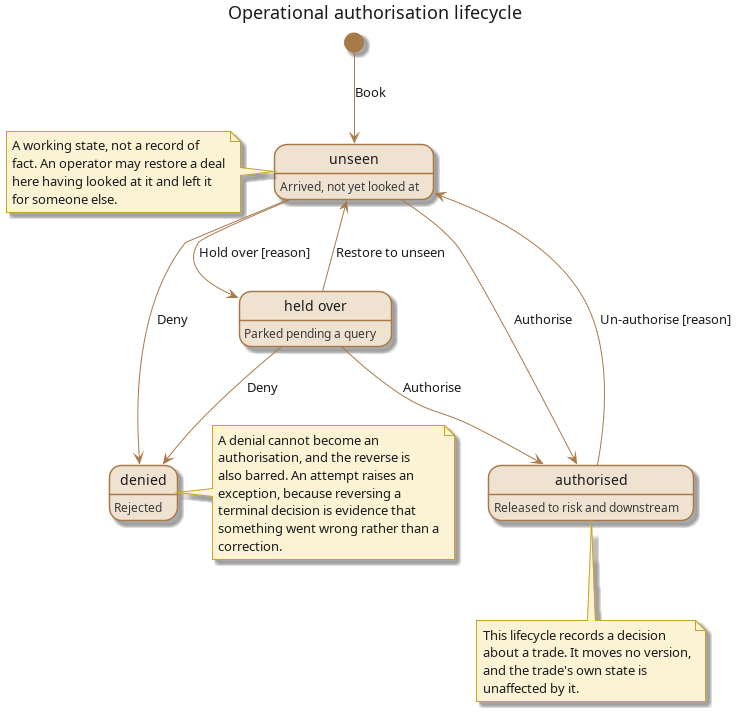
A trade's operational_authorisation_status moves through this
lifecycle. It is not a state of the trade itself:
the trade lifecycle runs alongside and is unaffected by it.
| State | Meaning | Exit |
|---|---|---|
unseen |
Arrived, not yet looked at | Authorise, deny, or hold over |
held_over |
Parked pending a query | Authorise or deny once resolved |
authorised |
Approved; visible to risk and downstream | Un-authorise, with a reason |
denied |
Rejected | None; authorising raises an exception |
unseen is a working state rather than a record of fact. An operator
may restore a deal to unseen, having picked it up, looked at it, and
left it for someone else.
3.1. A denial cannot become an authorisation
The prohibition is deliberate and is the most informative rule in the queue. A deal cannot move from denied to authorised, and an attempt raises an exception. The reverse is also prohibited.
The reasoning is that reversing a terminal decision is not a correction but evidence that something went wrong, and is worth surfacing rather than absorbing. The route back is an explicit un-authorise carrying a reason, which is an undo rather than a second decision.
That distinction runs through this corpus. Trade activity treats an undo as a mirror rather than a deletion, for the same reason.
3.2. Held over is a suspension, not a rejection
A deal is held over pending information: a query on the margin a customer holds, a question on the sales ticket, an awaited amendment.
The reason is chosen from an enumeration rather than typed, and the enumeration is revealing. Most of its entries are not doubts about the trade at all but handover markers between regional teams: asia to authorise, london to follow, new york order. The queue is doing double duty as a follow-the-sun workflow.
Holding a trade over carries risk in both directions, and both are real. A genuine trade held over is a binding agreement carrying unmanaged risk hidden from the traders. A trade that is not genuinely ours needs to come off the books rather than sit in a queue. Trade classification covers the second case.
Two reports follow: the time a deal has been held, and a held-over report listing what stayed in the queue overnight, with reasons.
4. What the operator sees
Fields that have changed are highlighted, which is what makes an amendment reviewable rather than merely visible.
A structure displays all its components. Operational Authorisation covers why a typed structure authorises as a whole.
Each deal carries its settlements and confirmations, with their own flags and comments, and may be marked off for premium or expiry netting.
4.1. Comments are always required
A denial requires a comment, and so does a hold. The notes go further: comments are always required, including on an authorisation.
An amendment additionally carries a reason code and a department, and an operational error flag. That flag is the one that earns its place: it separates a trade that changed for a business reason from one that was booked wrongly, which is what makes an error rate measurable rather than anecdotal.
Some reasons require escalation, where a head of desk must authorise the change rather than the usual approver. Trade versioning covers the reason codes themselves.
4.2. Concurrency is a notification, not a lock
A new version may appear while an operator is still authorising the previous one. The queue notifies and offers a refresh rather than locking the deal.
That is a deliberate choice about who waits. A lock would block the trader from amending while Operations reads, which inverts the priority between booking and checking.
5. Auto-authorisation
Not everything needs a person. Counterparties and product types may be marked for auto-authorisation by rule, and Operations configures the rules.
One case is not configurable: an exercised deal authorises automatically. An exercise is a system-generated consequence of an already-authorised option meeting an observed fixing, so there is no new human decision to check.
Auto-authorised deals still produce their own report, so the exemption is visible rather than silent. That is the pattern throughout: an exception to a control is recorded, not hidden.
6. Exception flags that cause a hold
The queue sits alongside other categories Operations monitors, and these frequently cause a deal to be held.
| Flag | Meaning |
|---|---|
| Late | Saved or executed past a cut-off |
| Off-premises | Executed somewhere other than the trader's agreed location |
| Out of hours | Outside regional business hours, at a weekend, or on a public holiday |
| Unconfirmed | Not confirmed, or confirmed too late |
The first three are about the circumstances of booking rather than the terms of the trade, which is what distinguishes this control from the agreement steps.
7. Reports
| Report | Purpose |
|---|---|
| Unauthorised trades | By recency, one row per structure |
| Auto-authorised deals | Visibility of what bypassed human review |
| User authorisations | Authorisations by user |
| Errors prior to authorisation | Errors noted against the authorisation |
| Held over report | What stayed in the queue overnight, with reasons |
| Post trade amendments and cancellations | Changes after the trade date |
| Same day amends and cancellations | Booked and modified the same day |
Structures collapse to a single row in each, which is the reporting counterpart of authorising a structure as a whole.
8. Open questions
- Whether
unseenandheld_overbelong to the same enumeration asauthorisedanddenied, given the first two are working states an operator sets and the second two are decisions. - Whether un-authorise returns a deal to
unseenor to a distinct state that records the reversal. - Whether a denied trade should be removed from the book, since it
remains
livein the trade lifecycle while carrying a decision that it should not stand.
9. Sources
Drawn from internal analysis notes on authorisation, which summarise requirements material. No external standard is cited.
10. See also
- Trade — the structure note that orders this cluster, and where to read this page in it.
- Operational Authorisation — what the control is and why it exists.
- Trade Lifecycle — the trade's own states, which this lifecycle runs alongside.
- Trade Blotter — the front-office screen this one checks the work of.
- Trade Activity — the events an authorisation approves.
- Trade Classification — the controls guarding the same boundary.
- Knowledge — the hub of all knowledge notes.