Access Token
Table of Contents
This page defines the service architecture pattern Access Token in the pattern language. Every request carries a token that securely identifies the requester, and each service verifies it without calling the issuer. In ORE Studio the token is a JWT that IAM signs. It carries the tenant, the party, the visible parties and the permissions that row-level security and the permission checks use.
1. Also known as
- Bearer token, in RFC 6750, which defines how a token travels on a request.
- Session token, the name ORE Studio uses for the token a login returns.
2. Context
The platform is a set of services behind an edge, the HTTP gateway and the NATS bus. A request enters at the edge and can pass through several services before it reaches the store that answers it. Each service checks permissions, and the database applies row-level security by tenant and party.
3. Problem
How does every service that handles a request know who the requester is, and what the requester may do?
4. Forces
- A call to the issuer on every request makes the issuer a bottleneck and a single point of failure.
- A service must not trust an identity it cannot verify.
- The identity must reach the database, because row-level security decides which rows a query sees.
- An identity that cannot expire is a permanent credential once it leaks.
5. Solution
The issuer signs a token at login. The token states the subject, the tenant,
the party, the visible parties, the permissions and an expiry. Every request
carries it in the Authorization header. Each service verifies the signature
with the issuer's public key, which it fetches once, and checks the expiry. It
then builds a request context from the claims, checks the permission the
operation needs, and sets the tenant and the party on the database session.
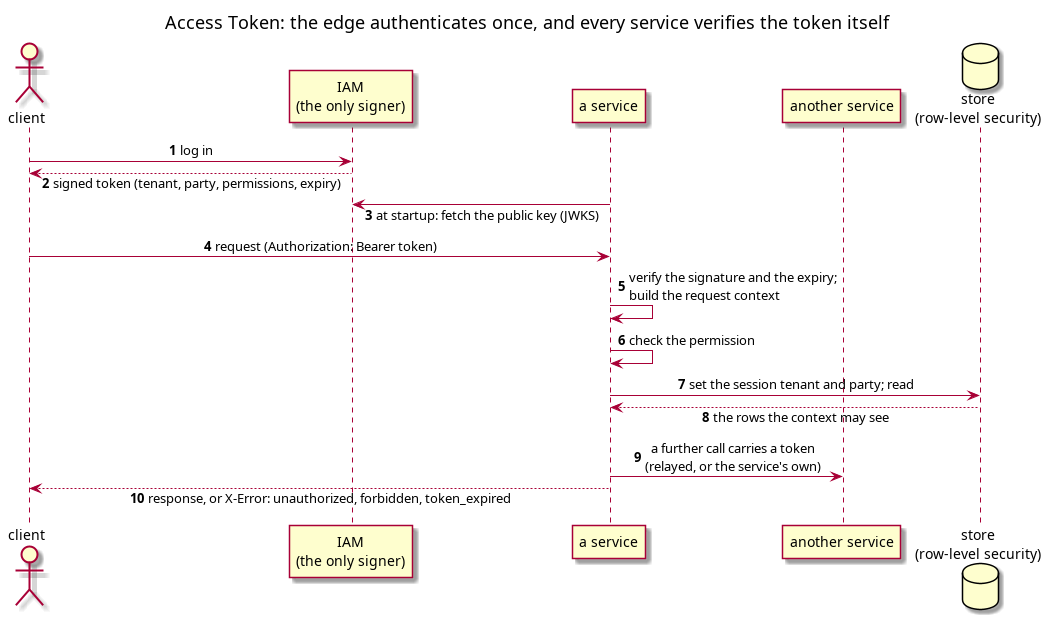
Figure 1: Access Token: the client logs in once, each service verifies the token with the issuer's public key, and the database filters rows by the tenant and the party in it.
Source: [[./pattern_access_token.puml][pattern_access_token.puml]]. Regenerate with
plantuml -tpng doc/knowledge/service_architecture_patterns/pattern_access_token.puml.
The claims decide everything downstream. The request context takes them, the database session takes the tenant and the party, and the audit columns take the username.
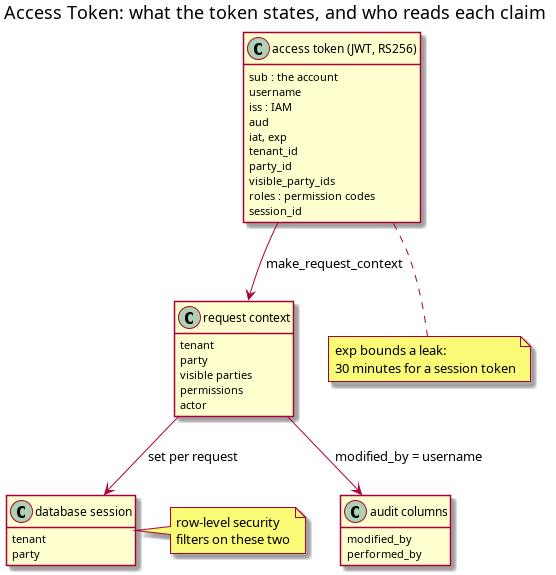
Figure 2: Access Token: the claims the token states, and where each one goes: the request context, the database session that row-level security reads, and the audit columns.
Source: [[./pattern_access_token_claims.puml][pattern_access_token_claims.puml]]. Regenerate with
plantuml -tpng doc/knowledge/service_architecture_patterns/pattern_access_token_claims.puml.
6. Failure handling
A service refuses in a fixed order, and each refusal has its own code. Only
token_expired is worth a retry, and only after a renewal.
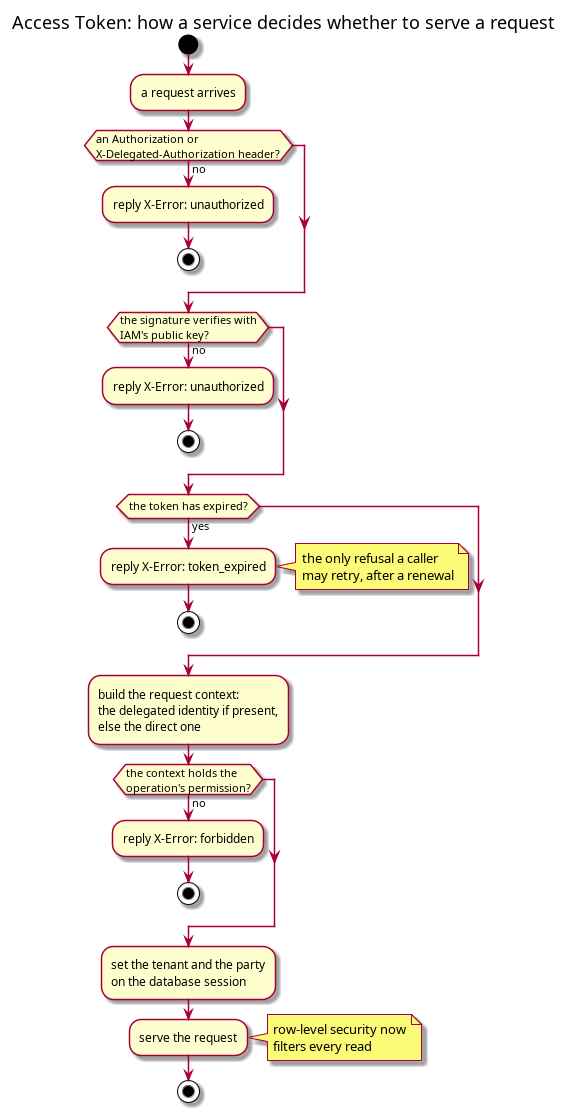
Figure 3: Access Token: the checks a service makes in order, the code each refusal carries, and the point where row-level security takes over.
Source: [[./pattern_access_token_verification.puml][pattern_access_token_verification.puml]]. Regenerate with
plantuml -tpng doc/knowledge/service_architecture_patterns/pattern_access_token_verification.puml.
| Concern | What the pattern does |
|---|---|
| Errors | A missing token answers unauthorized. A token without the permission answers forbidden. The reply has an empty body and an X-Error header, and a client reads the header before it decodes the body. |
| Timeouts | Does not apply to verification, which is local. The key fetch at startup has its own timeout, and a service with no key refuses every request. |
| Retries | An X-Error: token_expired reply is retried once, after a refresh. Every other refusal is final: the same token gets the same answer. |
| Idempotency | Does not apply. Verification has no effect. |
| Observability | The subject, the tenant and the party of the context are on every log line of the request. A refusal logs the reason and the subject. |
7. Pitfalls
- A refusal decoded as a body. A client that decodes the reply before it reads
X-Errorreports a decode error. The real cause is an authentication failure. See Anatomy of a Service. - The wrong algorithm at the edge. IAM signs with RS256. An edge that verifies another algorithm refuses every token, and the failure looks like a permission bug. See Service-to-service auth.
- A second verifier "as a fallback". A shared secret beside the public key is a second way to be believed. It authenticates nothing legitimate and widens what a stolen secret can do.
- A token stored as state. A token in a row, a queue archive or a workflow instance outlives its request and becomes a credential at rest.
8. Security
The token is a bearer credential: whoever holds it acts as its subject until it expires. Its lifetime bounds the cost of a leak, which is 30 minutes for a session token by default. Only IAM signs, so a service that is compromised cannot forge a token for another subject. The permissions in the token are a snapshot, so a revoked permission takes effect at the next token.
9. Resulting context
- Benefits
- Services verify identity with no call to IAM. The tenant and the party reach the database on every request, so row-level security applies to every read.
- Liabilities
- A token cannot be revoked before it expires. A change to an account's roles reaches its sessions only at their next token.
10. In ORE Studio
- Signing. IAM signs with RS256 and publishes its public key through JWKS. The
claims are
jwt_claimsinores.security: subject, tenant, party, visible parties, roles, expiry. - Lifetime.
token_settingsinores.iam.core: an access lifetime of 1800 seconds, renewal at 80% of the lifetime, and a session ceiling of 8 hours. - Verification.
make_request_contextinores.servicebuilds the request context, andhas_permissionchecks a permission. - The edge. The HTTP gateway verifies with the same key and never signs. See Service-to-service auth.
- The database. Multi-Tenancy Architecture sets the session's tenant and party, and PostgreSQL Row-Level Security filters on them.
- Object storage. Storage policy mints an object capability the same way: a signed, short-lived token whose claims name the buckets and key prefixes a caller may touch, verified by the storage service against the same published key.
11. Related patterns
- Client Credentials — how a service obtains an access token for itself.
- Token Relay — how a service passes the caller's access token on.
- Token Exchange — how a service obtains a different access token for a purpose.
12. Sources
- Chris Richardson, Pattern: Access token, microservices.io.
- RFC 7519, JSON Web Token.
- RFC 6750, OAuth 2.0 Bearer Token Usage.
- RFC 7517, JSON Web Key — the key set a verifier fetches.
13. See also
- Service architecture patterns — the structure note that orders this pattern language, and where to read this page in it.