Grant Management
Table of Contents
This page defines the service architecture pattern Grant Management in the pattern language. The issuer holds a person's consent as a grant with an id, and a client uses, queries and revokes it by that id. In ORE Studio IAM holds the run grants that let scheduled work act as a tenant and a party long after the person who scheduled it signed out.
1. Also known as
- Run grant, the name the reporting design uses for its grants.
- Stored consent or standing delegation.
- The offline access refresh token of RFC 6749 solves the same problem with a long-lived credential the client holds. This pattern keeps the consent on the server instead.
2. Context
A person starts work that will run later and repeatedly, such as a scheduled report. When it runs, the person is not present and their token has expired. The work must still act within the person's authority and no wider.
3. Problem
How does work that runs without its owner present act with the owner's consent, without the client holding a long-lived credential?
4. Forces
- A stored token is a credential at rest, and a refresh token is a long-lived one.
- The consent must be revocable, and revocation must reach the work soon.
- A person must not grant more than they hold, and must lose it when they lose the permission.
- The client must refer to the consent in messages and rows that are not secret.
5. Solution
The client asks the issuer to create a grant, on behalf of the person and with the person's token. The grant names the person, the tenant and the party, the scope, the resource it serves and the services that may use it. The issuer checks that the person holds the scope, stores the grant, and returns its id. The client stores the id. The id is not a credential: using it needs the client's own token as well, through Token Exchange, and the issuer re-checks the grant and the grantor each time. The client revokes the grant when the work ends.
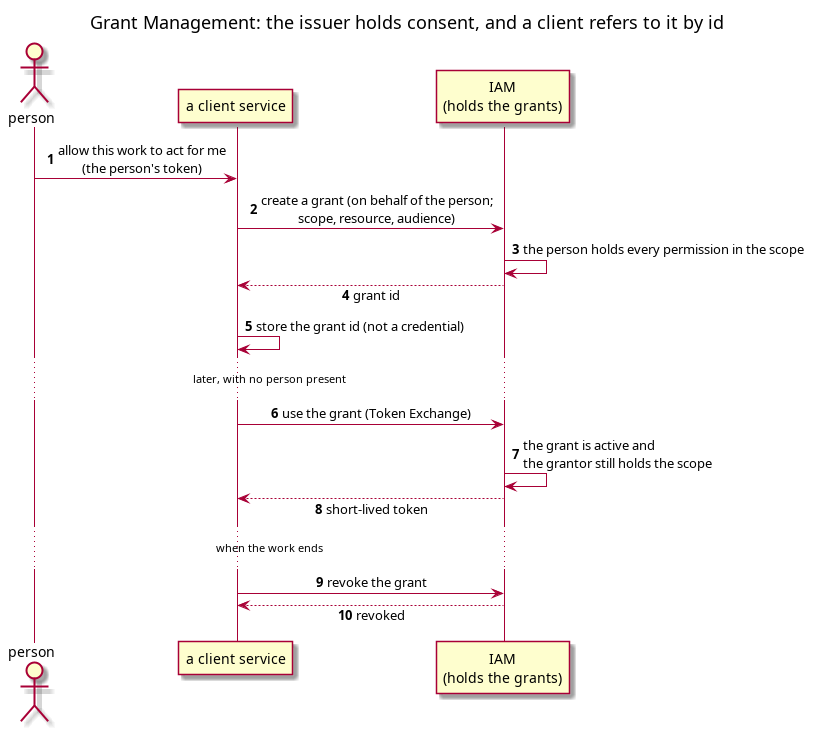
Figure 1: Grant Management: a person's consent becomes a grant held by IAM, used later through Token Exchange and revoked when the work ends.
Source: [[./pattern_grant_management.puml][pattern_grant_management.puml]]. Regenerate with
plantuml -tpng doc/knowledge/service_architecture_patterns/pattern_grant_management.puml.
A grant has a lifecycle of its own. It ends by revocation, by its last permitted use or by its time limit. A grantor who left or lost the scope does not end the grant: each use is refused until the owning service revokes it.
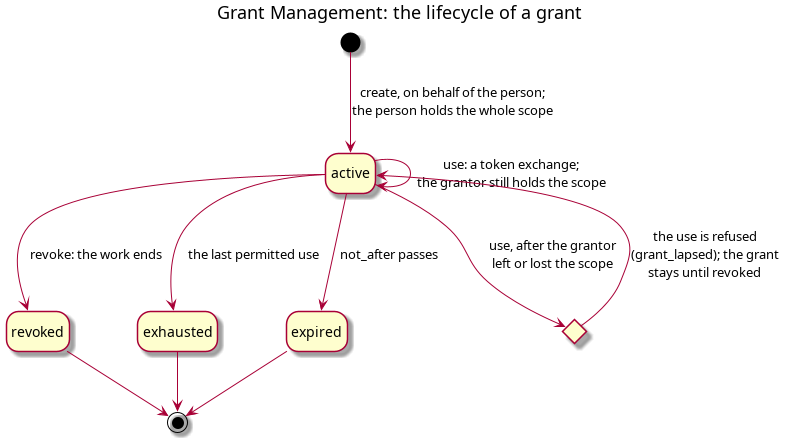
Figure 2: Grant Management: a grant is created active, is used through exchanges, and ends revoked, exhausted or expired. A lapsed grantor refuses each use and leaves the grant active.
Source: [[./pattern_grant_management_states.puml][pattern_grant_management_states.puml]]. Regenerate with
plantuml -tpng doc/knowledge/service_architecture_patterns/pattern_grant_management_states.puml.
6. Failure handling
| Concern | What the pattern does |
|---|---|
| Errors | A use of a revoked, expired or lapsed grant answers forbidden with the reason. A lapsed grant is one whose grantor is inactive or no longer holds the scope. The client stops the work and asks a person for a new consent. |
| Timeouts | Create and revoke are requests with a timeout. The work that uses a grant follows Token Exchange. |
| Retries | Create is idempotent for a resource and a grantor, so a retry returns the active grant. Revoke is idempotent. |
| Idempotency | A second create for the same resource and grantor returns the active grant. A second revoke changes nothing. |
| Observability | The issuer records who created, used and revoked each grant, and why a use was refused. |
7. Pitfalls
- A grant id treated as a secret. The id appears in messages and rows. Safety comes from requiring the client's own token and an audience check, not from hiding the id.
- A grant that never lapses. Checking the grantor only at creation lets a person who has left keep acting through their grants. Check at every use.
- Revocation forgotten. A deleted schedule whose grant stays active is standing authority nobody uses. Revoke with the work, and reconcile grants against the work that should hold them.
- A grant wider than the work. A grant with the person's whole role is a session in disguise. Grant a role made for the work.
8. Security
A grant is authority without a credential. It is only as strong as the checks at use: the actor must hold the exchange permission and be in the grant's audience, the tenant must match, and the grantor must still hold the scope. A stolen grant id alone is useless. A compromised service in the audience can use the grants that name it until they are revoked, and the issue log records each use.
9. Resulting context
- Benefits
- Work acts with a person's consent for months, with no stored credential. Revoking the grant, or deactivating the person, stops it.
- Liabilities
- The issuer stores and checks grants, so it gains state. A revocation reaches work in flight only when its current token expires.
10. In ORE Studio
- Run grants. IAM holds them and serves
iam.v1.run_grants.put,revoke,getandexchange. Run grants and run tokens holds the entity, its checks and its lifecycle. - Scheduled reports. Reporting creates a grant when a person schedules a report definition and revokes it when the definition is unscheduled or deleted. Report execution at scale states the role and the audience.
11. Related patterns
- Token Exchange — how a grant is used.
- Token Relay — the alternative while the person is present.
- Scheduled Work Acting as a Tenant — the composite this pattern starts.
12. Sources
- OpenID Foundation, Grant Management for OAuth 2.0, Implementer's Draft — the grant id, and the query and revoke operations.
- RFC 6749, OAuth 2.0, section 1.5, Refresh Token — the client-held alternative.
- RFC 7009, OAuth 2.0 Token Revocation.
13. See also
- Service architecture patterns — the structure note that orders this pattern language, and where to read this page in it.