Reference Data
Table of Contents
Reference data, and the quality framework that governs it, are the subject of this chapter. It explains what reference data is and how it differs from market data and trades, then covers the data quality framework that governs it: the six industry-standard DQ dimensions, the bitemporal storage model, versioning and immutable history, provenance tracking, and the structured change reason system. Readers who want to jump straight to managing specific entity types can skim this chapter and return to it when questions arise about audit trails or data quality controls.
What is Reference Data?
Reference data is the static or slowly-changing master data that all financial activity depends on. It defines the vocabulary of the system — the currencies a trade is denominated in, the counterparty on the other side of a deal, the book it settles into, the country a legal entity is incorporated in. Without it, nothing else can be described precisely.
OreStudio's reference data covers a wide range of entity types:
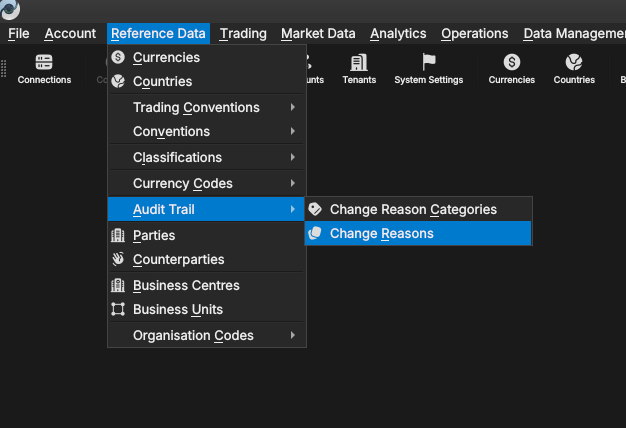
Figure 1: The Reference Data menu showing the full set of entity types managed by OreStudio. The Audit Trail sub-menu provides access to Change Reasons and Change Reason Categories.
- Currencies — ISO 4217 codes, display formatting, and rounding rules.
- Countries — ISO 3166 alpha-2 codes and names.
- Trading conventions and calendars — holiday calendars, settlement day rules, date rolling conventions, and tenor definitions that drive date arithmetic in trade processing and valuation.
- Counterparties — the external legal entities your organisation trades with.
- Books — the internal trading books that own positions.
- Business units and portfolios — the organisational structure within a party.
- Party types and statuses — the classification vocabulary for parties.
- Classifications — supplementary taxonomies such as currency market tiers and monetary natures.
Reference data is distinct from the other two main categories of data in the system:
- Market data — prices, FX rates, yield curves, and volatility surfaces that update continuously throughout the trading day. Market data is time-stamped and immutable once recorded; a new observation does not overwrite an old one.
- Trades — specific financial transactions between parties with defined cashflows, valuation models, and lifecycle states. Trades reference the reference data (they need a currency, a counterparty, a book) but they are not reference data themselves.
The key property of reference data is that it changes slowly and deliberately. A currency's rounding convention is not something that shifts intraday — it is corrected through a controlled, audited process. OreStudio enforces this with a comprehensive data quality framework described in this chapter.
GLEIF and the Legal Entity Identifier (LEI)
The Global Legal Entity Identifier Foundation (GLEIF) is a not-for-profit organisation that oversees the global LEI system on behalf of financial regulators. A Legal Entity Identifier (LEI) is a 20-character alphanumeric code that uniquely identifies a legal entity participating in financial markets — a bank, a corporation, a fund, a branch. LEIs are mandated by major regulatory frameworks including MiFID II, EMIR, Dodd-Frank, and Basel III for trade reporting and counterparty identification.
GLEIF publishes the full registry of LEI entities and their corporate hierarchies (parent-child relationships) as open data. OreStudio uses the GLEIF dataset to seed counterparties and, when a party's root LEI is selected during tenant provisioning, to populate the initial party hierarchy from real organisational data.
A BIC (Bank Identifier Code, ISO 9362) is an 8 or 11 character code identifying a specific financial institution, used in SWIFT messaging for settlement routing. GLEIF publishes a LEI-to-BIC mapping dataset that OreStudio also imports, allowing settlement systems to resolve a counterparty's BIC from its LEI.
Data Quality
Financial calculations are only as reliable as the data they consume. A misspelled currency name is a cosmetic nuisance; an incorrect rounding rule, a wrong counterparty identifier, or a stale market tier classification can silently propagate into risk figures, margin calls, collateral calculations, and regulatory reports. The consequences range from minor reconciliation breaks to significant financial loss or regulatory censure.
OreStudio's reference data layer is designed around the definition of data quality from ISO 8000 and the DAMA Data Management Body of Knowledge (DAMA-DMBOK): data quality is the measure of how well a dataset satisfies the requirements of its intended business use. In financial markets this means data must be not only accurate but also complete, consistent, timely, valid, and unique — the six industry-standard DQ dimensions described below.
The Six Dimensions
Accuracy is the degree to which data values agree with their authoritative golden source. OreStudio seeds currencies from ISO 4217, countries from ISO 3166, and counterparty identifiers from the GLEIF LEI registry. Where a discrepancy arises between a record in OreStudio and its source, the source takes precedence; the system provides tooling to re-import from authoritative datasets.
Completeness means all mandatory attributes are present. The service layer rejects saves that omit required fields and returns a validation error; the Qt UI marks missing mandatory fields visually before a save is attempted.
Consistency is the absence of contradictions between related entities. A currency's rounding type must be drawn from the governed rounding-types table; its market tier from the currency-market-tiers table. Foreign-key constraints in the database enforce this at the persistence layer.
Timeliness means data is available when calculations need it. The tenant provisioner imports standard catalogues at setup time so foundational reference data is ready before any trading activity begins. NATS events propagate updates to all connected clients in real time.
Validity is adherence to business rules and formats. ISO code lengths, numeric code ranges, currency format strings, and rounding precision bounds are all validated at save time.
Uniqueness ensures no duplicate records exist for the same entity. Primary key constraints at the database level prevent duplicates; the service layer surfaces a clear error if a duplicate is attempted.
Bitemporality
The most important architectural property of OreStudio's reference data layer is its use of bitemporality — the recording of two independent time dimensions for every stored fact.
The first dimension is valid time, recorded in valid_from and
valid_to columns on every row. Together they form an open interval
[valid_from, valid_to) bounding the period during which this version
of the record is authoritative. The live (current) row carries
valid_to = 9999-12-31 23:59:59 — a sentinel meaning "no known
expiry". When an update is saved, the database trigger closes the
existing row by setting valid_to to the current time, and inserts a
new row with valid_from = now and valid_to = sentinel. The
application never writes valid_from or valid_to directly — the
trigger owns both columns.
The second dimension is transaction time, surfaced to the application
as the recorded_at field. It records when this version was written to
the database — independently of what period the version is valid for.
Transaction time answers the question "what did the system believe at
a given moment?"
All timestamps in OreStudio are stored and processed as UTC throughout. The Qt UI converts timestamps to your local timezone for display only; every timestamp you see in the application is a local-time rendering of a UTC value stored in the database.
The combination of the two time dimensions allows OreStudio to answer questions that neither alone could answer:
- What is the current record for USD? — the live row has
valid_to = sentinel. - What did the USD record look like on a specific past date t? —
find the row where
valid_from <t < valid_to=. - When did we first record the current name for a currency? —
inspect the
recorded_atof the version where the name field changed. - Revert to an earlier version — inserts a new row copied from the historical version, leaving all intermediate versions intact.
Bitemporality is particularly important for calculation reproducibility. Being able to reconstruct the exact state of all reference data as it existed on a past valuation date is a prerequisite for explaining historical calculation results, for regulatory back-testing, and for resolving disputes about previously reported figures.
Versioning and Immutable History
Every save to a reference data entity creates a new, numbered version. The version counter starts at 1 on the first save and increments monotonically. History is immutable: no version is ever deleted or modified. Even a "revert" operation creates a new version — it does not roll the counter back or remove intermediate history.
This immutability guarantee is deliberate. Compliance frameworks such as MiFID II and EMIR require that firms demonstrate the state of their data at any past point in time. OreStudio's history tables provide this proof unconditionally.
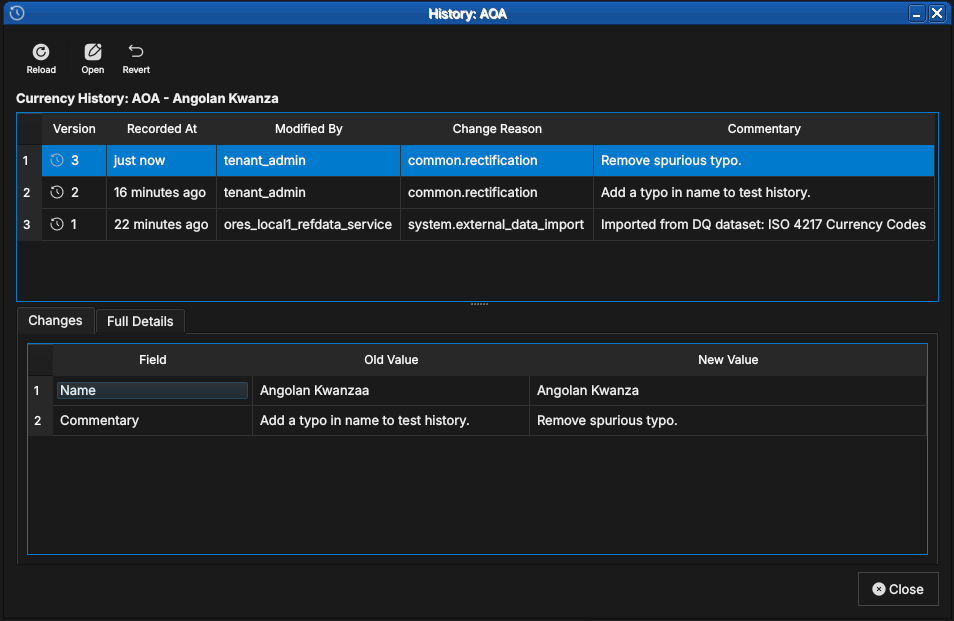
Figure 2: The Currency History dialog for the Angolan Kwanza, showing three versions. The Changes tab shows a field-by-field diff for the selected version against its predecessor.
The history dialog, accessible from every detail dialog's title bar or the list window's right-click menu, shows the full version list. Selecting a version populates a detail panel. The Changes tab shows a field-by-field diff; the Full Details tab shows the complete record at that version. The Revert button reinstates a historical version as a new current version.
Provenance
Every version of every reference data record carries six standard provenance fields. The Provenance tab in every detail dialog shows them read-only; it is disabled in create mode since no provenance exists before the first save.
The table below is the at-a-glance map from what you see on the tab to where each value comes from. Note the split: the two facts that must be tamper-proof — the version number and the moment of writing — are set by a database trigger and can never be supplied by the application; the four that carry business meaning are set by the application from your session and your answers to the change reason prompt.
| UI label | Field | Set by |
|---|---|---|
| Version | version |
DB trigger |
| Modified By | modified_by |
Application |
| Performed By | performed_by |
Application |
| Recorded At | recorded_at |
DB trigger |
| Change Reason | change_reason_code |
Application |
| Commentary | change_commentary |
Application |
version- Monotonically increasing integer starting at 1, incremented by the database trigger on every save. Never written by the application.
modified_by- The username of the account that submitted the save request.
performed_by- The username on whose behalf the change was
performed. Usually the same as
modified_by; they differ in automated workflows, where a service account submits a change on behalf of a human operator —modified_bythen identifies the service andperformed_bythe human, preserving accountability at both layers. recorded_at- The UTC wall-clock timestamp at the moment the row was written. Like all timestamps in OreStudio it is stored as UTC and displayed in your local timezone.
change_reason_code- A structured code drawn from the change reasons table identifying the business justification for the change. See Change Reasons below.
change_commentary- A free-text note accompanying the change. Mandatory for some reason codes, optional for others. Displayed in the history dialog and stored permanently with the version.
Change Reasons
Before every save OreStudio prompts for a change reason — a structured code identifying the business justification. Change reasons are organised into categories accessible from Reference Data → Audit Trail.
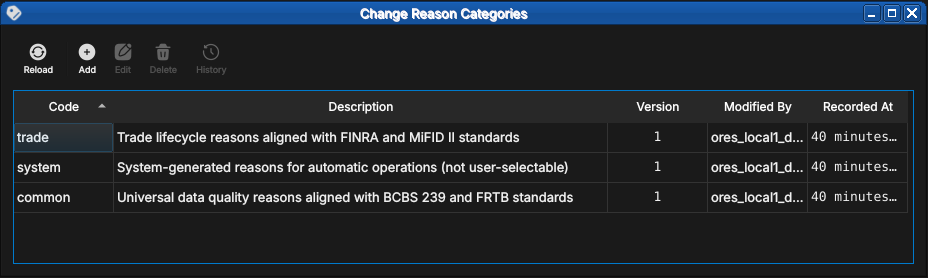
Figure 3: The Change Reason Categories window showing the three built-in category groups and their regulatory alignment.
Screenshot pending: the Change Reasons list window (Reference Data → Audit Trail → Change Reasons).
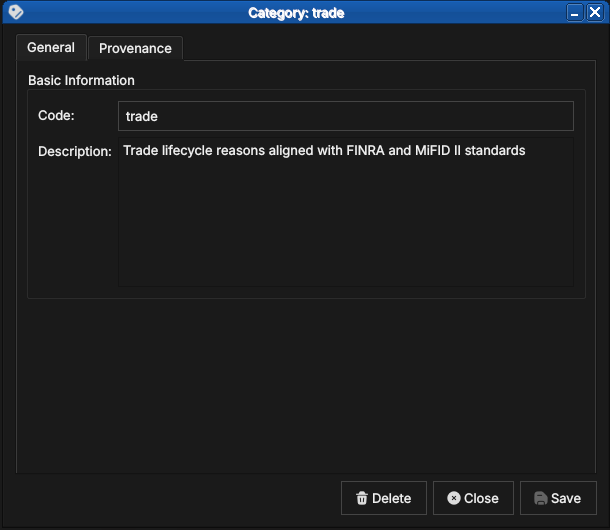
Figure 4: The detail dialog for the trade category, showing its regulatory description.
Change reasons serve two purposes: they act as a forcing function against silent undocumented changes, and they make the audit trail machine-readable and regulatorily aligned. The category structure maps directly to BCBS 239, FRTB, MiFID II, and FINRA reporting obligations.
Each category below opens with a matrix of its codes: which operations
each code applies to (create, amend, delete) and whether the code
demands commentary — codes marked required will not save without a
note, the rest take "—" as optional. The full code as stored in the
audit trail is the category-qualified form, category.code — for
example trade.fat_finger; the matrices and descriptions omit the
prefix within each category section.
The System Category
System reasons are assigned automatically by the application and services. They are not shown in the change reason prompt and cannot be selected manually.
| Code | Create | Amend | Delete | Commentary |
|---|---|---|---|---|
initial_load |
x | — | ||
new_record |
x | — | ||
external_data_import |
x | required | ||
import |
x | x | — | |
test |
x | x | x | — |
tenant_terminated |
x | — | ||
admin_reset |
x | — |
initial_load- Initial system provisioning or database migration. Used once during deployment.
new_record- Normal operational record creation by the application or a service.
external_data_import- Import from an external data source (ISO feed, GLEIF, vendor file). Commentary must record the data lineage source.
import- Data loaded via the CLI import command.
test- Test data created by automated test suites.
tenant_terminated- Applied when a tenant is marked as terminated.
admin_reset- Data reset by a system administrator during re-provisioning.
The Common Category
Common reasons are the universal data quality reasons, aligned with BCBS 239 and FRTB standards. These are the reasons most frequently used by operators during day-to-day data maintenance.
| Code | Create | Amend | Delete | Commentary |
|---|---|---|---|---|
non_material_update |
x | — | ||
rectification |
x | x | — | |
duplicate |
x | — | ||
stale_data |
x | x | — | |
outlier_correction |
x | x | required | |
feed_failure |
x | x | required | |
mapping_error |
x | x | required | |
judgmental_override |
x | x | required | |
regulatory |
x | x | required | |
other |
x | x | required |
non_material_update- A cosmetic or administrative change with no economic impact — a "touch" to refresh a timestamp or correct capitalisation.
rectification- Correction of a user or booking error. The most commonly used reason for fixing a data-entry mistake.
duplicate- Removal of a duplicate record where an equivalent entry already exists.
stale_data- Data not updated within the required liquidity horizon, requiring a refresh or removal.
outlier_correction- Manual override following a plausibility check failure — a value outside acceptable bounds overridden by an operator. Commentary must identify the plausibility rule that triggered the review.
feed_failure- Correction caused by an upstream vendor or API data issue. Commentary must identify the failed feed.
mapping_error- Incorrect identifier translation — for example a wrong ISIN-to-FIGI mapping. Commentary must describe the mapping error.
judgmental_override- Expert judgment applied when market prices or reference values are unavailable and an operator must supply a value manually.
regulatory- Mandatory compliance adjustment required by a regulatory obligation or instruction.
other- Exceptional changes that do not fit any other category. The commentary must fully explain the reason — this code exists as a last resort and should be used sparingly.
The Trade Category
Trade reasons are aligned with FINRA and MiFID II trade lifecycle reporting requirements.
| Code | Create | Amend | Delete | Commentary |
|---|---|---|---|---|
fat_finger |
x | x | — | |
system_malfunction |
x | x | required | |
corporate_action |
x | x | — | |
allocation_swap |
x | x | — | |
re_booking |
x | x | required | |
other |
x | x | required |
fat_finger- Erroneous execution — a trade entered with the wrong quantity, price, or instrument due to a keying error.
system_malfunction- Change caused by a technical glitch or algorithmic error in an execution system. Commentary must identify the system and the nature of the malfunction.
corporate_action- Adjustment following a corporate action such as a stock split, dividend reinvestment, or merger.
allocation_swap- Reallocation between a house account and a client sub-account, or between sub-accounts.
re_booking- Correction of a wrong legal entity booking — a trade entered under the wrong counterparty or book. Commentary must identify the correct entity.
other- Exceptional trade lifecycle changes that do not fit any other code.
Extending Change Reasons
Change reason categories and individual codes are stored as versioned reference data and can be added through the same Qt UI and CLI tools used for other entities. In principle, a tenant administrator can create additional categories and codes for firm-specific workflows.
In practice this should be done cautiously:
- The standard codes are aligned with regulatory frameworks (BCBS 239, FRTB, MiFID II, FINRA). Non-standard codes risk creating audit trail entries that do not map cleanly to regulatory reports.
common.otherandtrade.otherwith mandatory commentary cover most exceptional cases without adding custom codes.- Custom codes cannot be distinguished from standard codes by the system, so the tenant must maintain its own record of which codes are standard and which are custom.
- Removing or renaming a code after it has been used in the audit trail leaves historical records referencing a code whose meaning is no longer documented.
Summary
This chapter established the foundations that every entity chapter builds on. Reference data is the slowly-changing vocabulary of the system, distinct from streaming market data and transactional trades, and OreStudio governs it with the six industry-standard data quality dimensions. The bitemporal storage model gives every record an immutable version history; provenance records who changed what, when, through which service, and why; and the structured change reason system turns every modification into an auditable event. These mechanisms appear identically in every entity window — the following chapters, starting with currencies, document each entity on top of this shared foundation.
See also
- ISO 8000 — international standard for data quality.
- DAMA-DMBOK — data management body of knowledge, including the DQ-6 framework.
- Temporal database — background on transaction time, valid time, and the bitemporal model.
- Time and Timestamps: Architecture and Conventions — internal architecture document (
doc/knowledge/architecture/time-architecture.org). - BCBS 239 — Basel Committee principles for effective risk data aggregation and reporting.
- GLEIF — the Global Legal Entity Identifier Foundation; publishes the LEI registry and the LEI-to-BIC mapping dataset.