Cybernetic Levels
Table of Contents
This page applies ideas from cybernetics — specifically Stafford Beer's
Viable System Model — to ORE Studio. There are five levels (S1 to S5) that separate
concerns across time horizons: from the agent running one task right now (S1)
to the durable identity of the product as a whole (S5). In addition there is an
independent audit channel — written S3* and pronounced "three-star" to
distinguish it from the operational S3 control role; the two sit at the same
level in Beer's model but do different jobs. A stateful document is tagged with
the level it serves (#+level: frontmatter), so all artefacts of a given level
are findable with one grep. The levels are not a strict hierarchy of authority —
they are a separation of concerns. Higher levels do not override lower ones;
they constrain them.
1. System 1: Operations
In Beer's VSM, System 1 is the operational unit that interacts directly with its environment to do the work. In ORE Studio it is the agent at the keyboard: a subprocess that picks up a single task, implements it, and merges a PR. Everything above S1 only exists to keep S1 fed with coherent, well-scoped work.
| Field | Value |
|---|---|
| Scope | A single task. |
| Time horizon | Hours to a day. |
| Thinks about | How to implement this task within its size budget. |
| Executor | An agent (subprocess) spawned by an orchestrator. |
| Inputs | A task document and the codebase. |
| Outputs | A PR, an updated task document marked done, any discovered tasks filed for triage. |
| Owns | The implementation of the task. Nothing more. |
| Lifecycle touchpoints | Runs the Sprint execution phase — claims BACKLOG tasks, transitions them through STARTED / BLOCKED / DONE, opens and lands one PR per task. Files discovered tasks for S2 to triage. |
| System doc | S1 Agent — load this doc when taking on the S1 role. |
2. System 2: Coordination
In Beer's VSM, System 2 is the anti-oscillation layer: it coordinates the operational units below so they don't collide or duplicate work. In ORE Studio it is the orchestrator LLM the user assigns to a story — it decomposes the story into tasks, hands them out to S1 agents, reviews what they produce, and decides what to do with anything discovered along the way.
| Field | Value |
|---|---|
| Scope | A story and its tasks. |
| Time horizon | Days. |
| Thinks about | How the story decomposes into tasks, what size each task must be, what order they run in, what to do with discovered tasks. |
| Executor | The orchestrator LLM the user assigned to the story. |
| Inputs | A story document, the sprint mission, the codebase. |
| Outputs | Tasks, decisions, review of agent output, story completion. |
| Owns | Scoping, task sizing, in-story prioritisation, review. |
| Lifecycle touchpoints | Decomposes promoted stories into tasks during Sprint planning; reviews S1 output and triages discovered work during Sprint execution; resolves each story (DONE / ABANDONED / carried) during Sprint closure. Also files captures into the product backlog when discovered work cannot fit any current story. |
| System doc | S2 Orchestrator — load this doc when taking on the S2 role. |
3. System 3: Control
In Beer's VSM, System 3 is operational management — it allocates resources to S1, integrates S2's coordination signals, and keeps the whole operational layer running coherently. In ORE Studio it is the sprint planner: a session invoked when a sprint opens or closes, that decides which stories the sprint will pursue and verifies they cohere around one mission.
| Field | Value |
|---|---|
| Scope | The current sprint, with awareness of the previous and next. |
| Time horizon | Weeks. |
| Thinks about | Does the set of stories in the sprint cohere with the sprint mission? Are short-term hacks accumulating? Are sprints linear in intent? Are discovered stories being triaged? |
| Executor | A session invoked on demand by the user. |
| Inputs | The sprint backlog, completed sprints, current sprint mission. |
| Outputs | Sprint planning, story prioritisation, retrospectives. |
| Owns | Medium-term planning, sprint coherence. |
| Lifecycle touchpoints | Drives the entire sprint phases sequence — refines the product backlog continuously, defines the sprint mission and chooses stories in Sprint planning, generates release notes and runs the post-mortem in Sprint closure, and decides when a next→deferred demotion or deferred→next promotion is appropriate. |
| System doc | S3 Sprint Planner — load this doc when taking on the S3 role. |
4. System 3*: Audit
In Beer's VSM, System 3* ("three-star") is the independent audit channel — it watches the operational layer from the outside to catch drift the inside cannot see. In ORE Studio it is scheduled scripts plus an occasional session: invariant checks that the docs and code say what they should, run continuously rather than per sprint.
| Field | Value |
|---|---|
| Scope | The whole information architecture. |
| Time horizon | Continuous. |
| Thinks about | Are invariants holding? Orphan tasks, stale recipes, broken links, completed work not linked to PRs, plans that outlived their task. |
| Executor | Scheduled scripts plus a session invoked on demand. |
| Inputs | Every document under doc/. |
| Outputs | Audit reports, automatic state corrections, tasks to fix drift. |
| Owns | The integrity of the system itself. |
| Lifecycle touchpoints | Observes the heartbeat invariant during Sprint execution (STARTED / BLOCKED staleness), checks every id-link resolves, audits DISCOVERED tasks that overstay one orchestrator session, verifies predecessor / successor symmetry on cross-sprint stories. |
| System doc | S3* Auditor — load this doc when taking on the S3* role. |
5. System 4: Intelligence
In Beer's VSM, System 4 is the outward-looking, strategic layer — it watches the environment over a longer horizon and asks "where is this going?". In ORE Studio it is the version planner: a session that checks whether the sequence of sprints adds up to the version mission and intervenes when it doesn't.
| Field | Value |
|---|---|
| Scope | The current major version. |
| Time horizon | Months. |
| Thinks about | Does the sequence of sprints lead to a coherent release? Are there sprints missing? Is the version's identity being eroded? |
| Executor | A session invoked on demand by the user. |
| Inputs | The version identity, the sprint sequence, the product identity. |
| Outputs | Version plan, sprint sequencing, release scope decisions. |
| Owns | Medium-to-long-term planning. |
| Lifecycle touchpoints | Cross-checks each sprint's mission against the version mission during Sprint planning; participates in release cut decisions during Sprint closure (whether to publish a release or land mid-version); responsible for moving captures next↔deferred when the next version's focus changes. |
| System doc | S4 Version Planner — load this doc when taking on the S4 role. |
6. System 5: Policy / Identity
In Beer's VSM, System 5 is the policy layer — it carries the identity of the organism, the durable answer to "what are we?". In ORE Studio it is the product identity doc and the sessions that maintain it; everything below S5 is filtered through that identity when deciding what counts as "ORE Studio" at all.
| Field | Value |
|---|---|
| Scope | The product as a whole. |
| Time horizon | Indefinite. |
| Thinks about | Is this idea ORE Studio or not? Does a proposed version fit the product? Is a far story in scope? |
| Executor | A session invoked on demand, usually with the user collaborating. |
| Inputs | The product identity, candidate versions, candidate far stories. |
| Outputs | Identity updates, scope decisions (accept / reject / defer), out-of-scope notes. |
| Owns | What ORE Studio is and is not. |
| Lifecycle touchpoints | Filters story choice during Sprint planning (does each candidate fit the product vision?); reviews backlog captures for identity-fit and decides accept (the capture stays in next/deferred) or reject (the capture is deleted, with the rationale noted in commit history). |
| System doc | S5 Identity Steward — load this doc when taking on the S5 role. |
7. Information flow
Information moves through the levels in three directions: downward as constraint (higher levels narrowing the space of acceptable lower work), upward as signal (lower levels reporting what actually happened), and sideways as audit (S3* observing the whole stack from outside).
7.1. Downward — constraint
Identity → version identity → sprint mission → story goal → task goal. Each higher level constrains the space of acceptable lower-level work.
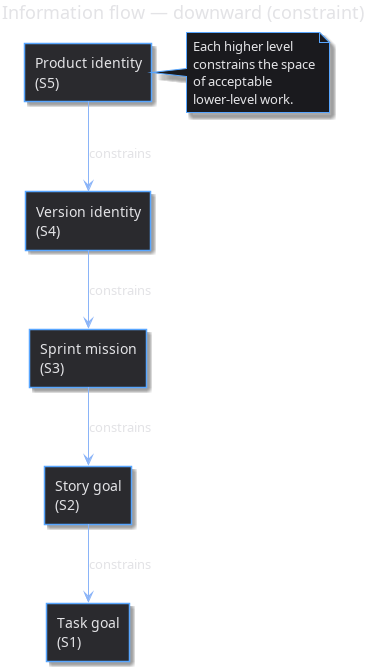
Figure 1: Constraint flowing downward through the cybernetic levels.
7.2. Upward — signal
Task completion → story completion → sprint retrospective → version release notes → identity check. Each lower level surfaces what actually happened to the level above.
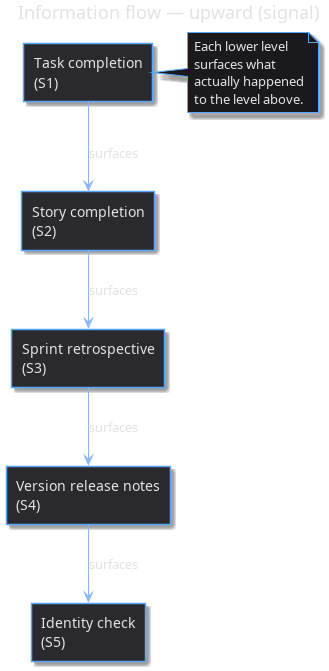
Figure 2: Signal flowing upward through the cybernetic levels.
7.3. Sideways — audit
System 3* observes all levels and reports drift back outside the operational hierarchy.
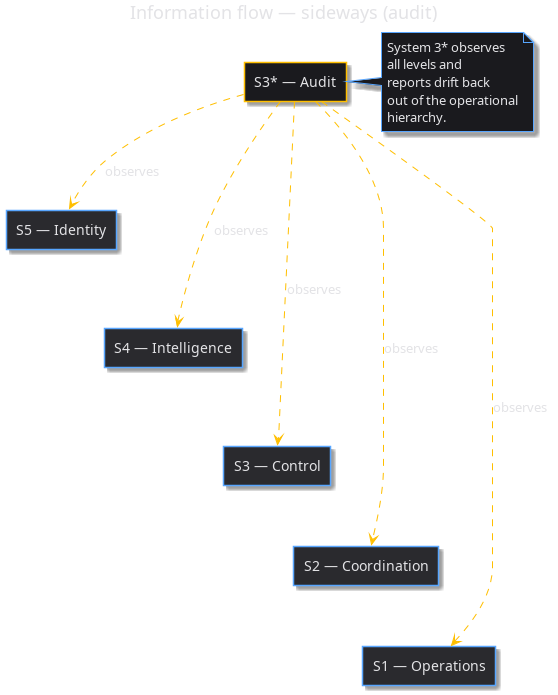
Figure 3: S3* audit observes all five levels from outside the operational hierarchy.
8. Connection to and divergence from the VSM
ORE Studio's five-level model is inspired by Beer's Viable System Model but is not a faithful implementation of it. This section records where the mapping holds, where it diverges, and the known limitations of the analogy.
8.1. Where the mapping holds
- Separation of time horizons — the core insight carries intact. S1 operates in hours, S2 in days, S3 in weeks, S4 in months, S5 over the product lifetime. This is directly analogous to Beer's intended separation.
- S3\ as independent audit* — the audit channel is structurally separate from the operational hierarchy in both Beer's model and ORE Studio. In both cases it bypasses the reporting chain to observe S1 directly.
- Recursion in principle — any sufficiently large task could itself be decomposed into S1–S5 sub-levels. The model is applied at the story/sprint level but the structure would hold at finer granularity.
- Viability requirement — removing any level breaks the system. A project with no S4 (version planning) drifts without strategic direction; a project with no S5 (product identity) loses coherence over time.
8.2. Where it diverges
- S1 is an LLM agent, not a human worker. Beer's S1 units are autonomous operational teams with their own management structure. In ORE Studio, S1 is a single-session subprocess that executes one task and terminates. It has no internal S2–S5; it is an atom, not a recursive system.
- S2 is asynchronous documentation, not a live coordination layer. Beer's S2 is a real-time anti-oscillation mechanism (schedules, shared protocols, inter-unit signals). In ORE Studio, S2 is the orchestrator that decomposes a story into tasks and reviews agent output — a more sequential, supervisory role than Beer intended.
- S3 and S4 are invoked on demand, not continuously running. In a true VSM, S3 and S4 are always active. In ORE Studio, they are sessions triggered by the user at sprint open/close or version review. The system is not self-regulating between invocations.
- No algedonic channel. Beer's VSM includes an algedonic signal — an emergency bypass that lets S1 alert S5 directly when pain or pleasure is intense enough to require immediate policy attention. ORE Studio has no equivalent; escalation goes through the normal levels.
8.3. Known limitations
- Single-agent serialisation — because tasks are executed one at a time in a single worktree, true S2 coordination (preventing collision between concurrent S1 units) rarely applies. The model is aspirational for multi-agent parallelism that is not yet the norm.
- Human in the loop at every level — Beer designed the VSM for autonomous organisations. In ORE Studio, the user is present at S3–S5 and often participates in S2. This collapses some distinctions the model assumes are structurally enforced.
- The analogy is a lens, not a specification. The level labels
(
#+level:tags) are a filing convention, not a runtime enforcement. Nothing prevents an S1 agent from making S4-class decisions; the model relies on convention and review, not architecture.