Codegen meta-model
Table of Contents
1. Codegen logical model implementation
The purpose of Logical Space is to separate what to generate from
how it is configured: a logical model is a language-neutral
description of domain concepts, projected into physical artefacts
independently of any generator's internal machinery. ores.codegen's
logical model is
the set of every .org file an author writes under a component's
modeling/ directory — one file per logical element (an entity, a
junction, a lookup table, …). For the generator to do anything with
one of these files, it first has to answer a prior question: what
kind of logical element is this file describing at all? A junction
needs its two FK sides read; an entity needs its primary key read;
neither reading applies to the other. That classification is the
element's metatype, carried in the frontmatter as
#+type: ores.codegen.<metatype>, and it is given by the Logical
Meta Model (LMM). This section describes the LMM.
2. Metatypes as metaclasses
Because a metatype classifies what kind of thing each model file
is — rather than describing any one model file's content — the eight
metatypes can usefully be thought of as metaclasses: classes one
level up from the model files themselves, in exactly the sense a UML
class is one level up from its instances. ores.codegen.entity is
not an entity; it is the class of things that are entities. This is
not a loose analogy — it is the same relationship Applied MASD §
"Metatype" states plainly: "currency is the entity; domain_entity
is its metatype… in MASD, currency is an instance of the
metatype domain_entity'."
Reading the eight metaclasses side by side (see Codegen input org-file
schema reference for their full frontmatter/section listings) shows
they are not unrelated siblings: every one of them requires an
:ID:, a #+type, and (with one exception) a #+component — a
common shape every metaclass specializes with its own identity
fields. That is a generalisation/specialisation relationship, and it
is worth drawing as one:
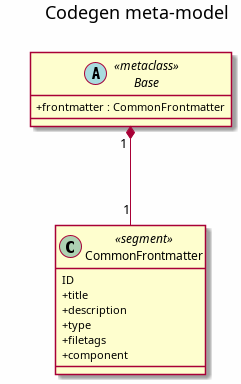
(Source: codegen_meta_model.puml,
rendered with plantuml.)
Base is abstract — no model file has #+type: ores.codegen.base;
it exists only to hold the frontmatter every metaclass inherits, as
one typed field. Each of the seven concrete metaclasses below
specializes both Base (adding its own segments) and
CommonFrontmatter (adding its own identity fields) — see Codegen
org-entity meta-model for Entity's specialization drawn out in
full, the only metaclass documented to that depth so far.
3. Segment
ORE Studio extended the MASD logical meta model with segments: not
themselves a MASD concept, but a bundle of related fields within
logical space — a coherent group of frontmatter keywords, headings,
and property-drawer properties that an author fills in together and
that project into one facet, or a small closed set of closely related
facets, as one unit. Every concrete metaclass is composed of zero or
more segments, as drawn in the diagram above. ores.codegen.entity's
* SQL heading and everything under it is one segment; so is the
** Presentation sub-heading under * C++ and everything under it1 — see
Codegen org-entity meta-model for Entity's segments drawn out in
full.
A segment exists so a reader (or an LLM) can find "everything about the data this metaclass needs in order to project into its UI facet" in one page, without also needing to hold the rest of the metaclass's fields in view. A segment lives in logical space, but it is not itself an addressable unit there — the metaclass as a whole is; a segment is only a sub-grouping of its fields. It has no counterpart at all in physical space — a facet does, and is what a segment's fields ultimately project into — which is precisely why every segment page opens with a Physical model mapping table: to make explicit which facets — real points in physical space — that segment's fields project into.
Base's one segment, Common frontmatter, is the first one worth
documenting, because every metaclass's own frontmatter inherits from
it — not because the rest of a metaclass's segments build on it; most
segments (SQL, Presentation, …) are unrelated to frontmatter entirely.
4. Structural versus non-structural variability
A .org model file bundles three logically distinct concerns into a
single physical document: the modelled element's shape, its authored
variability, and any protected regions it requires. This bundling,
and the criterion by which a given field is properly classified as a
feature rather than a structural predicate, is treated formally
in Applied MASD § "The entity model file as a unified literate
document," which also contrasts this approach with how classical
UML+Profile MDE distributes the same three concerns across three
separate artefacts. A field on any segment page whose classification
is not immediately evident should be evaluated against that
criterion rather than assumed.
Two questions arising from this distinction remain open for the
present meta-model: whether every segment page ought to carry an
explicit structural/non-structural label for each of its fields, and
whether Entity's domain_entity "shape" concept is properly
understood as an instance of MASD's existing profile construct.
Both are tracked by capture Formalize the codegen entity knob system as
a proper MASD/MDE feature model rather than resolved piecemeal
across individual segment pages.
5. Common frontmatter
Every metaclass's frontmatter inherits from CommonFrontmatter: the
properties below are declared once, here, and every metaclass's own
frontmatter — documented on that metaclass's own hub page — extends
this set rather than repeating it.
| Keyword | Purpose |
|---|---|
:ID: (drawer) |
UUID of this org file. Used for cross-document links; also what makes the file an org-roam node at all, independently of codegen. |
#+type: |
The metatype discriminator. Its value is what dispatches to a specific archetype set — see Applied MASD § "Metatype". |
#+filetags: |
Org-roam tags; convention is :model:<metatype-noun>:<component>:, e.g. :model:entity:refdata:. |
#+component: |
Component the model belongs to (refdata, trading, …). Present on every metaclass except ServiceRegistry (ores.codegen.service_registry), which is cross-component by nature (one registry of every backend service). |
book, an Entity, showing CommonFrontmatter alone (its own
specialized fields, #+entity_singular and friends, are layered on
top — see below):
,:PROPERTIES:
,:ID: <uuid>
,:END:
#+title: ores.refdata.book
#+type: ores.codegen.entity
#+filetags: :model:entity:refdata:
#+component: refdata
Each concrete metaclass's own specialized frontmatter — the identity/naming fields a generator needs to render that metaclass's archetype set — is documented on its own hub page once one exists; until then, see Codegen input org-file schema reference § that metatype for the quick list. The specialized fields diverge considerably between metaclasses:
| Metaclass | Specialized fields (on top of the base above) |
|---|---|
Entity |
#+entity_singular, #+entity_plural, #+entity_title, #+brief |
Junction |
#+name, #+name_singular, #+name_title, #+name_singular_words, #+brief — a junction has no single subject to be "the entity," so its naming scheme is built around the relation's plural/singular forms instead. |
LookupEntity |
#+has_tenant_id, #+has_coding_scheme, #+has_image_id, #+has_artefact_insert_fn — structural declarations made at frontmatter level, no naming fields. |
Entity's full specialized-frontmatter treatment lives on Codegen
entity meta-model — file-level conventions.
6. The metaclasses
The table below lists the descendants of the base metaclass and
provides details of each: its metatype, hub page, and where its
model files live. Base itself is abstract and has no row, no model
files, and no #+type value of its own.
| Metaclass | Metatype (#+type) |
Hub page | Model files live under |
|---|---|---|---|
Entity |
ores.codegen.entity |
Codegen org-entity meta-model | projects/ores.<component>/modeling/ores.<component>.<entity>.org |
Junction |
ores.codegen.junction |
(not yet authored to this depth — see schema reference for the shallow treatment) | same |
LookupEntity |
ores.codegen.lookup_entity |
(not yet authored) | same |
FieldGroup |
ores.codegen.field_group |
(not yet authored) | same |
Table (retired) |
ores.codegen.table |
Superseded by ores.codegen.entity; type removed from the generator |
— |
ServiceRegistry |
ores.codegen.service_registry |
(not yet authored) | same |
Module |
ores.codegen.module |
(not yet authored) | same |
Every entity model file, regardless of metaclass, is also an
instance of the pattern described in Applied MASD § "The entity model
file as a unified literate document": one physical .org document
bundling the logical element's shape, its authored variability, and
any protected regions (paste blocks) it needs. Read that section for
why these documents look the way they do.
7. Use of :ignore: in models
Every metaclass's body is a set of top-level sections, and a
generator's templates read only the ones its facets recognise (* SQL,
* C++, …). A section outside that recognised set — free-form
prose about the model itself, say — is simply invisible to codegen
unless it is explicitly tagged :ignore:, which asks the loader to
skip that heading when reading the file. The tag means "skip this
heading," not "this document is unimportant" — an unfortunate naming
collision if you're skimming the table of contents of a model that
uses it:
* About this file
,:PROPERTIES:
,:ignore: t
,:END:

Free-form notes for a human reader; codegen never reads this section.
8. See also
- Applied MASD — the modeling approach every metaclass's model files follow, including the UML contrast.
- Logical Space — metatype as a MASD concept; the logical entity types table.
- Physical Space — what a metaclass's archetypes ultimately produce.
- Facet — the physical-space grouping each metaclass's archetypes bind to.
- Variability / ORE Studio Variability Model — how a metaclass's facets get activated and configured.
- Codegen input org-file schema reference — the shallow, all-eight-metaclasses-at-once quick reference this page's deep hubs supersede one metaclass at a time.
Footnotes:
It is confusing that segment names (SQL, Presentation, …) look
identical to technical space names. They are not a reference to the
technical space itself — a segment is a logical-space grouping of
fields, not a physical-space one. The name is shared only because the
fields bundled into that segment happen to be the ones the matching
technical space's facet(s) need.