Codegen entity meta-model — SQL
Table of Contents
This page is a segment of the Codegen org-entity meta-model hub, covering
the * SQL section and the ores.sql.schema facet it feeds: bi-temporal
table create/drop, insert triggers, and notify triggers.
The columns it operates on are declared once, shared with C++, on the
Keys and columns page — this page is only the SQL-specific fields
layered on top.
This page splits its fields across two diagrams, per Applied MASD § "The entity model file as a unified literate document":
- Structural — always part of the entity's shape, never toggled —
drawn as a UML class diagram under Flags below.
:tablename:is the one field of this section that qualifies: a required identity field with no default, every entity needs exactly one value. - Non-structural — the authored, optional VMM features of the
ores.sql.schemabundle — drawn as a UVL feature diagram under Projection configuration below.
The :has_parent_id: hierarchy block is the exception. Its three
properties are authored at the entity root, not in this section, so
Hierarchy below covers them here while
Keys and columns models them
with the other structural features.
1. Physical model mapping
| Facet | Description |
|---|---|
| ores.sql.schema | Bi-temporal schema: table create/drop, insert triggers, notify triggers. |
2. Flags
The section always opens with a ** Flags drawer:
* SQL
** Flags
,:PROPERTIES:
,:tablename: ores_refdata_books_tbl
,:END:
| Property | Required | Meaning |
|---|---|---|
:tablename: |
yes | The generated table's name. Convention: <product>_<component>_<entity_plural>_tbl. |
Structural view — the SQL segment's fields, per the split above,
plus its one paste block kind (extra drop statements, below), drawn
as its own class: a block kind's ID is the well-known kind UUID,
distinct from any entity's per-instance implementing block:
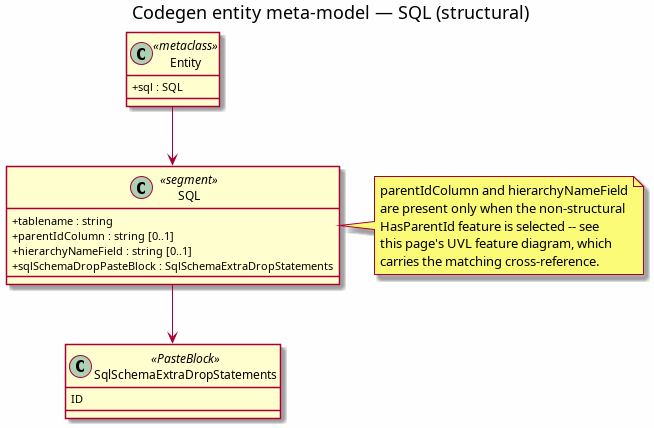
(Source: entity_meta_model_sql_structural.puml,
rendered with plantuml.)
The :tablename: flag above (ores_refdata_books_tbl) drives the
generated create table statement's identifier directly:
create table if not exists "ores_refdata_books_tbl" (
    "id" uuid not null,
    "tenant_id" uuid not null,
    "version" integer not null,
    -- ... columns from Keys and columns ...
);
Future SQL sub-sections (custom triggers, indices) live alongside
this Flags sub-heading.
3. Hierarchy: has_parent_id
Some entities form a tree via a self-referencing soft foreign key.
A book belongs to a portfolio, and a counterparty can have a
parent counterparty. Setting :has_parent_id: true makes the
ores.sql.schema facet
generate a recursive-CTE function that walks that tree, so consumers
don't each hand-write their own recursive query. The C++ facets gate
their matching members on the same feature: get_hierarchy on the
repository and the service, and the protocol and NATS-handler entries
that reach them.
All three properties sit in the entity's root * Flags drawer, beside
:has_tenant_id: and :has_workspace_id:. :has_parent_id: is a
structural feature, not one of this section's ores.sql.schema knobs;
its bundle is Keys and columns.
| Property | Required | Meaning |
|---|---|---|
:has_parent_id: |
no | Turns the hierarchy block on. |
:parent_id_column: |
if set | The self-referencing FK column name, e.g. parent_party_id. |
:hierarchy_name_field: |
if set | An existing column used as the display label in the tree. |
The first property turns the block on and the other two name the columns the generated function reads. Set the first without the others and the function names empty columns, so author all three together.
counterparty is one such self-referencing entity. Its model shows
where each property lives. The feature and the two column names are in
the root drawer; the table name is in this section:
* Flags
,:PROPERTIES:
,:schema:               public
,:product:              ores
,:component:            refdata
,:profile:              self-referencing-hierarchy
,:parent_id_column:     parent_counterparty_id
,:hierarchy_name_field: full_name
,:END:

* SQL
** Flags
,:PROPERTIES:
,:tablename: ores_refdata_counterparties_tbl
,:END:
The bound Self-referencing hierarchy profile
assigns :has_parent_id: true, so the model does not state it. A model
with no such profile writes the line itself, in that same root drawer.
Generates a
<product>_<component>_<entity_plural>_hierarchy_fn(p_tenant_id, p_root_id, p_from_root)
recursive-CTE function returning flat (id, parent_id, name) rows —
the subtree rooted at p_root_id when p_from_root is false, or
(resolving up to the real root first) the whole tenant tree when
true.
The generated function only produces flat rows; it does not build a
tree. Turning those rows into an actual tree is generic work that
does not vary from one hierarchical entity to the next, so it is not
generated at all — every consumer instead calls the same hand-written
ores::utility::domain::hierarchy.hpp, whose build_tree() turns a
vector of flat hierarchy_flat_row into a tree of hierarchy_node.
:has_parent_id: does not generate everything a hierarchical
entity needs, though. The self-referencing FK column itself
(parent_<entity>_id) and its insert-trigger validation are still
hand-written today. The hierarchy function does not depend on that
column being generated; it composes independently either way.
4. Projection configuration (variability)
Every property below is, in MASD Variability terms, a feature
(ores.sql.schema bundle) — authored on the model's sql section and read
through in codegen/core.py=/=org_loader.py, never computed. None of
them changes the entity's logical shape, only the generated DDL,
triggers, and rules. Full classification and cross-facet index: ORE
Studio Variability Model § "Bundle: ores.sql.schema" — this section is the
narrative home for these knobs; that page indexes them.
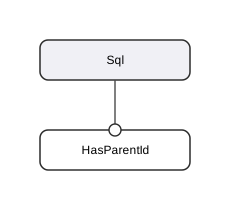
The bundle as a feature model:
| Feature | Type | Default | Effect |
|---|---|---|---|
:current_state: |
bool | false | Table holds one row per key and no history at all: no valid_from=/=valid_to, no GIST exclusion, no temporal checks, no version or audit tail, and the model's own primary key. Because it has no temporal axis it has no history surface either: no history endpoint, no history request/response messages and no history subscription. A current-state entity still validates its tenant_id on insert, and keeps any ** Indexes it declares (without a valid_to predicate). Structural consequence: removes the temporal axis. |
:system_scope: |
bool | false | Table is system-tenant-scoped: tenant_id defaults to the system tenant and the insert trigger forces it. Structural consequence: changes the tenant_id column default. |
:nullable_tenant_id: |
bool | false | tenant_id is nullable (system records carry NULL); selects the nullable-tenant validation and index variants. Structural consequence: changes tenant_id nullability. |
:extra_checks: |
collection<string> | ∅ | Additional CHECK constraints to emit on the table. |
:extra_delete_sets: |
collection<string> | ∅ | Extra SET clauses in the soft-delete rule. |
:fk_copy_validations: |
collection<struct> | ∅ | FK validations that also copy/denormalise fields from the referenced row. |
:text_code_validations: |
collection<struct> | ∅ | FK validations against a text lookup column. |
:party_id_from_book_id: |
struct | absent | Derive and validate party_id=/=portfolio_id from book_id in the trigger. |
:party_id_from_session: |
bool | false | Set party_id from the session GUC app.current_party_id. |
:rls_tenant_isolation: |
bool | false | Emit enable row level security + a permissive tenant-isolation policy (T1) as a trailer of the create file, and its drop in the drop file. |
:rls_party_isolation: |
bool | false | Also emit a party_id-scoped as restrictive policy (T3) over ores_iam_visible_party_ids_fn membership; requires :rls_tenant_isolation:. |
:rls_system_tenant_visible: |
bool | false | Widen the tenant-isolation policy body to own-tenant or system-tenant (T2); requires :rls_tenant_isolation:. |
Current-state is a distinct axis from :no_audit_columns:. A
:no_audit_columns: entity (a TimescaleDB hypertable) drops only the
version column and the audit tail; it keeps valid_from=/=valid_to as its
transaction-time window, and its reads still filter on valid_to. A
:current_state: entity drops the whole temporal axis: the SQL create has no
valid_from=/=valid_to, no GIST exclusion and no temporal check, and its
primary key is the model's own key (for login_info, account_id), not
(tenant_id, key, valid_from, valid_to). It has no history surface: the
service declares no get_<entity>_history, the C++ and TypeScript protocol
headers state no history request/response pair and no history subject, the
NATS registrar subscribes to no history subject, and the shell-command and
presentation history facets omit the history verb and field mapper. The C++
domain type then has no recorded_at and the repository upserts
(insert_or_replace) and hard-deletes instead of closing a validity window, so
a caller must not expect version rows from read_all or a soft delete from
remove. The insert trigger still
validates tenant_id, and the hand-written table's indexes and constraints
carry over through the ** Indexes and ** Checks sections (plus the
per-column :skip_uuid_check: / :skip_empty_check: and per-FK :skip_check:
suppressions), which is how the iam_login_info table keeps
login_info_locked_idx and avoids gaining a nil-UUID check it never had.
The feature is authored in the * SQL ** Flags drawer, beside the other SQL
projection knobs above.
Tenant-scoping is a policy, not three booleans. :system_scope: and
:nullable_tenant_id: are mutually exclusive with the default
(standard-tenant) mode; together they form a single enumerated feature —
tenant-scoping policy ∈ {standard, system, nullable}. If they migrate
anywhere, it is into the logical model as a tenant-scoping attribute
(they lean structural despite being authored as knobs).
Row-level security emission is an explicit intent flag, not a
consequence of having a tenant column. The :rls_*: features above
emit enable row level security and the matching policy blocks inline
at the end of the generated per-entity create file, so a regenerated
table owns its whole SQL lifecycle. They default off and no profile
fixes them: many tenant-column tables deliberately skip RLS
(system-owned registries, currently silenced by RLS_001 ignore
entries in validation_ignore.txt), and a party_id column is not
party isolation scope on its own (e.g. market_series). The emitted
blocks are verbatim copies of the dominant hand-written shapes from
the components' *_rls_policies_create.sql files (T1 tenant-only, T2
own-or-system-tenant, T3 restrictive party membership). Because
create policy resolves ores_iam_current_tenant_id_fn at creation
time, inline emission is only legal for components created after the
iam section of create/create.sql; the pre-iam components keep their
RLS-layer files until that ordering question is resolved.
SECURITY DEFINER on insert/validate triggers is not a feature —
checked against library/templates/sql_schema_domain_entity_create.mustache, it
is emitted unconditionally today, matching the
entity commissioning process reference's mandatory rule. It is
mentioned here only so nobody goes looking for a
:security_definer: knob that no longer exists.
5. Paste blocks
The SQL segment defines the following paste block kinds, one per
sub-heading below — see Paste blocks for the general mechanism they
assume.
5.1. Extra drop statements
This paste block defines additional DROP statements inserted into
the generated <component>_<entity_plural>_drop.sql, just before
drop table if exists. Use this when the entity's companion
_table.org model generates database objects (e.g. a validate
function) that the entity template itself has no way to know about.
If no entity implements this kind, the marker collapses to nothing.
Example of an inclusion of this paste block in a template (sql_schema_domain_entity_drop):
drop function if exists {{product}}_{{component}}_{{entity_plural}}_insert_fn;
<<paste:5E47F108-1350-4540-B3C2-E83DD5379B2D>>
drop table if exists "{{product}}_{{component}}_{{entity_plural}}_tbl";
To use this paste block on an entity, declare it under ** Paste
blocks > *** Extra drop statements, with the body in a block named
body. See the following example:
** Paste blocks
*** Extra drop statements

#+begin_src sql :name body :implements 5E47F108-1350-4540-B3C2-E83DD5379B2D
drop function if exists ores_refdata_validate_rounding_type_fn;
#+end_src
An entity is not limited to a single drop statement, nor to a
single block: it may write several statements inside one body
block, or spread them across several *** Extra drop statements
sub-headings. Either way, codegen collects them all, in the order
they appear in the model, and concatenates them with a blank line
between each.
6. See also
- Codegen org-entity meta-model — the hub.
- Keys and columns — the column declarations this section's DDL is built from.
- Paste blocks — the shared paste-block mechanism.
- Variability — MASD's formal vocabulary for the
ores.sql.schemafeatures above.:tablename:(§ "Flags") is structural, not variability.:has_parent_id:(§ "Hierarchy") is variability, but its bundle is structural. - ORE Studio Variability Model — the
ores.sql.schemabundle's classification and cross-facet index; this page is the narrative home for those knobs.