ores.http.api
Table of Contents
Diagram
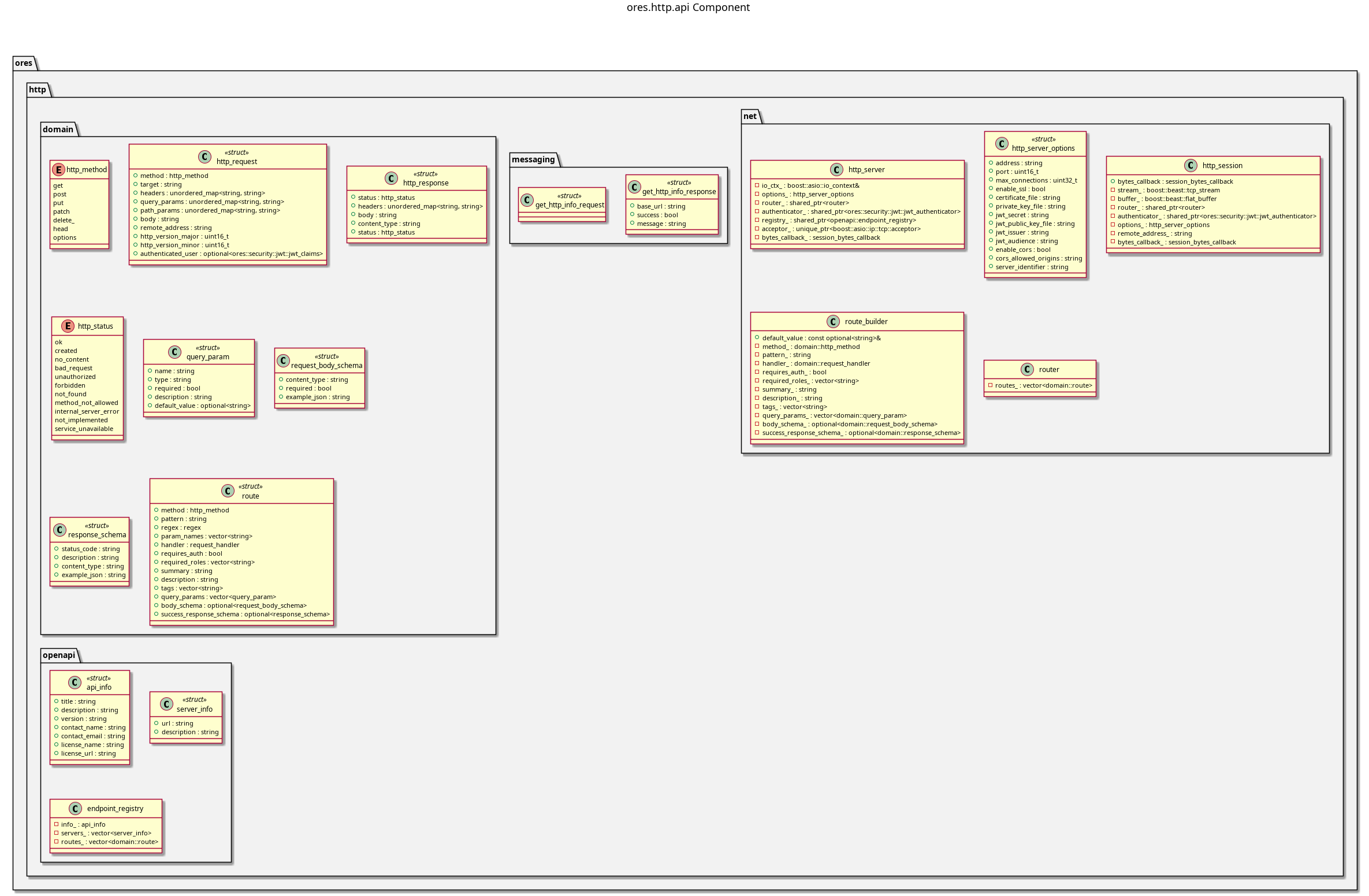
Figure 1: ores.http.api
Summary
ores.http.api is the primary HTTP infrastructure library for ORE Studio. It
provides an asynchronous HTTP/1.1 server built on Boost.Beast and Boost.Asio,
JWT authentication middleware (parsing, validation, and claims extraction),
path-based routing, an OpenAPI endpoint registry, and all domain types for HTTP
request/response and JWT claims. This is the foundation for the REST-API surface
exposed to external clients (web, mobile) alongside the NATS-based internal API.
Inputs
- Incoming HTTP requests on the configured TCP port.
- JWT tokens in the
Authorization: Bearerheader for authenticated routes. - Configuration: bind address, port, JWT public key.
Outputs
- HTTP responses to clients.
- Parsed JWT claims injected into request context for downstream handlers.
- OpenAPI endpoint registry used to generate
openapi.jsonat runtime.
Entry points
include/ores.http.api/net/http_server.hpp— server lifecycle management.include/ores.http.api/net/router.hpp— route registration and dispatch.include/ores.http.api/domain/— HTTP and JWT domain types.include/ores.http.api/openapi/— OpenAPI endpoint registry.include/ores.http.api/messaging/— any NATS protocol schemas for HTTP bridge.
Dependencies
- Boost.Beast, Boost.Asio — async HTTP server.
nlohmann/jsonorrfl— JWT claim serialisation.ores.iam.api— JWT claims types aligned with IAM sessions.
See also
- ores.http.core — concrete route implementations (IAM, assets, risk, etc.).
- ores.http.server — server entrypoint.