ores.nats
Table of Contents
1. Diagram
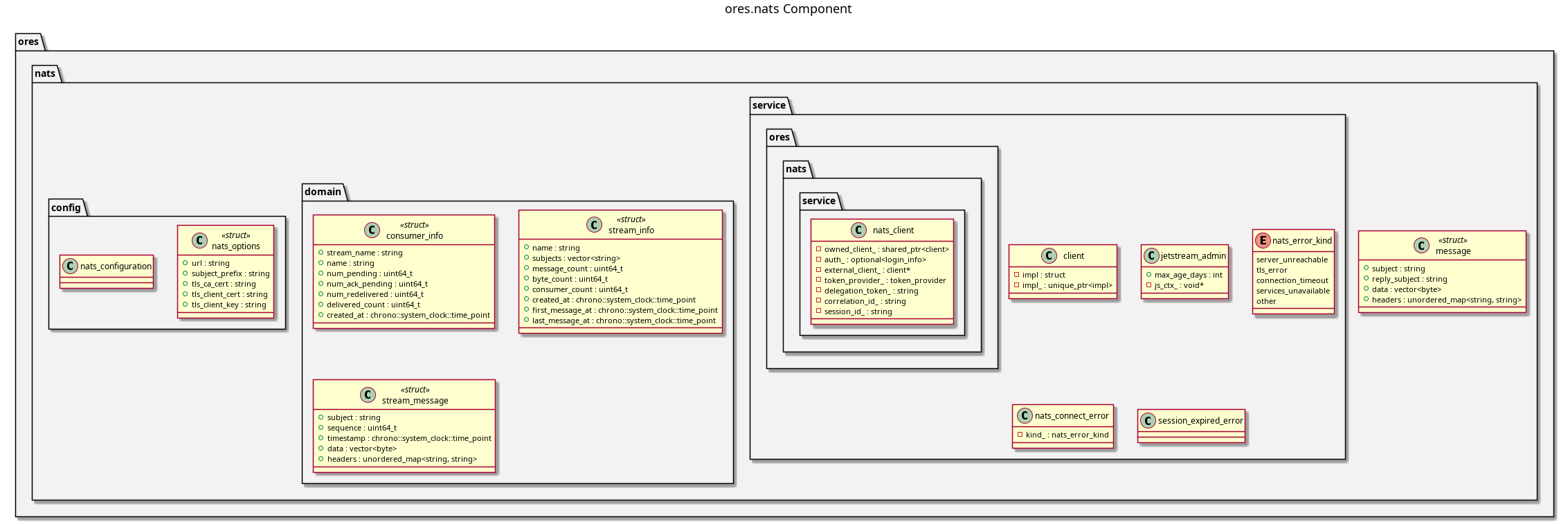
Figure 1: ores.nats
2. Summary
ores.nats is the NATS messaging transport library for ORE Studio. It provides
the three messaging patterns used across all services: synchronous request/reply,
queue-group subscribe for load-balanced handlers, and JetStream for durable event
streams. Every message body is serialised by wire_codec in the format the
process resolved at startup, msgpack unless ORES_NATS_WIRE_FORMAT says
otherwise, so the format is decided once and never renegotiated per message.
Subject names follow the convention {domain}.v1.{entity}.{operation}, with an
optional prefix for multi-instance deployments. The library is a direct
dependency of every domain service.
3. Inputs
- NATS server URL and optional subject prefix from configuration.
- Encoded request messages from clients or other services, with a bearer token where the caller authenticated.
- JetStream stream configuration for durable event streams.
4. Outputs
- Encoded reply messages sent to the caller's reply subject.
- Queue-group subscriptions delivering messages to exactly one handler instance.
- JetStream published messages and consumer acknowledgements.
5. Entry points
include/ores.nats/service/client.hpp— connection, publish, subscribe and JetStream publish, the surface every caller uses.include/ores.nats/service/jetstream_admin.hpp— stream provisioning.include/ores.nats/service/subscription.hpp— queue-group subscribe.include/ores.nats/service/jwks.hpp— the IAM public-key fetch the service runner uses to verify tokens.include/ores.nats/domain/message.hpp— NATS message and correlation types.include/ores.nats/domain/wire_codec.hpp— the encoder every caller writes through.include/ores.nats/config/—nats_optionsand CLI argument parsing.
6. Dependencies
nats.c— C NATS client library.rfl— JSON and msgpack serialisation for message payloads.ores.logging— structured logging.
7. See also
- NATS — the upstream messaging technology: subjects, wildcards, queue groups, JetStream, NKey/JWT security.
- ORE Studio Messaging Reference — index of every service's subject namespace and links to per-service messaging references.