ores.platform
Table of Contents
1. Diagram
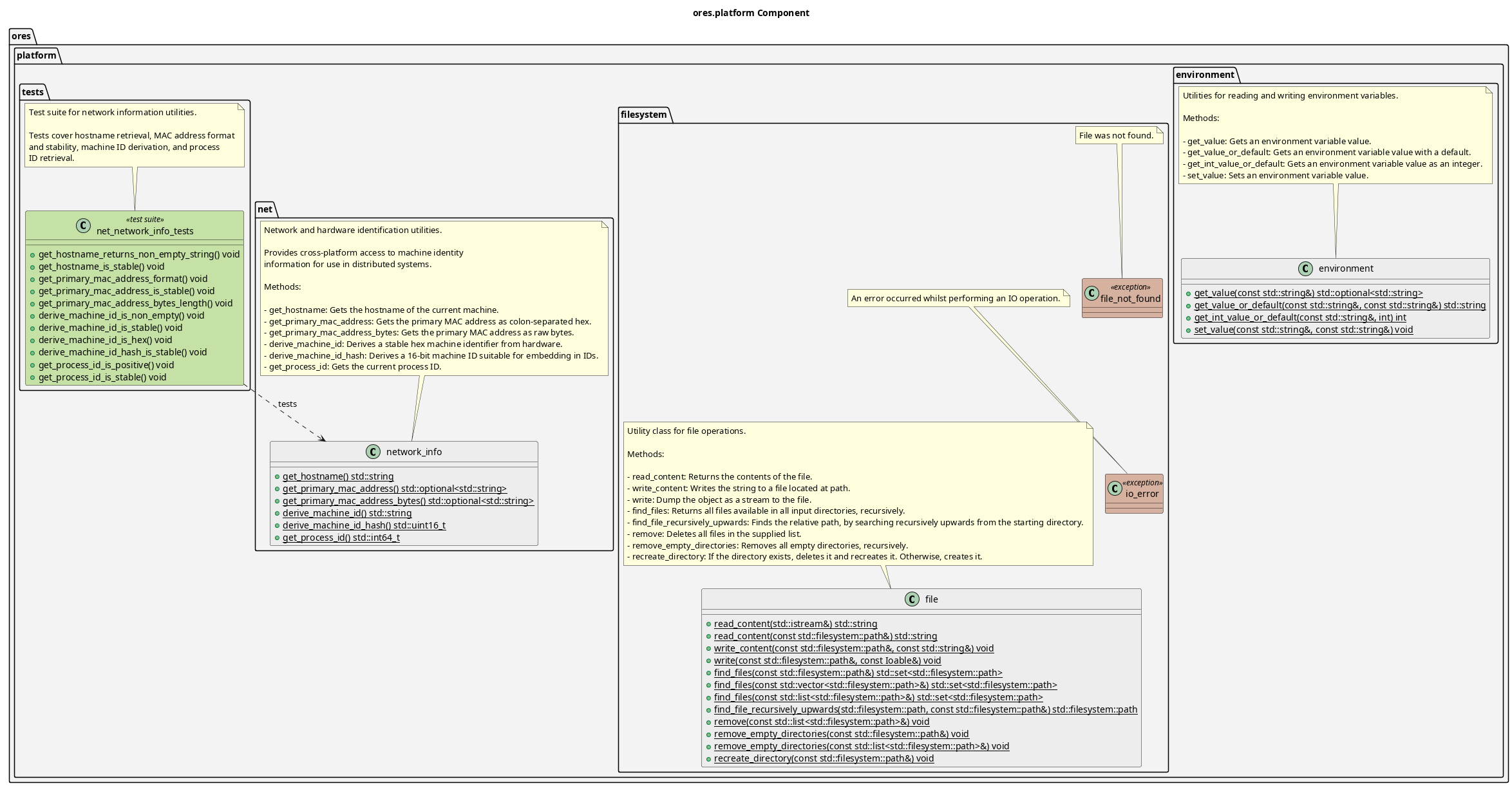
Figure 1: ores.platform
2. Summary
ores.platform is the single home for platform-specific code in ORE
Studio. It wraps the operating-system facilities that every other
component would otherwise reach for directly, so that no other component
carries a _WIN32, __linux__ or __APPLE__ conditional, and no other
component includes a raw OS header. A component that needs a platform
concern calls this component; when the concern has no home here yet, the
abstraction is added here first and only then used.
The component holds no ORE Studio dependency. Its dependencies are the
C++ standard library and Boost: Boost::process supplies the current
process id, and Boost::exception supplies the exception hierarchy the
filesystem facet throws. That independence is what makes it usable from
every layer, from the foundation libraries up to the services and the
shell, without a risk of a dependency cycle.
The component is model-free. It owns no entity, no NATS subject and no protocol header, so none of its types is generated and none appears on the wire. Everything it exposes is hand-written.
The time facet is the busiest surface by a wide margin:
ores.platform/time/datetime.hpp is included by several hundred files
across the tree, which is why its format policy matters beyond this
component. Timestamps are stored and transmitted as UTC, in ISO 8601
with a Z suffix; local time is used for display only.
3. Facets
environment/— process environment variables, read through an injectableenvironment_providerso that a caller can substitute an in-memory map for the real environment under test. The facet shipsfake_environment_providerfor that purpose, andenvironmentroutes every call through the installed provider.filesystem/— reading and writing file content, deleting a list of files, thefile_not_foundandio_errorexceptions the facet raises, and thescoped_temp_fileandscoped_temp_directoryguards that own a temporary path until they leave scope.net/— machine identity: the hostname, the primary non-loopback hardware address in both colon-separated and raw-byte form, and the stable machine identifier derived from the two.process/— the current process id, the path and build time of the running binary, and the signal set a service treats as a request for a graceful shutdown.time/— the time conversion and formatting surface.datetimeowns the ISO 8601 and database string formats,time_utilsowns the cross-platformgmtime,localtimeandtimegmwrappers plus the calendar-date conversions, andrelative_time_formatterrenders human-readable relative times such as "yesterday" and "in 3 days".
4. Inputs
- Operating-system environment variables.
- Filesystem paths for file read and write operations.
- System network interfaces, for the hardware identity.
- The executable's own filesystem metadata, for its build time.
time_tandstd::chronotime points supplied by callers.
5. Outputs
- Type-converted environment variable values, with the absent and the unparseable case both distinguishable from a real value.
- File content, and the exceptions raised when a file or directory cannot be read.
- A path under the system temporary directory, held by a guard that removes it on destruction.
- The hostname, the primary MAC address, a stable hex machine identifier, and the current process id.
- Cross-platform
time_tto UTC and localtmconversions, ISO 8601 and database timestamp strings, calendar dates, and relative-time display strings. - The running binary's path and build time.
6. Entry points
include/ores.platform/environment/—environment,environment_provider,fake_environment_provider,real_environment_provider.include/ores.platform/filesystem/—file,file_not_found,io_error,scoped_temp_file,scoped_temp_directory.include/ores.platform/net/—get_hostname,get_primary_mac_address,get_primary_mac_address_bytes,derive_machine_id,derive_machine_id_hash.include/ores.platform/process/—current_pid,executable_path,executable_build_time,shutdown_signals.include/ores.platform/time/—datetime,time_utils,relative_time_formatter,k_timestamp_format.
7. Dependencies
- The C++ standard library.
Boost::process— the current process id.Boost::exception— the exception hierarchy the filesystem facet throws.
No ORE Studio component is a dependency of this one.
8. See also
- Component Architecture Audit – the structural checklist and the platform-placement rule this component exists to satisfy.
- Component Clean Standard – the checklist this component was worked through.
- Time and Timestamps: Architecture and Conventions – the UTC-storage and local-display policy the
timefacet implements. - Facet – the catalogue that fixes the facet folder names above.
- Component Documentation Guide – what fills this overview well.
- PlantUML class diagram conventions – the rules the component diagram follows.
- Unit test conventions – the Catch2 conventions the component's tests follow.
- Code Review Checklist – the naming and component-only checks this component passes.
target_link_libraries(${lib_target_name}
    PUBLIC
        Boost::boost
        Boost::exception
    PRIVATE
        Boost::process)
target_link_libraries(${tests_target_name}
    PRIVATE
        ${lib_target_name}
        ores.telemetry.core.lib
        ores.utility.lib
        ores.testing.lib
        Catch2::Catch2
        faker-cxx::faker-cxx
        ores.openssl_cleanup
        Threads::Threads)