ores.qt.scheduler
Table of Contents
Diagram
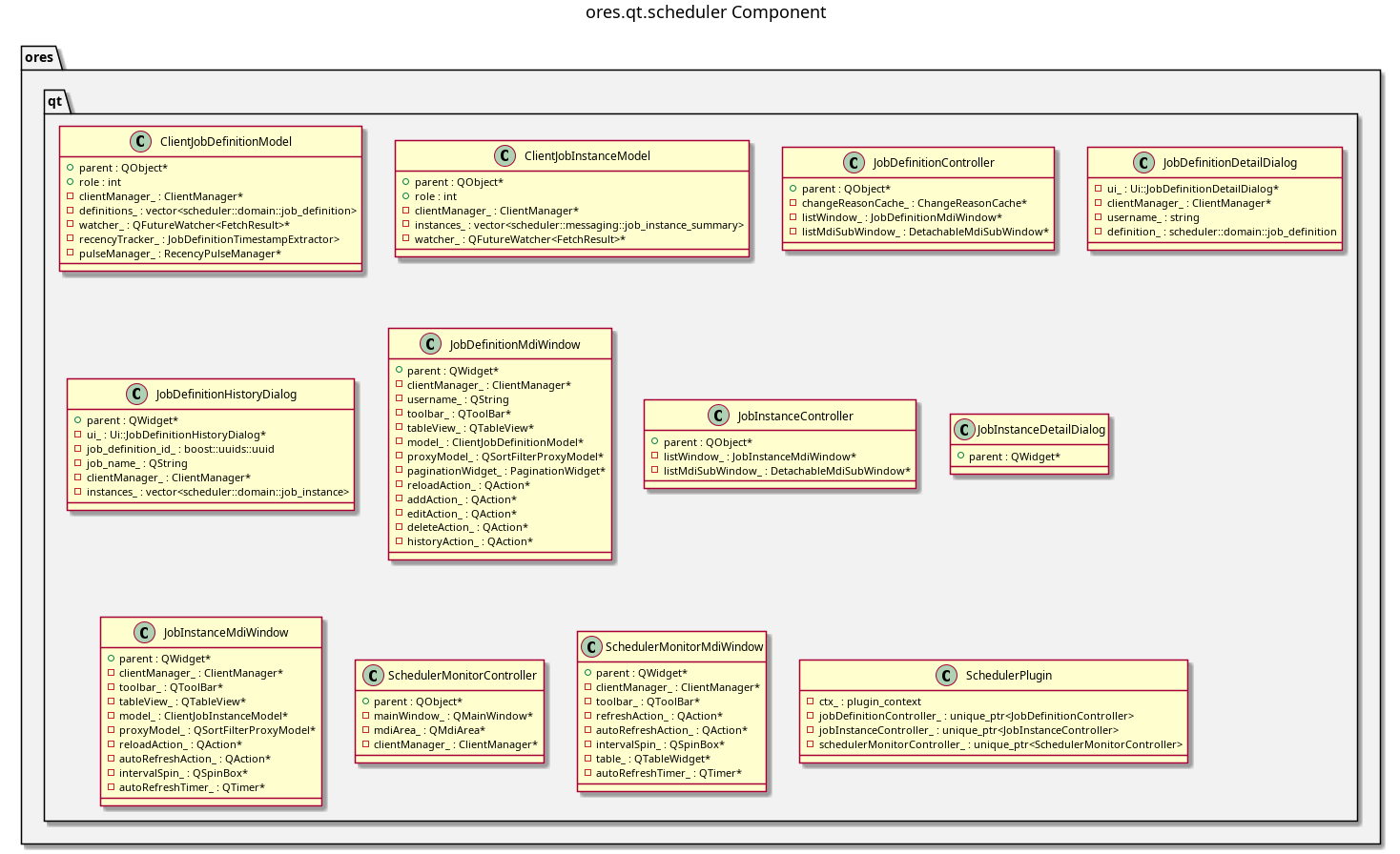
Figure 1: ores.qt.scheduler
Summary
ores.qt.scheduler is the Qt plugin for the job scheduling domain. It
provides MDI windows and dialogs for managing job definitions, viewing and
managing job instances, and the Scheduler Monitor for live job-state
inspection. It owns the Operations top-level menu and contributes the
job-related items (Job Definitions, Job Instances, Job Monitor) to it;
ores.qt.workflow contributes workflow items to the same menu.
Inputs
- NATS responses from the scheduler service (job definitions, job instances, job state events).
- User interactions: create/edit job definitions, monitor/cancel job instances.
shared_menus_context.operations_menupointer for menu ownership.
Outputs
- Rendered MDI windows for job definition, job instance, and scheduler monitor.
- NATS request messages sent to the scheduler service on user actions.
- Operations top-level menu (returned via
create_menus).
Entry points
include/ores.qt/SchedulerPlugin.hpp— plugin class; owns Operations menu.include/ores.qt/JobDefinitionController.hpp— job definition controller.include/ores.qt/JobInstanceController.hpp— job instance controller.include/ores.qt/SchedulerMonitorController.hpp— live job-state monitor.
Dependencies
ores.qt.api— IPlugin, base controller/window/dialog classes, ClientManager.ores.scheduler.api— job definition and instance domain types and NATS schemas.
See also
- ores.scheduler.api — domain types and NATS protocol schemas for scheduling.
- ores.qt.workflow — contributes workflow items to the Operations menu.
- ores.qt.api — shared Qt infrastructure and base classes.
- Qt Plugin Architecture — plugin lifecycle and menu-contribution model.
- Entity Controller Pattern — controller/window/dialog/model structure.