ores.security
Table of Contents
1. Diagram
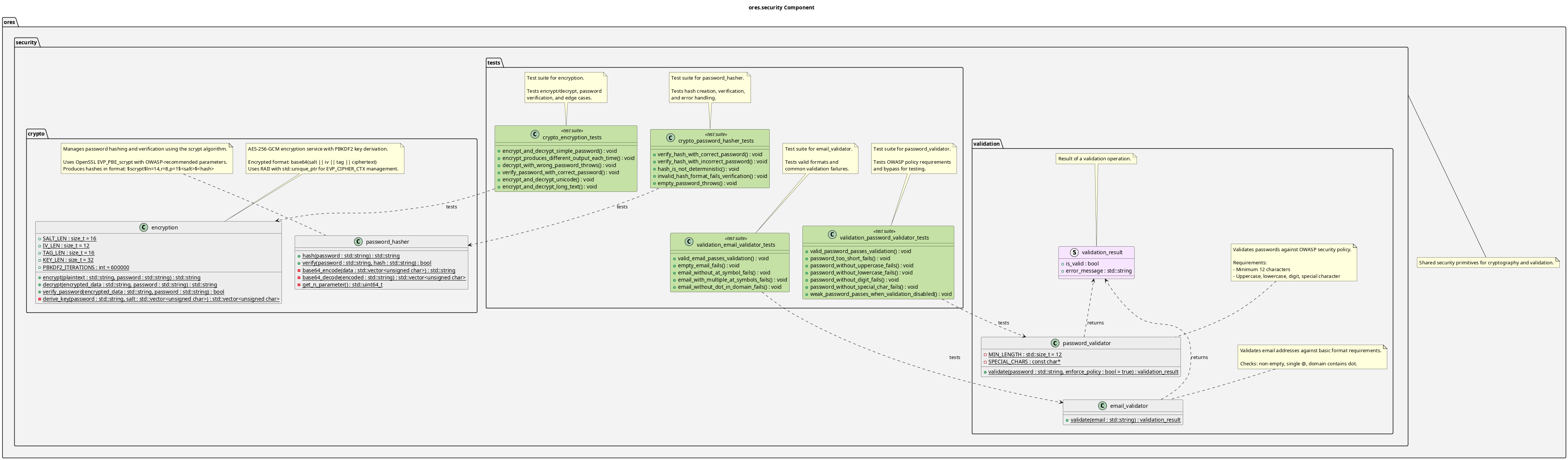
Figure 1: ores.security
2. Summary
ores.security holds the security primitives the tree shares: the scrypt
password hash, JWT signing and validation, and the policy validators for
passwords and email addresses. It owns no entity, no protocol and no
subject, so nothing here is generated and nothing here appears on the wire
except the tokens it mints and reads.
The JWT facet is the component's public face by a wide margin: 441 C++ files
outside the component include jwt_authenticator.hpp, because every service
validates the tokens IAM issues. The rest is narrow: password_hasher.hpp
reaches 4 files, jwt_claims.hpp 7, jwt_error.hpp 2, and the two
validators 2 each. The password hash and the validators are IAM's bootstrap
handler, account operations and signup services, and one build helper in
ores.web; the claims reach IAM's auth and account handlers, the HTTP
request shape, and the synthetic feed handlers.
The component is cryptographic, so the cost of a hash and the reach of a token are its two policy surfaces, and both are pinned by tests rather than by convention.
3. Facets
crypto/—password_hasher, the scrypt hash and its verification. The hash string carries its own parameters in the$scrypt$ln=14,r=8,p=1$<salt>$<hash>form, so a stored hash states the cost it was made with. Production uses ln=14, the OWASP-recommended cost;ORES_TEST_PASSWORD_FASTselects ln=10 for the suite. Verification refuses a stored hash weaker than the cost the running build produces, so a downgraded hash cannot be used to make an offline attack cheap.jwt/—jwt_authenticatorsigns with HS256 or RS256 and validates with either, constraining the algorithm, the issuer, the audience and the expiry, and reporting which of those failed throughjwt_error.jwt_claimsis the shaped claim set the rest of the tree reads, andboost_json_traitsbinds jwt-cpp to Boost.JSON.validation/—password_validatorapplies the OWASP policy (at least 12 characters, upper and lower case, a digit and a special character), andemail_validatorchecks the shape of an address. Both returnvalidation_result, which carries the verdict and the reason.
4. Inputs
- A plaintext password to hash, and a password plus a stored hash to verify.
- A
jwt_claimsto sign, and a token to validate. - A candidate password or email address for the policy validators.
5. Outputs
- A scrypt hash string, or a boolean verification verdict.
- A signed token, or the validated claims.
- The
jwt_errorcase that stopped validation, when one did. - A
validation_resultcarrying the verdict and, when invalid, the reason.
6. Entry points
include/ores.security/ores.security.hpp— the namespace documentation header, whose@briefis this component's doxygen description.include/ores.security/crypto/password_hasher.hpp—hash,verify.include/ores.security/jwt/jwt_authenticator.hpp—create_hs256,create_rs256_signer,create_rs256_verifier,create_token,validate,validate_allow_expired.include/ores.security/jwt/jwt_claims.hpp—jwt_claims.include/ores.security/jwt/jwt_error.hpp—jwt_error,to_string.include/ores.security/validation/password_validator.hpp— the password policy.include/ores.security/validation/email_validator.hpp— the email shape.include/ores.security/validation/validation_result.hpp— the verdict type both validators return.
7. Dependencies
OpenSSL— scrypt, the random salt, and the RSA and HMAC primitives the JWTs are signed with.jwt-cpp, over theboost-jsontraits — token creation, decoding and the claim checks.ores.utility— the Base64 codec the hash string and the tokens use.ores.platform— the environment the fast-hash test flag is read from.ores.logging— the logger each facet writes to.
8. Recorded findings
- The validation error mapping was unreachable.
validateandvalidate_allow_expiredmapped jwt-cpp failures by searching the exception message for words such as "issuer" and "signature", and jwt-cpp's messages do not contain them, so every failure was reported asinvalid_tokenand the named cases were dead. Both now map from jwt-cpp'stoken_verification_errorcode and from the signature exception type, and each case has a test. validate_allow_expireddid not check the audience. The refresh path relaxed the expiry and, in doing so, skipped the audience constraintvalidateapplies, so a token minted for another service was accepted while the signature and issuer matched. It checks the audience now.- No not-before claim is ever set. The survey asked for an
nbftest;create_tokensets onlyiatandexp, so the not-yet-valid path cannot be reached through this API at all. Recorded rather than tested, because a test would have to fake the claim through jwt-cpp directly and would prove nothing about this component. crypto/encryptionis gone. It carried the component's only AES-256-GCM and PBKDF2 surface, and no file in the tree included it: its own test was the only consumer. It was deleted with that test rather than kept as an unused capability.- The namespace header stays.
ores.security.hppdocuments theores::securitynamespace for doxygen, and the diagram conventions read its@briefwhen they label the component, so a consumer census does not apply to it. G08 of the Component Clean Standard states that for every component.
9. See also
- Component Architecture Audit – the structural checklist and the placement rules this component is measured against.
- Component Clean Standard – the checklist this component was worked through.
- Facet – the catalogue that fixes the facet folder names above.
- Component Documentation Guide – what fills this overview well.
- PlantUML class diagram conventions – the rules the component diagram follows.
- Unit test conventions – the Catch2 conventions the component's tests follow.
- Code Review Checklist – the naming and component-only checks this component passes.