ores.sql
Table of Contents
1. Diagram
The schema is one diagram per group, because 463 tables in a single picture overflowed PlantUML's raster budget. The index names every group, the file it is drawn in and the tables it holds, and each group is drawn on its own.
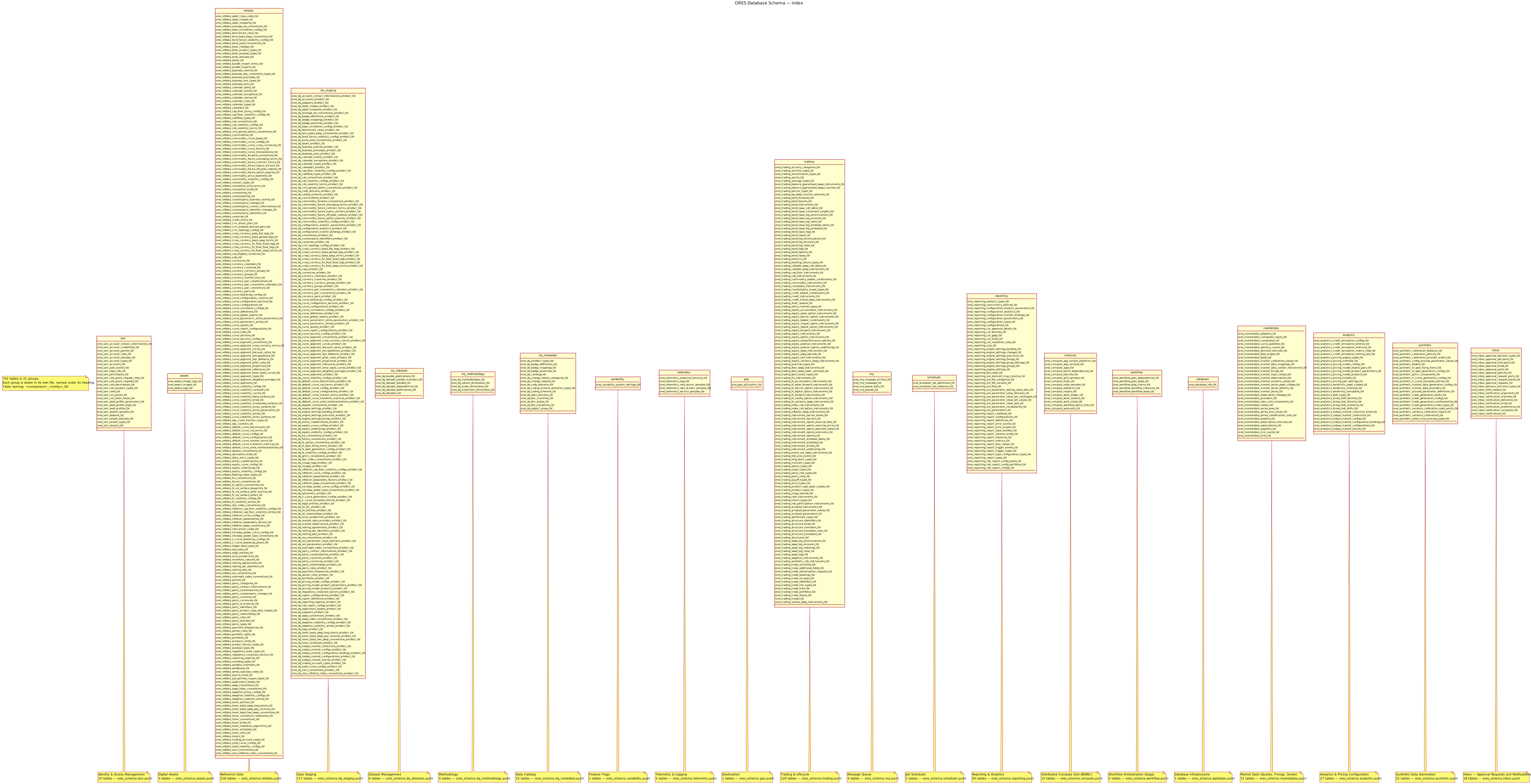
Figure 1: The schema index
| Group | Tables | Diagram |
|---|---|---|
| iam | 24 | 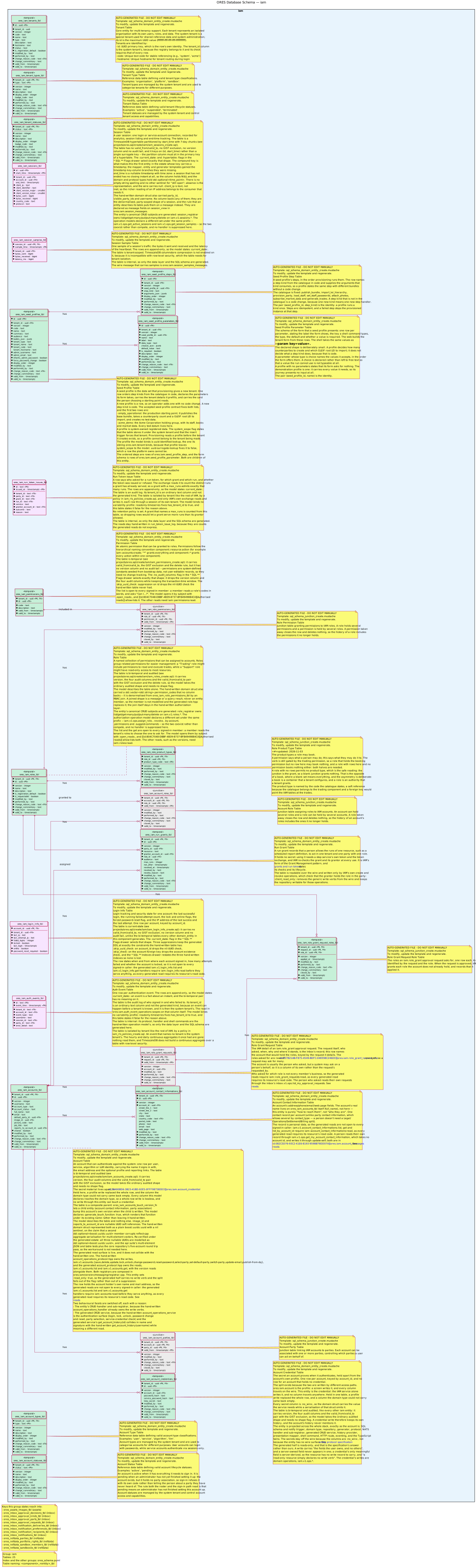 |
| assets | 3 | 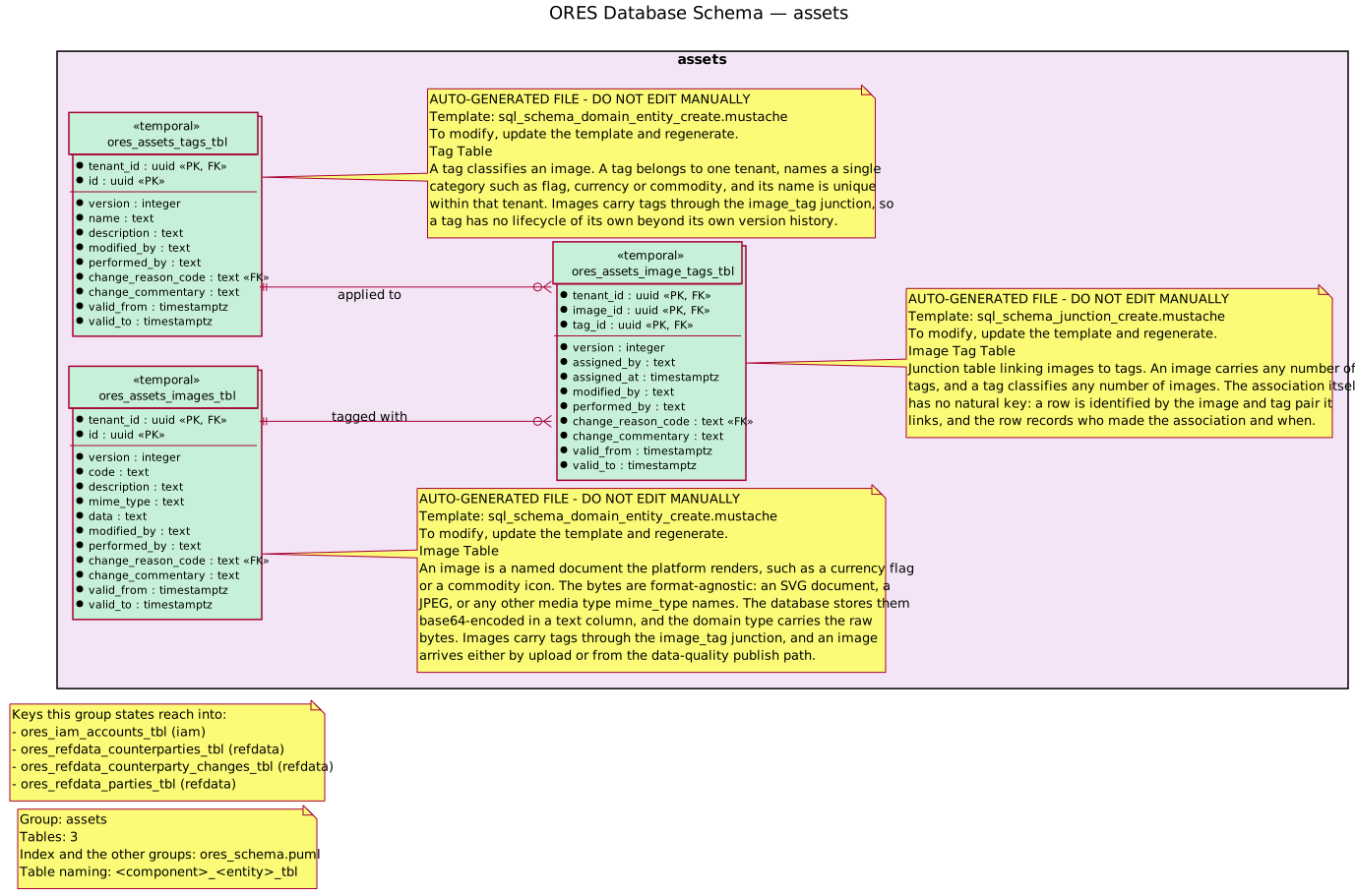 |
| refdata | 153 |  |
| dq_staging | 57 |  |
| dq_datasets | 6 | 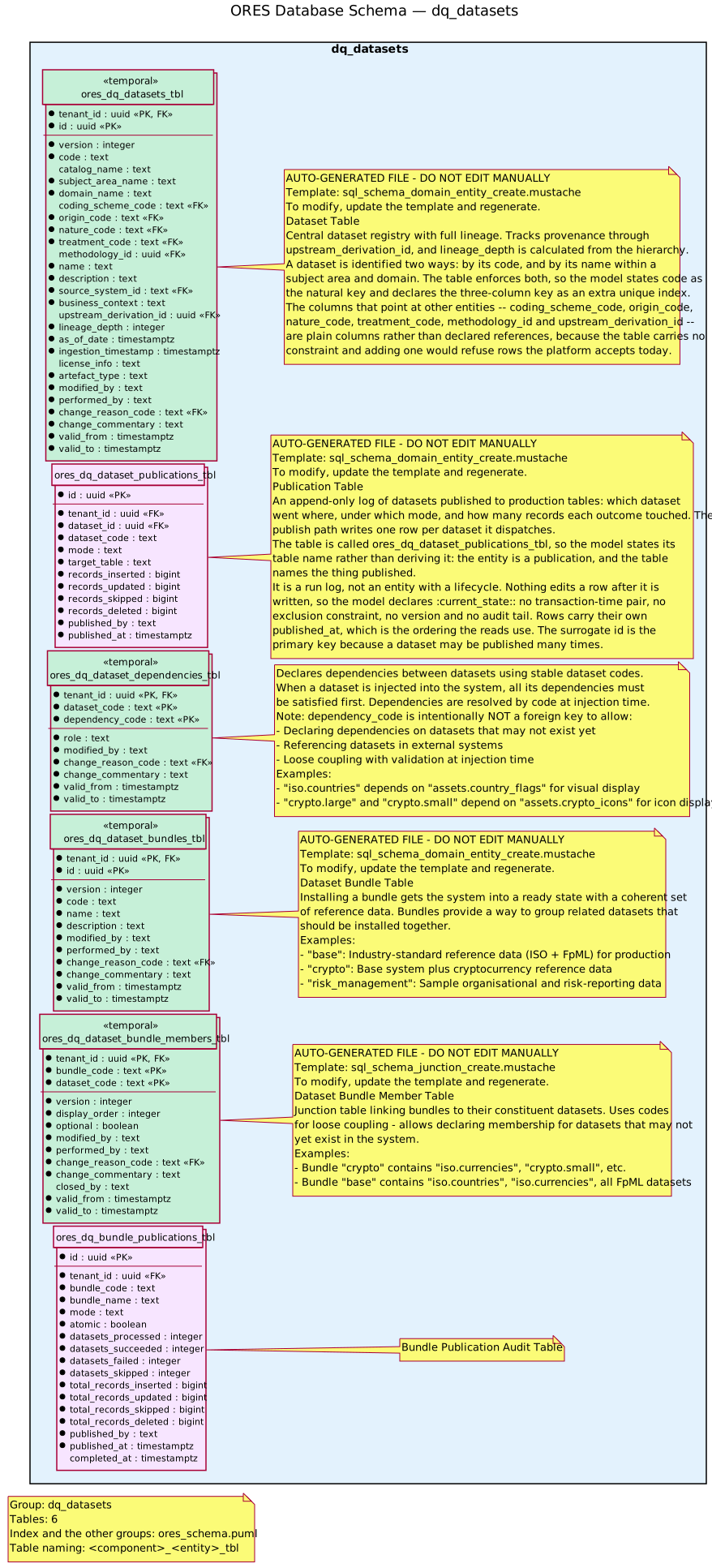 |
| dq_methodology | 4 | 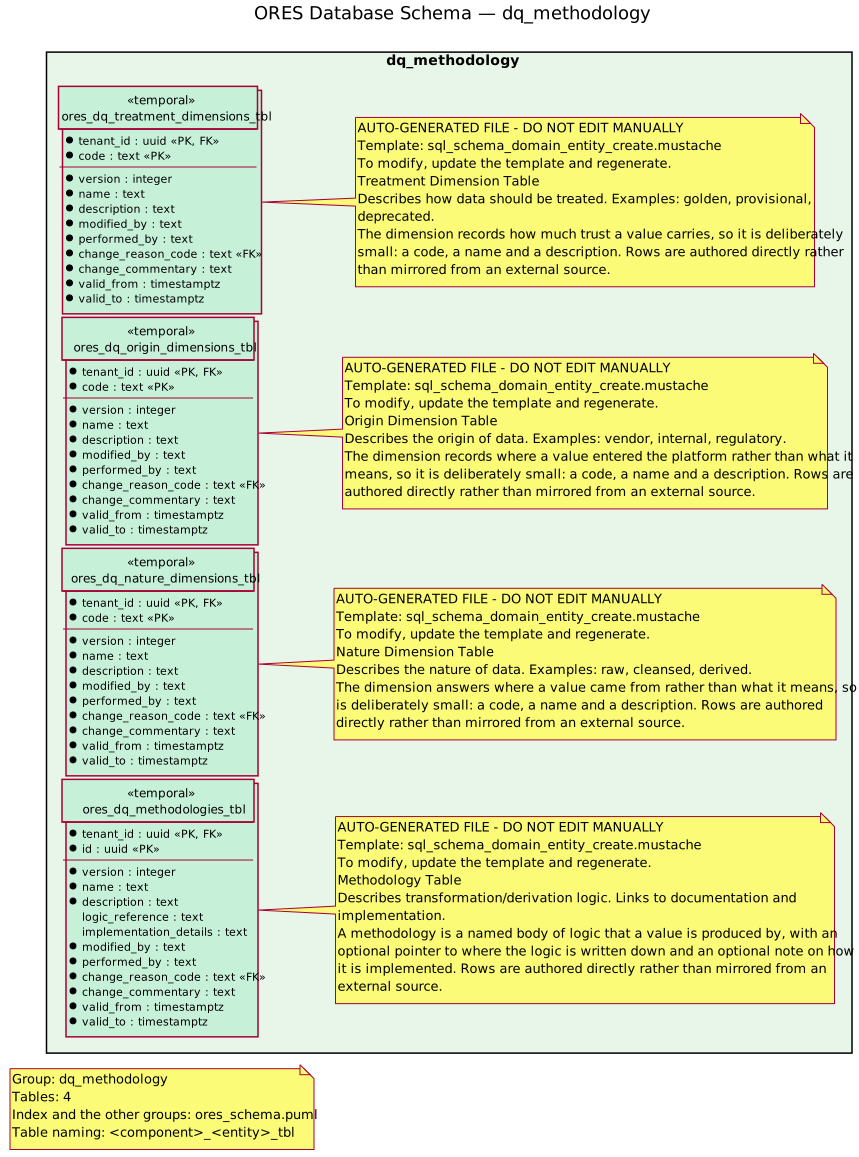 |
| dq_metadata | 15 | 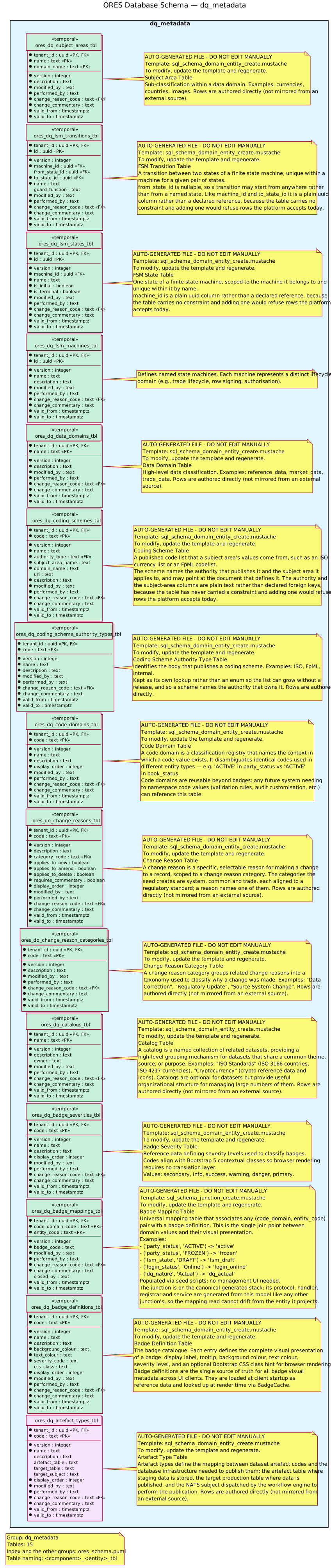 |
| variability | 1 | 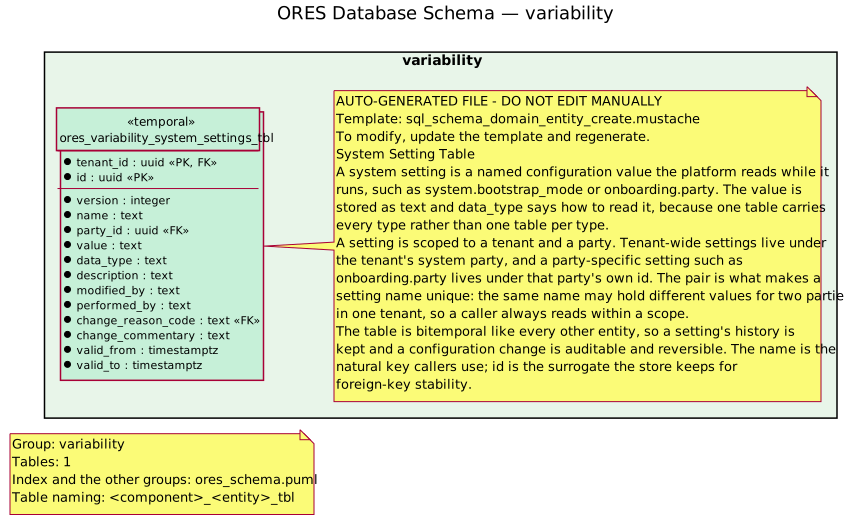 |
| telemetry | 5 | 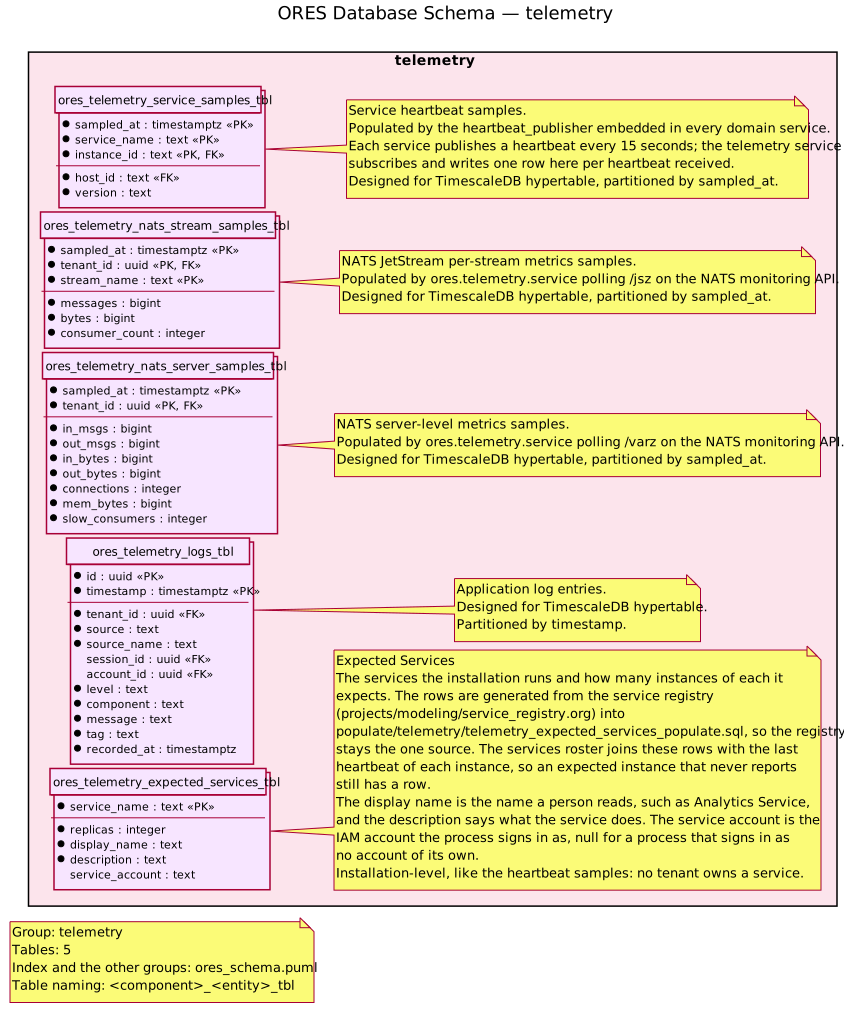 |
| geo | 1 | 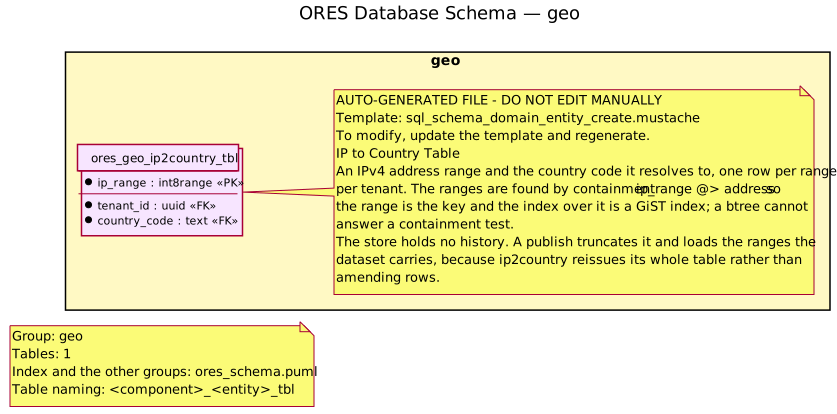 |
| trading | 99 |  |
| mq | 4 | 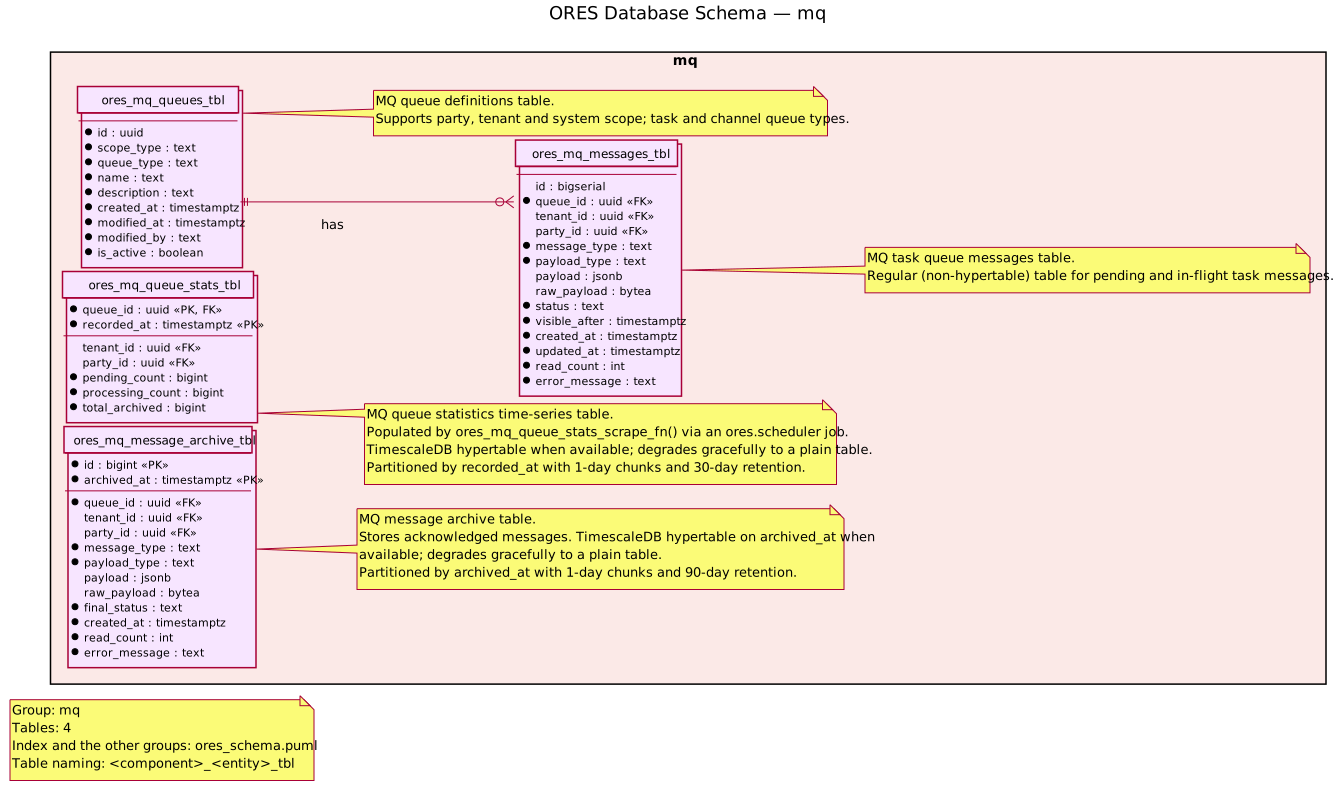 |
| scheduler | 2 | 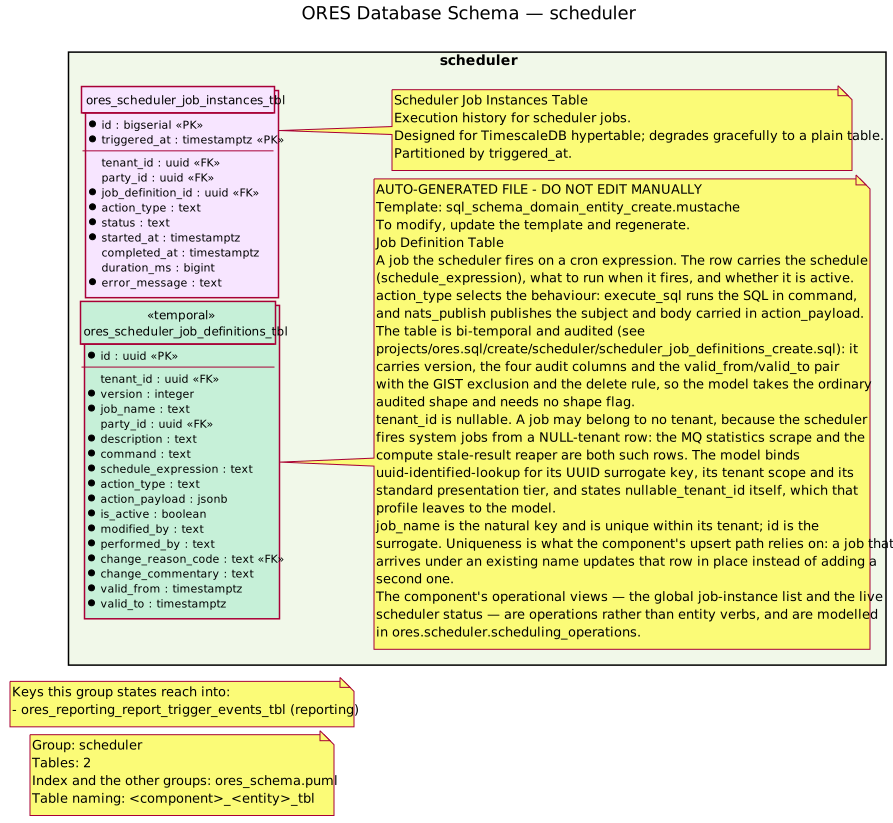 |
| reporting | 20 | 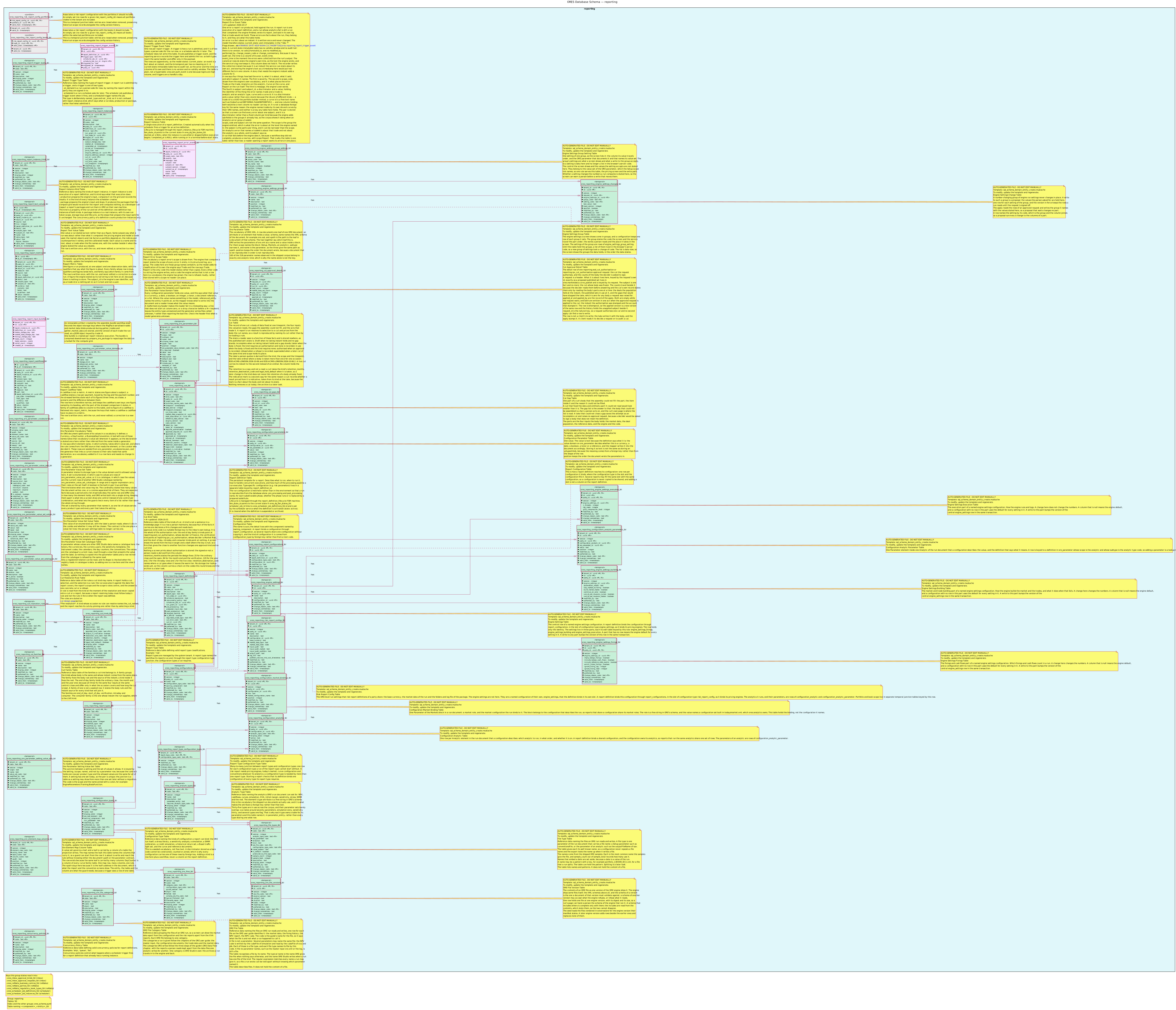 |
| compute | 12 | 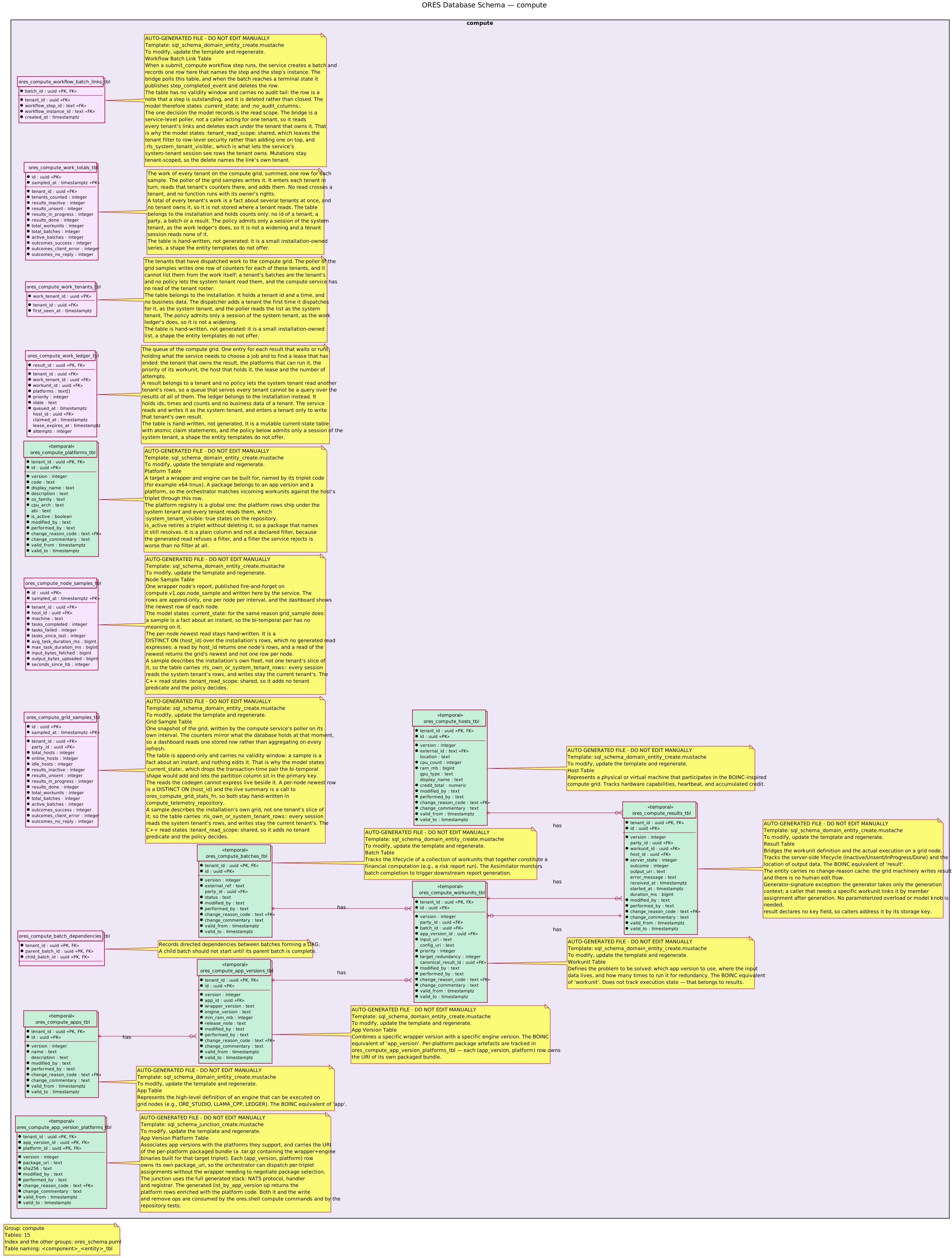 |
| workflow | 4 | 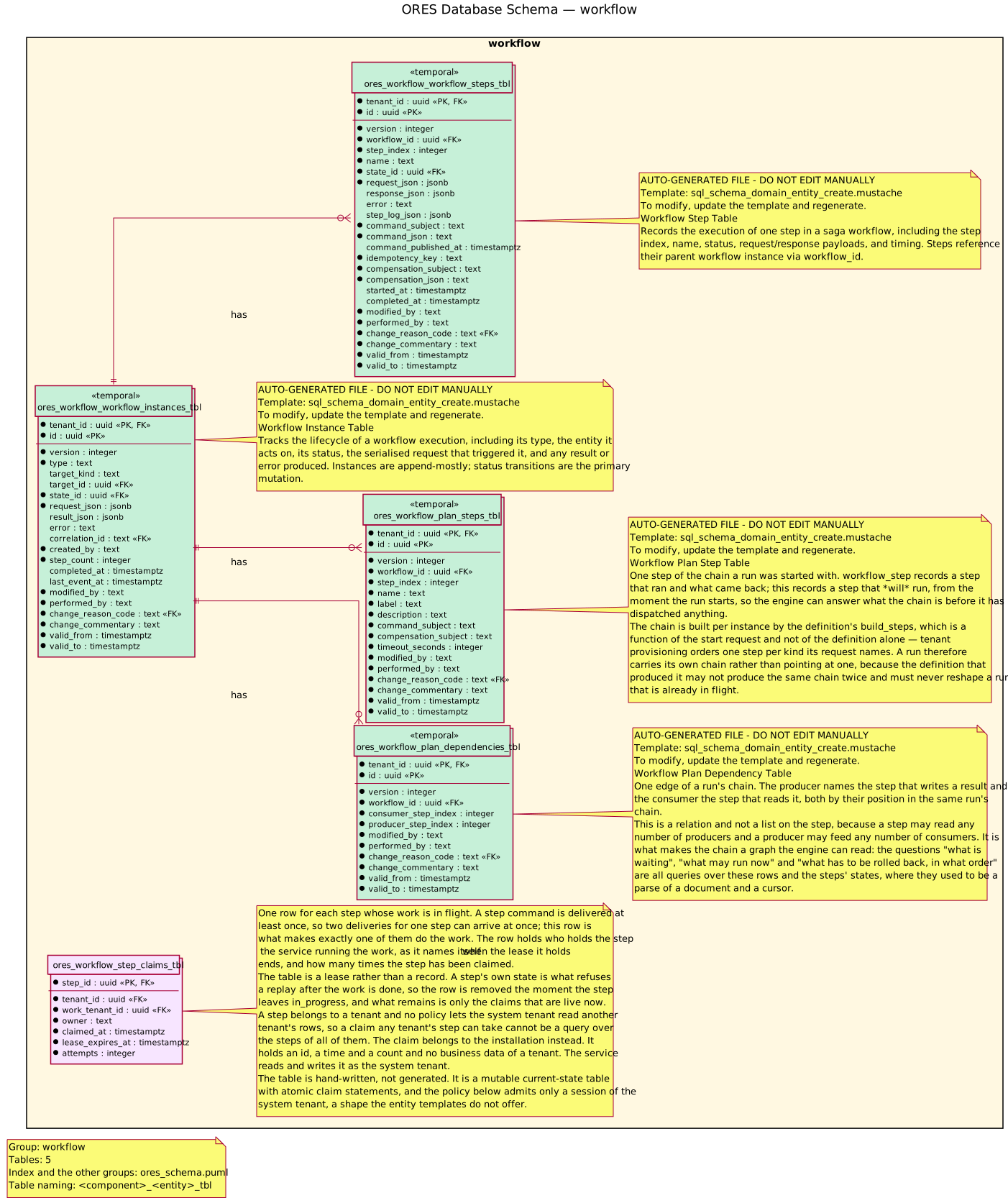 |
| database | 1 | 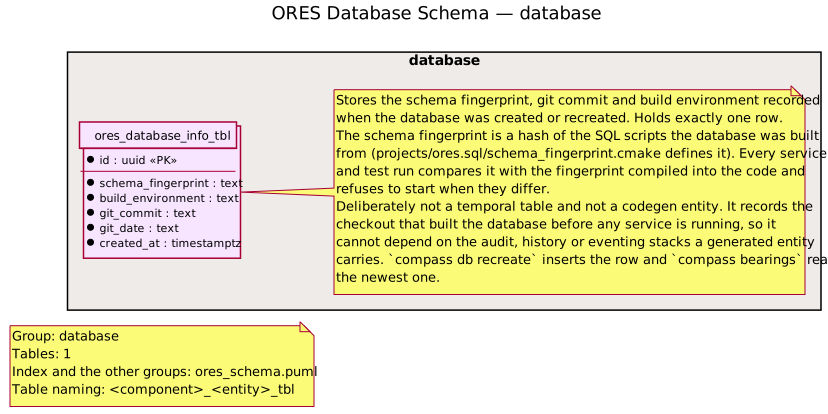 |
| marketdata | 10 |  |
| analytics | 20 | 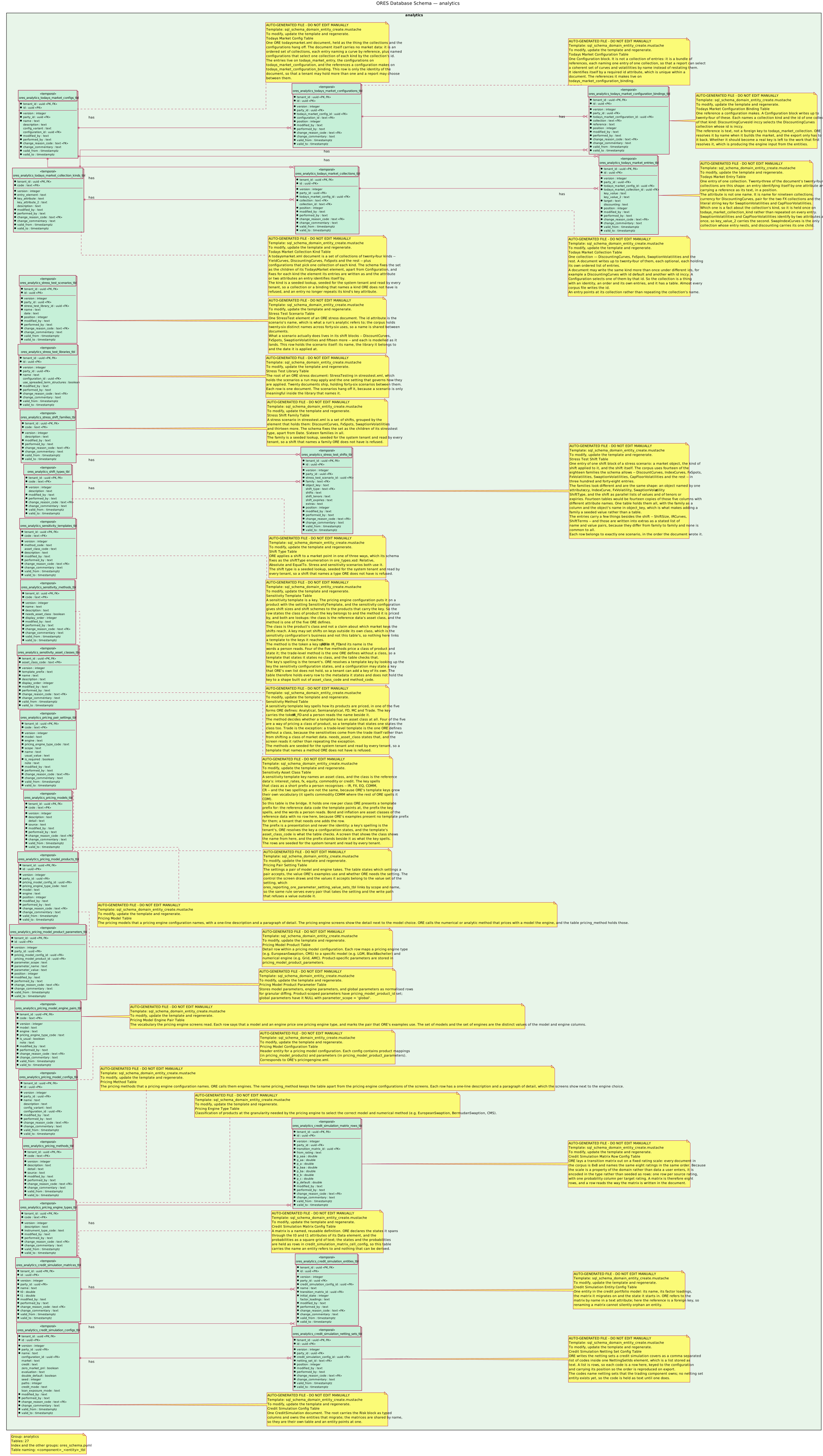 |
| synthetic | 9 | 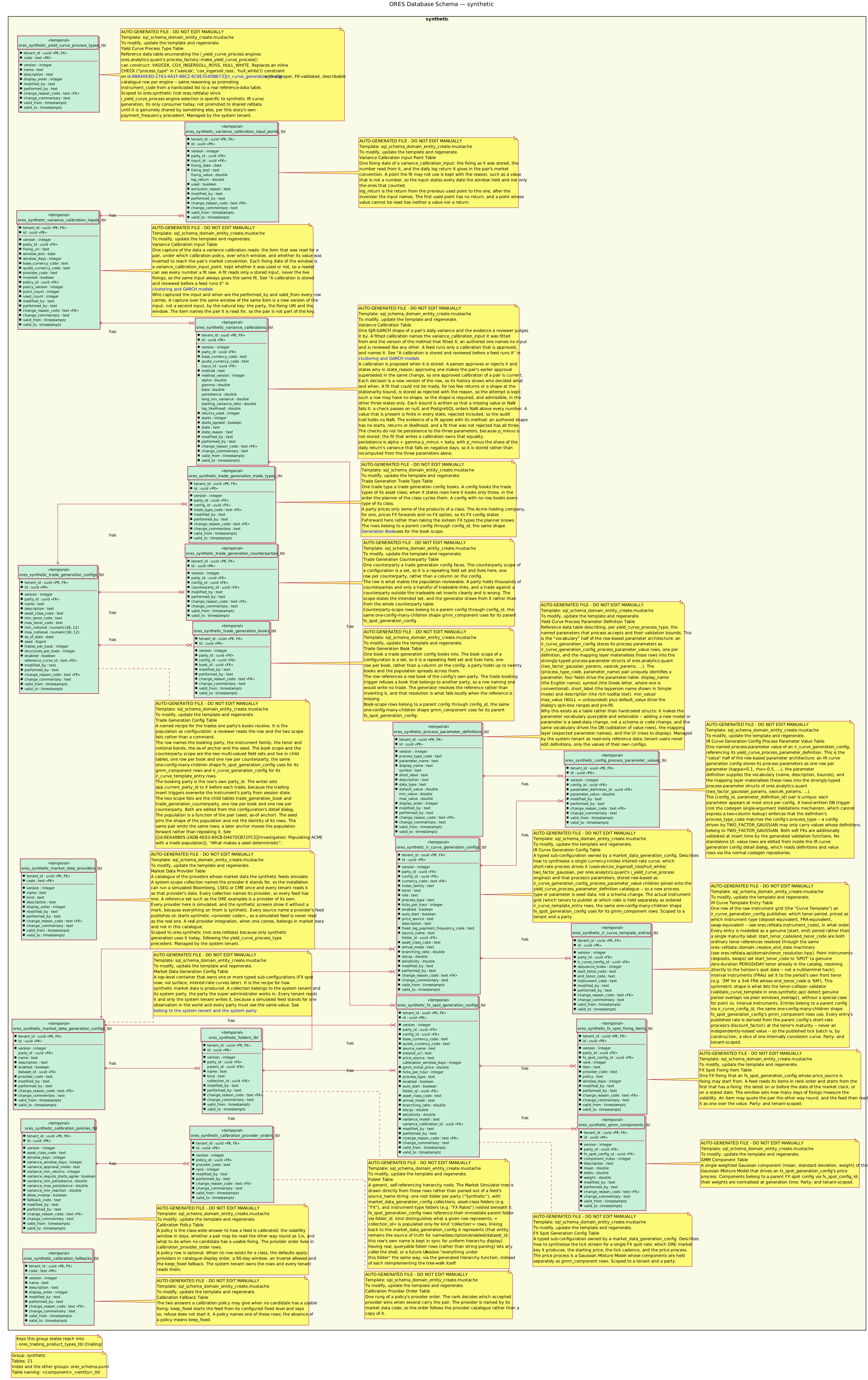 |
| inbox | 13 | 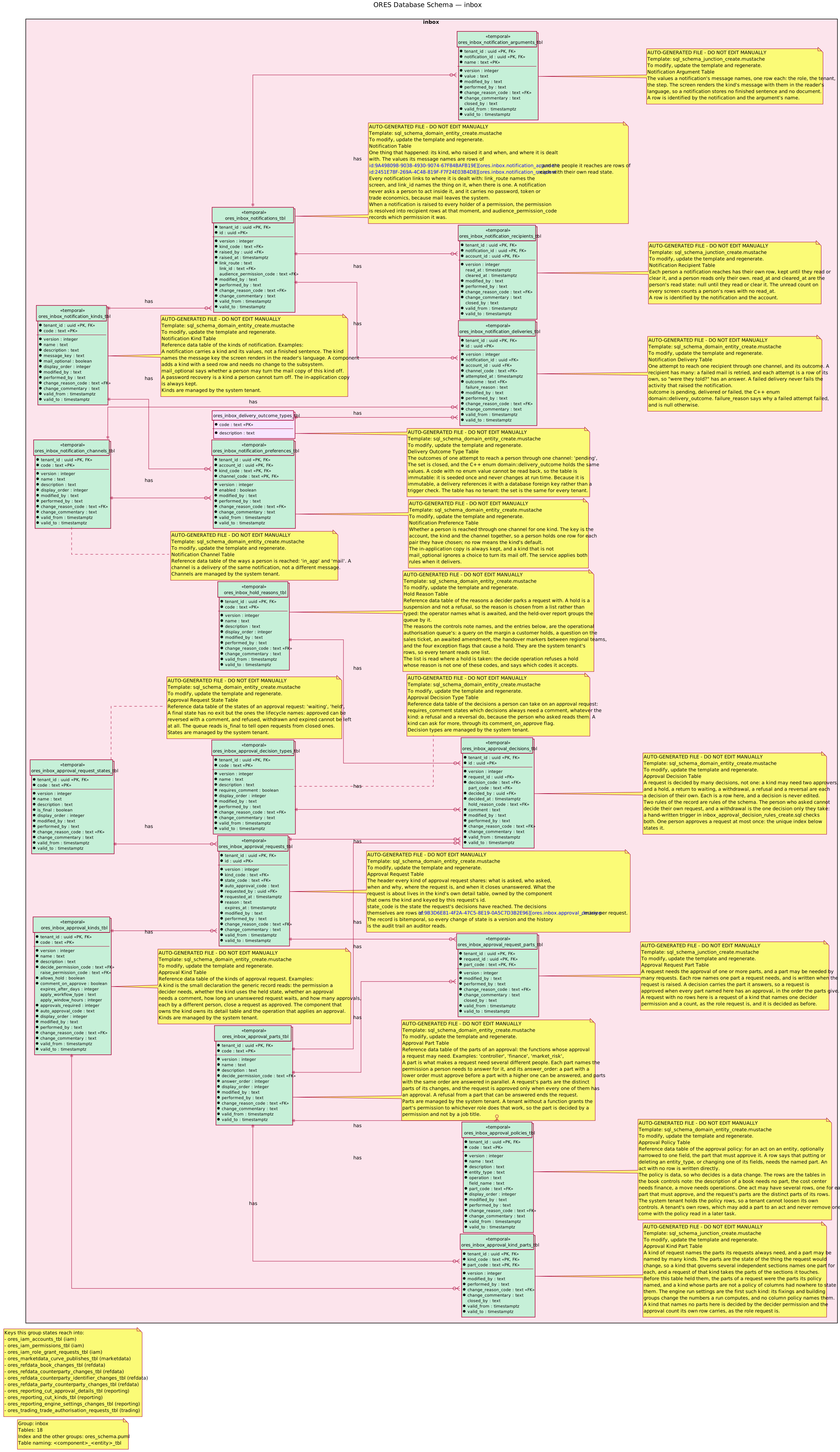 |
2. Summary
ores.sql contains the PostgreSQL schema, role provisioning, and lifecycle
management for the ORE Studio database. All tables use a single public
schema with the ores_ prefix and domain sub-prefix (ores_iam_*,
ores_refdata_*, ores_trading_*, etc.). Service database users
(ores_<env>_<service>_service) hold DML only on their own domain tables,
enforcing strict service table isolation. Helper scripts handle database
creation, reset, teardown, and SQL execution.
Schema upgrade policy: a database is never migrated. A schema change
edits the create/ scripts, which carry the canonical schema, and the
database is destroyed and recreated with compass db recreate -y -k.
There are no migration scripts and no backwards compatibility code:
nothing keeps an old table, column, name or permission code alive.
Schema fingerprint: schema_fingerprint.cmake hashes the SQL a
recreate reads (create/, populate/, instance/ and the top-level
.sql files). compass db recreate stamps it into
ores_database_info_tbl, and the build compiles the same value into
ores.database. Every service and test run compares the two when it
creates its database context, logs both, and refuses to start on a
mismatch; compass services start checks first. compass_db.schema_fingerprint
is the second implementation of the same definition, and a compass test
keeps the two in agreement.
3. Inputs
- PostgreSQL superuser credentials for initial setup.
- SQL DDL files under
create/. - Seed data files under
populate/.
4. Outputs
- A fully provisioned PostgreSQL database with all tables, roles, RLS policies, indexes, and seed data.
- Per-service users with exactly scoped DML grants.
5. Entry points
compass db recreate— drop and recreate the database from scratch (the standard schema upgrade path).compass db setup— create the database and apply DDL without dropping first.compass db sql— execute SQL against the ORE database.utility/validate_schemas.sh— validate schema consistency before push.
6. Scripts
All scripts live in projects/ores.sql/ and read credentials from .env
at the repository root (or from exported CI environment variables). Run them
from the repository root. service_vars.sh is auto-generated and not listed
here.
6.1. Lifecycle scripts
Scripts that manage the full database lifecycle: creation, teardown, recreation, reset, and SQL execution. Used during development setup, CI provisioning, and environment refresh.
| Script | Purpose | Notes |
|---|---|---|
compass db recreate |
Drop and fully recreate the database from scratch: roles, DDL, RLS, seed data. | Primary setup command; safe to re-run. Reads .env or CI env vars. |
compass db setup |
Create the database and apply DDL without dropping roles first. | Use when roles already exist but the database or schema needs creating. |
teardown_database.sh |
Tear down a named database — remove tables, revoke grants, drop roles. | Accepts DATABASE_NAME as argument. Checks for active connections before dropping. |
compass db drop |
Drop a named database, refusing if active connections are present unless --kill is passed. |
Connection checks ported into compass. |
compass db sql |
Execute a SQL file or command against the development database. | Reads host/credentials from .env; remaining args pass through to psql after --. |
compass db reset-system |
Reset all system-level data (IAM, roles, permissions) without dropping the schema. | Non-destructive; preserves tenant data. |
compass db reset-tenant |
Reset all tenant-level data for the current environment. | Non-destructive; preserves system data. |
recreate_env.sh |
Tear down and recreate the current environment's database end-to-end. | Combines teardown + recreate for a named environment. Reads .env. |
teardown_env.sh |
Tear down the current environment's database without recreating it. | Use when decommissioning a local or CI environment. Reads .env. |
6.2. Utility scripts
Scripts under utility/ for inspection, validation, and targeted
maintenance operations. Safe to run against a live database.
| Script | Purpose | Notes |
|---|---|---|
utility/validate_schemas.sh |
Validate SQL schema naming and convention invariants before pushing. | Requires Python 3. Run before committing schema changes. |
utility/validate_env_version.sh |
Verify the .env file's version is compatible with the current codebase. |
Guards against running stale env configs after schema migrations. |
utility/dump_database_version.sh |
Print the schema version currently recorded in the database. | Quick sanity check after a migration. |
utility/check_db_connections.sh |
Report active connections to a database. | Logic ported into compass db; kept for standalone use. |
utility/kill_db_connections.sh |
Terminate all active connections to a named database. | Required before a DROP DATABASE when connections are open. |
utility/list_databases.sh |
List all ORE Studio databases visible on the PostgreSQL server. | Useful for auditing environments. |
utility/show_roles.sh |
Show all database roles provisioned for ORE Studio. | Useful for verifying role provisioning after setup. |
utility/recreate_entity.sh |
Re-run create/populate scripts for a single entity. | Accepts <component>_<entity> argument; useful during entity development. |
7. Dependencies
- PostgreSQL 15+ with
pg_trgm,btree_gist, andpgcryptoextensions.
8. See also
- ores.database — C++ access layer that consumes this schema.