ores.trading
Table of Contents
1. Diagram
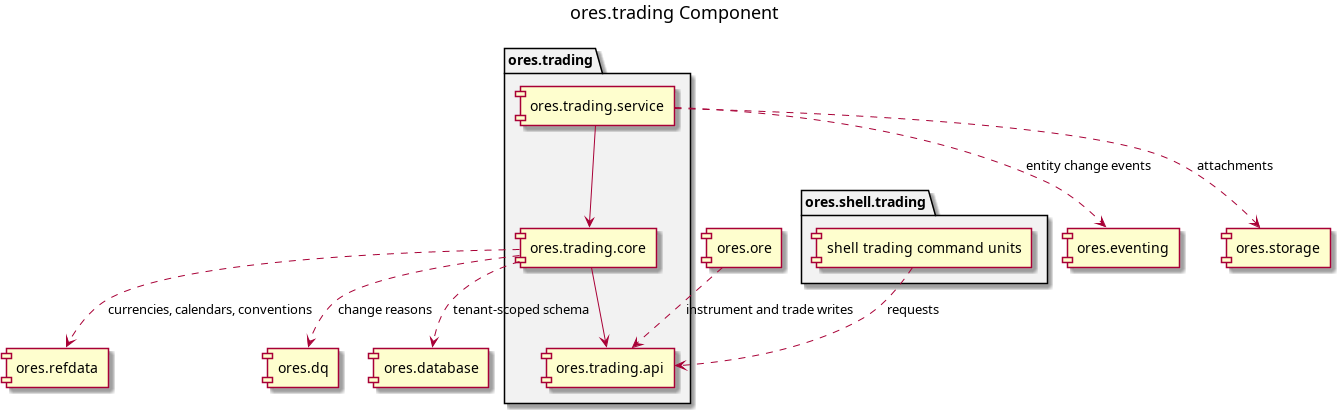
Figure 1: ores.trading
2. Summary
ores.trading holds the trade and instrument model: the trade envelope and
its lifecycle, the instrument identity, and one table per product family
across rates, FX, equity, credit, commodity, scripted and bond products.
The component is a composite of three parts. The api part is the shared
contract, core holds the repositories, readers and services, and
service wires the NATS handlers into a runnable binary. The entity
models under modeling/ are the literate source every one of those is
generated from, together with the SQL schema, the shell command units and
their recipes.
3. Sub-components
| Sub-component | Brief |
|---|---|
| ores.trading.api | Protocol types, domain entities, JSON/table I/O, and NATS message schemas for the tradi… |
| ores.trading.core | Trade booking and lifecycle management — domain model, repositories, services, and NATS… |
| ores.trading.service | NATS service entrypoint for the trading domain — wires handlers, repositories, and conf… |
4. Entity modules
| Module | Brief |
|---|---|
| ores.trading | Logical entities for the trading namespace. |
5. Inputs
- The entity and operation models under
modeling/, which are the source the domain types, repositories, services, messages and SQL are generated from. - Reference data from
ores.refdata: currencies, calendars, day count fractions, business day conventions and the other conventions a trade names. - Change reasons from
ores.dq, which every bitemporal write states. - Parties and tenants from
ores.iam, which scope every row.
6. Outputs
libores.trading.api.so— the domain, JSON and table I/O, and the NATS protocol headers.libores.trading.core.so— the repositories, the instruments and trade readers, and the services.ores.trading.service— the process that serves the trading subjects.- The generated SQL schema and the shell command units, which land in
projects/ores.sql/andprojects/ores.shell/trading/.
7. Entry points
ores.trading.service— the NATS service binary.include/ores.trading.api/— every public header a consumer includes.- The shell menu
trading, whose verbs come from the component's opted-in entity models.
8. Dependencies
ores.trading.api— the contract the other two parts and every consumer build against.ores.database— the tenant-scoped connection and the bitemporal helpers.ores.eventingandores.nats— the transport and the entity change events.ores.refdata,ores.dqandores.iam— the read-only data above.ores.oreconsumesores.trading.apito write ORE documents as trades.
9. See also
- ores.trading.api — the shared contract.
- ores.trading.core — the business logic and persistence.
- ores.trading.service — the service binary.
- Clean ores.trading to the component clean standard — the work that brought the component to the standard.