ores.utility
Table of Contents
Diagram
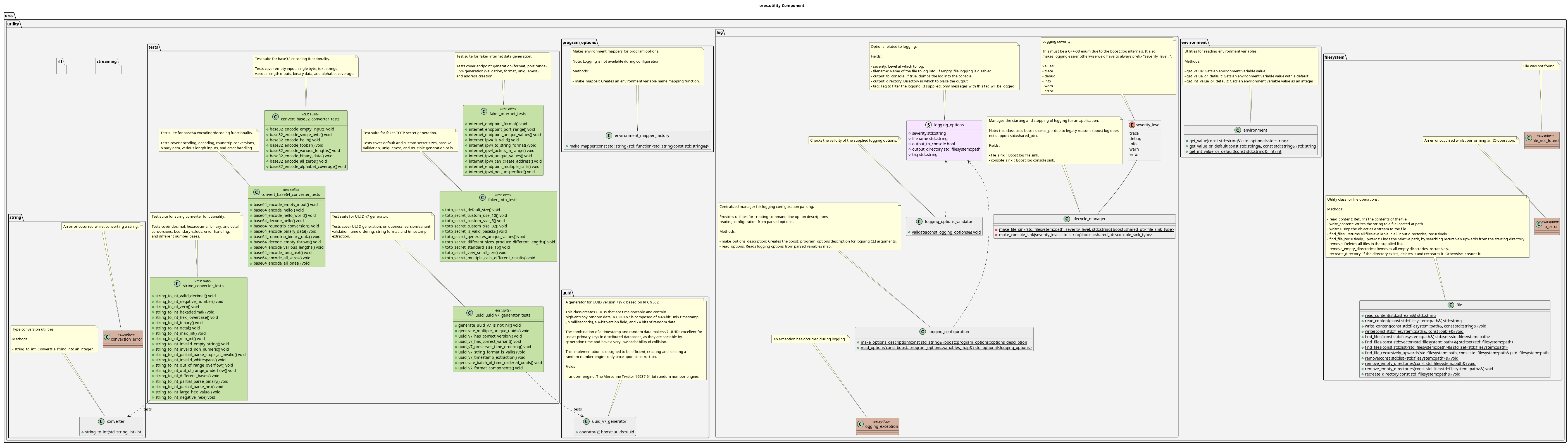
Figure 1: ores.utility
Summary
ores.utility is the foundation utilities library for ORE Studio with no
dependencies on any other ORE Studio component. It provides Base64/Base32
encoding, datetime formatting/parsing, UUID v7 generation (RFC 9562, sortable
by time), reflect-cpp type reflectors for common types (UUID, time_point, IP
address), test data generation (faker), concurrency helpers, and iostream
streaming operators for standard types. Database, logging, and platform
abstractions that originally lived here have been split out into ores.database,
ores.telemetry, and ores.platform respectively.
Inputs
- Raw data or strings passed to encoding/decoding functions.
- Timestamp strings or
time_pointvalues for datetime utilities. - Random seed / system state for UUID v7 and faker generation.
Outputs
- Base64/Base32 encoded or decoded strings.
- Formatted datetime strings and parsed
time_pointvalues. - Time-ordered
boost::uuids::uuidvalues. - Serialised and deserialised reflect-cpp values for common types.
Entry points
include/ores.utility/convert/— Base64/Base32 codecs.include/ores.utility/uuid/—uuid_v7_generator.include/ores.utility/datetime/— datetime formatting and parsing.include/ores.utility/faker/— internet and TOTP test data generators.include/ores.utility/rfl/— reflect-cpp reflectors for UUID, time_point, IP.include/ores.utility/streaming/— iostream operators for standard types.include/ores.utility/concurrency/— concurrency helpers.
Dependencies
- Boost.UUID, Boost.Asio — UUID and IP address types.
rfl— reflect-cpp serialisation.