A stored value reaches the row in the form the value set names
Table of Contents
1. Summary
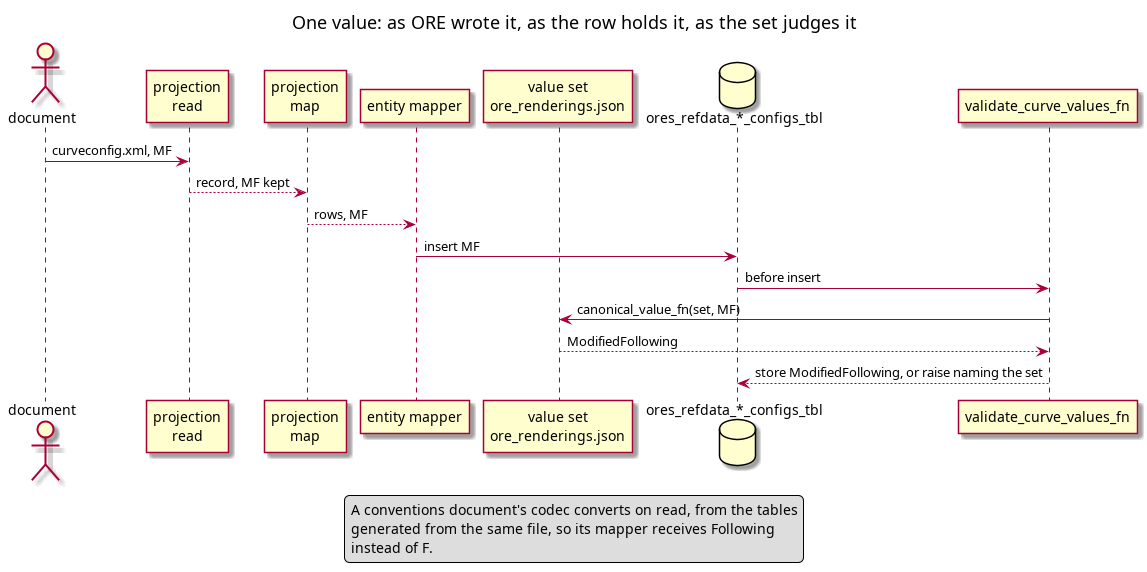
A value that ORE states in more than one rendering, F and Following for a
business day convention, reaches the table in one form because two boundaries
convert it, and neither is the entity mapper. The codec converts a convention
document on read, from the tables generated from the mapping file. The database
guard converts every write the codec did not convert: every curve document, and
every writer that maps no document at all.
The two boundaries are not duplication. The codec knows only the families it reads, and the guard is the one boundary every writer passes.
2. The call chain
A conventions document, where the codec knows the family:
conventions.xml  <FixedConvention>F</FixedConvention>
  conventions_family_swap.cpp::map_swap        F -> Following, from the tables
  swap_convention_mapper::map(domain)          rows, Following as it stands
  repository insert                            Following
  ores_refdata_validate_convention_terms_fn    the set agrees, or refuses
A curve configuration document, where it does not:
curveconfig.xml  <BusinessDayConvention>MF</BusinessDayConvention>
  curve_configuration_projection::read         MF kept
  curve_configuration_projection::map          rows, MF
  base_correlation_config_mapper::map(domain)  MF as it stands
  repository insert                            MF
  ores_refdata_validate_curve_values_fn        MF -> ModifiedFollowing
The code, in order:
projects/ores.sql/utility/ore_renderings.jsonstates the mapping: for each table, the form a configuration holds and every rendering that means it.projects/ores.ore/core/src/domain/conventions_renderings.hppholds the C++ tables, generated from that file byprojects/ores.ore/scripts/generate_renderings_tables.py. The check fails when the committed header differs from the file, and when a hand-written table appears beside it.…/conventions_fields.cpp:207:code_oflooks a rendering up in a table and raisesUnknown business day convention enum valuewhen it finds none.…/conventions_family_swap.cpp:37:bdc_ofreads a member through the table. Fifty-four more call sites in nineteen domain units do the same.…/curve_configuration_projection.cpp:1555:required_spellingkeeps the spelling the document wrote. The projection states no rule, so the row carriesMFuntil the database sees it.…/refdata_curve_configuration_columns_validate_create.sql:71and…/refdata_convention_terms_validate_create.sql:77: both guards askores_reporting_value_in_set_fnwhether the value is one the set states, thenores_reporting_canonical_value_fnfor the form it holds. A value outside the set is refused with the set's name; a rendering is stored as its form.projects/ores.refdata/core/src/repository/*_mapper.cpp: the entity mapper assigns the value it was handed. It converts nothing and includes no header for converting, which is what #4431 removed.
3. Why the codec converts where it can
The form a configuration holds is one of the renderings, and the mapping file is the only statement of which. A codec that reads a document without converting leaves the mapping to one boundary, the database, and that works. A codec that converts reads the same file the value sets read, so the codec and the guard cannot disagree about a value: they read one statement.
What the codec may not do is hold a table of its own. That is what made the refdata normaliser a second authority, and the generated header is how the copy stays a copy.
4. Why the guard is still needed
A convention document states the value a row carries, but not every writer maps a document. The publisher that imports a tenant's configurations, the seeder, and the curve projection all reach a table with a spelling no codec converted. A rule only the codec enforced would hold for one caller and leak for the rest, so the trigger is the boundary that makes the rule true of the table rather than of a path to it.
5. The tests that hold it
projects/ores.ore/core/tests/xml_curve_configuration_projection_roundtrip_tests.cpp:72reads, maps, reverses and writes every curve configuration in the corpus, then reads the result again and compares the two records. Both sides pass throughread, so the case proves the path is a fixed point of the mapping, not that the exported bytes equal the imported ones.projects/ores.refdata/core/tests/curve_configuration_database_roundtrip_tests.cpp:259writes a document through the store and states the round trip on what the store returns: the document it holds exports and reads back unchanged. This is the only case that can be right about a value the guard rewrote.…/test/reporting_ore_parameter_canonical_form_test.sqlasserts what the sets state, andores_reporting_canonical_value_violations_fn()names any live row that holds a rendering instead of its form. Zero today.
6. See also
- The ORE XML infrastructure — the structure note that orders this cluster; this page completes it by naming the two boundaries at which a rendering changes.
- The export writes the stored form, so a round trip is not byte-identical — answers the question this page leaves open, which is what the export emits once the rendering is gone.
- A value set is the only place an ORE parameter's rule is written — exemplifies the same split one level up: the set states the rule, a trigger enforces it, and neither is in the projection.
- One component reads every ORE document, and none of them stores XML — contradicts any reading of this page that puts document knowledge in the mapper: the projection owns the shape, the codec owns the rendering.