One component reads every ORE document, and none of them stores XML
Table of Contents
1. Summary
Every ORE document a run names is parsed and written by ores.ore. The
components that store the documents receive typed rows over the message bus and
never see XML. The boundary is not a convention: ores.ore.core links the three
message contracts it needs, and none of the owning components links ores.ore,
so a call from a store into the codec does not compile.
2. The five documents
An ORE input directory holds one run document and the configuration files its
Setup names. All five are the codec's to read.
<ORE>
  <Setup>
    <Parameter name="asofDate">2016-02-05</Parameter>
    <Parameter name="conventionsFile">conventions.xml</Parameter>
    <Parameter name="curveConfigFile">curveconfig.xml</Parameter>
    <Parameter name="marketConfigFile">todaysmarket.xml</Parameter>
    <Parameter name="pricingEnginesFile">pricingengine.xml</Parameter>
  </Setup>
  <Markets>
    <Parameter name="lgmcalibration">libor</Parameter>
  </Markets>
</ORE>
| Document | ORE root element | Read by | Rows owned by |
|---|---|---|---|
ore.xml |
<ORE> |
run_document_projection |
ores.reporting |
conventions.xml |
<Conventions> |
conventions_mapper |
ores.refdata |
curveconfig.xml |
<CurveConfiguration> |
curve_configuration_projection |
ores.refdata |
todaysmarket.xml |
<TodaysMarket> |
todays_market_projection |
ores.analytics |
pricingengine.xml |
<PricingEngines> |
pricing_engine_projection |
ores.analytics |
The Setup parameter is the only link between the run document and the other
four. projects/ores.ore/core/include/ores.ore.core/xml/run_document_files.hpp:48
lists the four pairs in one array, so the document names its own files and the
import does not guess a file name.
3. The path, and where it crosses
The import starts at
projects/ores.ore/service/src/messaging/run_configuration_handler.cpp:77, which
starts a workflow and answers at once. A step of that workflow calls import_run
(…/run_configuration_operations.cpp:309). The step reads each file the run
document names (…:257), maps it to rows there and then, and hands the rows to
the owning component as a request (…:276):
save_curve_configuration_document_request    -> ores.refdata
save_todays_market_document_request          -> ores.analytics
save_pricing_engines_document_request        -> ores.analytics
save_run_document_request                    -> ores.reporting
The message type is the document written as records, one per element, with the document's header beside them. This cluster calls those records rows: they are what a store writes, and no part of a file survives in them.
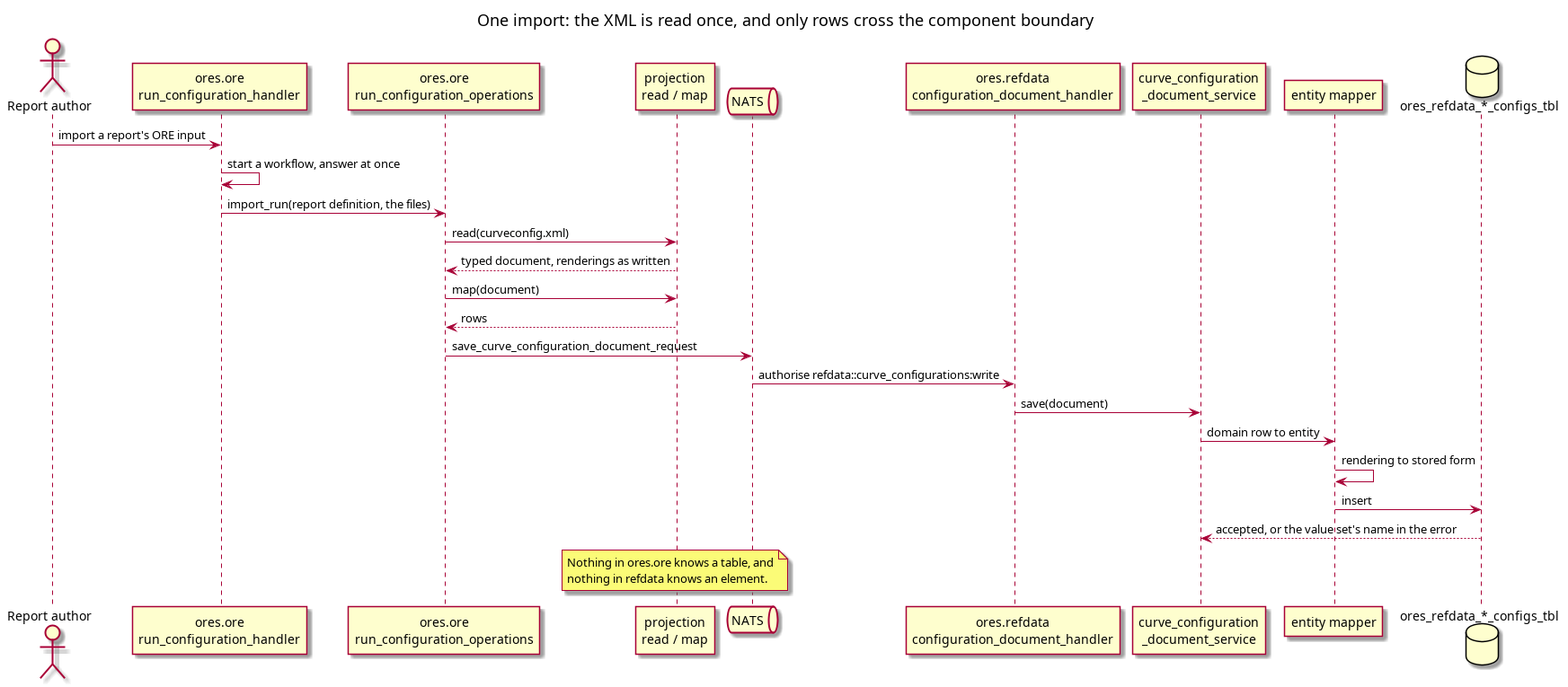
The other end is a handler per owning component, for example
projects/ores.refdata/core/src/messaging/configuration_document_handler.cpp,
whose save_curve_configuration_document authorises
refdata::curve_configurations:write, calls
curve_configuration_document_service::save, and replies. The request and reply
types are generated from the domain model and live in
projects/ores.refdata/api/include/ores.refdata.api/messaging/configuration_document_protocol.hpp.
4. Why the boundary is where it is
A component that parsed ORE XML itself would have to track the ORE schema version, and two components would then disagree about what an element means. The tree pays one price for the alternative it chose: everything a document can hold must be expressible as a row and as a message type. The gain is that the schema is compiled into one component's release, and that the stores can be tested without an XML file.
The dependency direction is what holds the boundary, and the compiler checks it:
projects/ores.ore/core/src/CMakeLists.txtlinksores.refdata.api.lib,ores.analytics.api.lib,ores.reporting.api.libandores.trading.api.lib.projects/ores.refdata/core/src/CMakeLists.txt,projects/ores.analytics/core/src/CMakeLists.txtandprojects/ores.reporting/core/src/CMakeLists.txtlink noores.orelibrary.
That asymmetry is the design. The codec may depend on the contracts of the
components it feeds; a component may not depend on the codec. Add
ores.ore.core.lib to a store's link line and the boundary is gone, with no test
to say so. The round-trip tests the next two pages name are what a reader has
instead.
5. The run document is not stored as a document
ore.xml looks like the other four and is not. The other four are stored as the
rows of one configuration, and reading one gives the document back.
projects/ores.reporting/core/include/ores.reporting.core/service/run_document_service.hpp
states the difference: reporting stores a risk report configuration and the
bindings that put each configuration in the run's slots, and get rebuilds the
run document from those rows.
That is why the export can build a complete ORE input from rows: the run document's content is the bindings, and each bound configuration is fetched from the component that owns it.
6. See also
- The ORE XML infrastructure — the structure note that orders this cluster; this page is its first step, because the boundary it draws is what the other five pages act inside.
- A stored value reaches the row in the form the value set names — completes this page: it descends from the boundary into the transformations the rows undergo.
- The export writes the stored form, so a round trip is not byte-identical — answers where the run document's reconstruction is used, and what the codec is asked to write.
- One map answers which ORE element a row is — contradicts any reading of this page that puts the element's name in the codec: the name a row is stored under is a row in a table, not a string in the projection.
- PostgreSQL Architecture — a neighbouring cluster that owns the message and transaction conventions the handlers here follow.