The life of a step
Table of Contents
A step is the unit of work the workflow engine dispatches, and its life is fixed: the caller mints the instance identifier and publishes a start message, the engine creates the run and publishes the step's command, the step handler does the work and publishes a completion, and the engine advances the run or finishes it. The caller is answered before any of that work happens, because the start message carries no reply subject, so the caller reads the run's progress rather than receiving it. The engine decides three things from one completion: whether the step is still in progress, whether it succeeded, and whether a next step exists. This note follows one step through that sequence and through the engine's decision path, including the policy a failed step follows: compensation that rolls the completed steps back, or a stop that parks the run for a retry verb.
1. Detail
1.1. The start: the caller mints the id and is answered
Tenant provisioning begins at the caller, not at the engine. The provisioning
operation validates the request, creates the tenant and its administrator, mints
the instance identifier, and publishes start_workflow_message to
workflow.v1.ops.start_workflow. The message carries that identifier, because the start
message's optional instance identifier lets a caller name the run before the
engine has seen the message.
The caller does not wait for the engine. It publishes the start message and no reply inbox, then answers the person with the instance identifier, the tenant identifier and the account identifier. A repeat of the same start is the same run, because the engine sees the existing instance and returns without touching it. the step protocol states the full obligation each side carries.
1.2. The engine persists the step it publishes
The workflow service turns a start message into a run. It looks up the definition by the workflow type, builds the step list from the request, the tenant and the correlation identifier, and creates the instance with its step count and its step list. It then builds the first step, persists the step, and publishes the command.
The order of those two acts carries the contract: the engine writes the step before it publishes it, so a restart can re-dispatch a step whose command never arrived. The command goes to the subject the step declares and carries exactly three headers - the step identifier, the instance identifier and the tenant. The step header is also the marker that tells a handler it has received a workflow command.
Every later step travels the same road. The engine computes the next position, rebuilds the step list, builds the command from the instance's request and the results so far, persists the new step, publishes it, and advances the instance's step position. A later builder reads an earlier result by the name of the step that produced it, never by position.
1.3. The handler answers, and the run advances
A handler recognises its workflow command from the headers and does its work. It
reads the three headers and answers with one outcome: success, success with
warnings, or failure. Each answer publishes a step_completed_event to
workflow.v1.ops.step_completed, whose step identifier echoes the one on the
command it answers.
The engine turns one completion into one decision. It ignores the event unless the step is still in progress, records the terminal state the outcome names, and treats success and success with warnings as success while failure leaves the forward path. On success it dispatches the next step; when the next position passes the last stored step, it marks the run complete with the last step's result. The run finishes positionally and needs no completion hook. idempotency in a workflow step covers what a repeat of this path costs.
1.4. What the sequence diagram shows
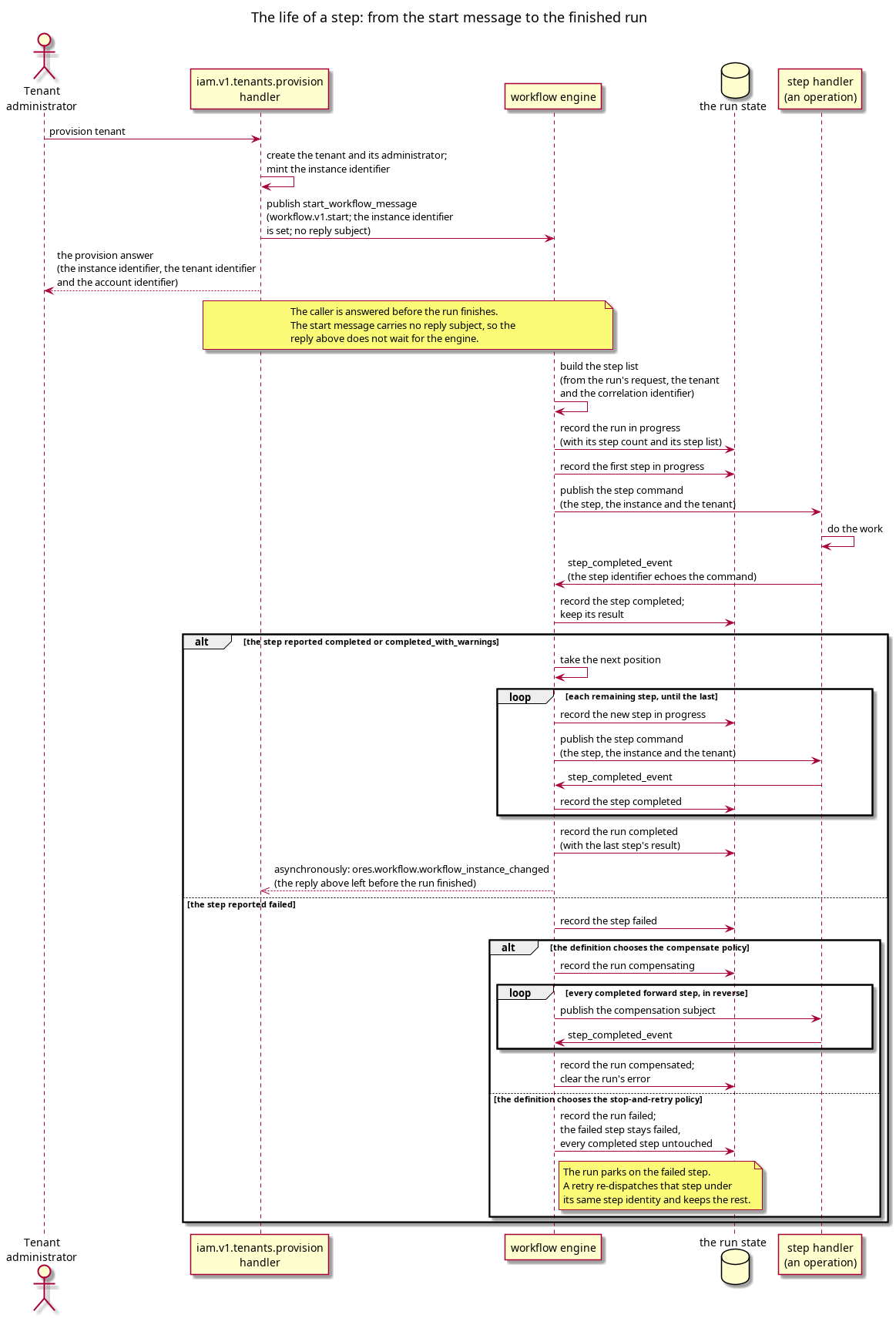
Figure 1: The life of one step from the caller's start message to the finished run: the caller mints the instance identifier and is answered, the engine creates the run and dispatches each step with the step, the instance and the tenant, a handler completes the step, and the engine advances or finishes the run. The lower branch is a failed step, and it draws the two failure policies a definition may declare: compensation of the completed steps and stop-and-retry.
Source: workflow_step_sequence.puml. Regenerate with
plantuml -tpng doc/knowledge/architecture/workflow_step_sequence.puml.
The diagram makes three facts visible that a reader of the design would otherwise assemble in pieces. First, the reply to the administrator does not wait for the engine to create any step, which is why the run's progress is read rather than returned. Second, the three identifiers are the whole of the step's identity: the engine stores the actor on the step's record but sends no caller token. Third, the completion is a fire-and-forget event on a fixed subject, so the engine cannot answer a step; it can only move the run on or leave the forward path.
1.5. What the flowchart shows
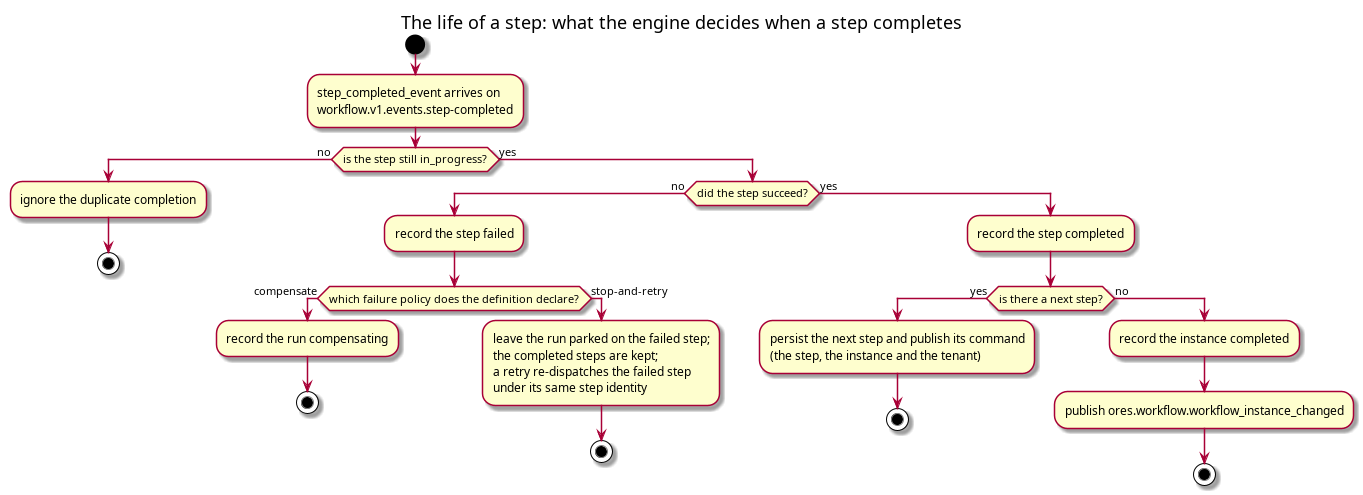
Figure 2: The engine's decision path for one step completion: a duplicate is ignored, a failed step follows the definition's failure policy, and a successful step either dispatches the next step or completes the run.
Source: workflow_step_flow.puml. Regenerate with
plantuml -tpng doc/knowledge/architecture/workflow_step_flow.puml.
The flowchart reads the same completion as three questions. The first is the duplicate guard: a completion for a step that is no longer in progress is a repeat, and the engine drops it. The second is the outcome: success and success with warnings continue the run, and failure leaves the forward path. The third is position: a next step exists, or the last step has finished and the run is complete. Every dispatch recomputes that position from the instance's current step position and its step count, not from the states of the steps that ran.
1.6. The branch a failed step follows
The flowchart draws both policies a definition may declare for a failed step. Under the compensate policy the engine moves the run to compensating, walks the completed forward steps in reverse, and publishes each one's compensation subject until the run is compensated, so the run undoes its completed work. Under the stop-and-retry policy the engine parks the run on the failed step, keeps the completed steps, and waits for a retry verb to re-dispatch the step that failed. A definition declares which policy its run follows, and the run's state is the engine's record of where that policy left it. failure, compensation and retry argues why provisioning chooses the stop-and-retry policy; the instance and step states records the states and edges each policy uses.
2. See also
- Workflows — the structure note that orders this cluster, and where to read this page in it.