Trade sets and trade groups
Table of Contents
1. Summary
A trade set is a set of trades, and it is the primitive. A trade group is a trade set created for a run of a process. A structure is a trade set that is also a product, and a link is neither, because it holds no container. This page is the way into the cluster: the test that tells these apart, the taxonomy they form, and the order to read them in.
2. Detail
2.1. The words
| Word | What it is | Its identity | Detail |
|---|---|---|---|
| Trade set | A set of trades, defined by a context | The context's entity, or a key of its own | Trade set |
| Trade group | A set created for a run of a process | Its own key, and a foreign key to the run | Trade group |
| Structure | A set that is also a product | Its own key | Trade Structures and Deal Composition |
| Link | A relation between trades that holds nothing | None | Trade links |
The words are not degrees of one thing. Every collection here is a trade set. A trade group is the one an operation creates, a structure is the one that is also a product, and a link is not a collection at all.
2.2. The test
Ask what defines the collection. If something in the business names it, it is a trade set, and the context's entity supplies its identity. If a process created it, it is a trade group, and the run supplies its identity. If it relates particular trades for a reason and contains nothing, it is a link.
The test follows from the rule Data-Oriented Design states for persisted data: relationships are keys, not ownership. A named collection cannot be a by-product of the links between its members, because nothing would then carry its name or record that it is empty.
The converse matters as much. A link is not a degenerate group. Recording a hedge as a group of two would give it an identity the business never refers to, and every reader would have to look through the group to reach the relation.
2.3. The taxonomy
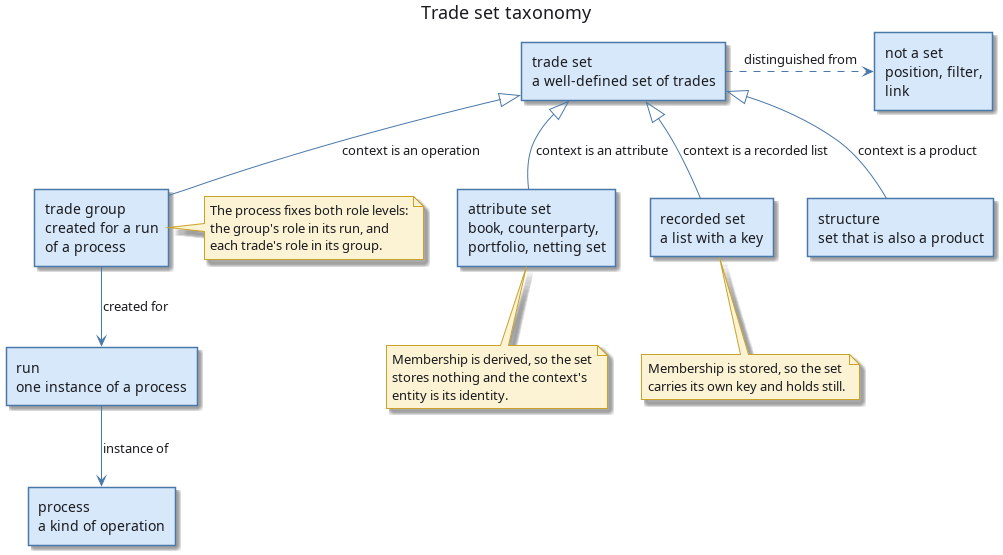
Figure 1: Trade set taxonomy: the contexts a set arises from, the trade group and its run, and what is not a set.
Source: trade_set_taxonomy.puml. Regenerate with
plantuml -tpng doc/knowledge/domain/trade_set_taxonomy.puml.
3. Documents in this cluster
Read in this order for a first pass; jump to any document for a single concept.
- Trade set — start here. The primitive, the contexts it arises from, and what is not a set.
- Trade set membership — how a context resolves membership, and how membership holds at a point in time.
- Nested trade sets — the sets that contain one another, and why membership is then part of a trade's identity.
- Trade group — the set an operation creates, the foreign key to its run, and the two levels of role the process fixes.
- Trade Structures and Deal Composition — the set that is also a product, and the composition ladder above it.
4. What this cluster does not cover
- Batching and chunking. How a set is partitioned for a report or for the compute grid, and the strategies that do it, belong with Compute Engine and the report-execution pages. This cluster supplies the set they partition.
- The run. The identity of a run, the process enumeration, and the states a run moves through are their own subject. This cluster states the foreign key and stops.
- Each process. A funding roll, a sweep and a compression have pages of their own. Trade group carries the catalogue and the role rules, and does not restate them.
- Links. Trade links and Trade link types carry the relations that are not sets.
- Positions and filters. Positions and Dynamic books are neither a set nor a link.
5. Sources
The set, group, structure and link vocabulary comes from internal analysis notes on structures and deal composition. The reading of the trade set as the primitive, the derived-versus-recorded membership rule, and the nesting test are this cluster's own synthesis.
6. See also
- Trade — the structure note that orders this cluster among the others.
- Trade links — the relations between trades that are neither sets nor groups.
- Trade link types — the catalogue of link types.
- Netting sets — the set credit exposure is computed over.
- Trade compression, Trade merge and Trade allocation — processes with the most structure in their groups.
- Positions — the aggregate that is neither a set nor a link.
- Data-Oriented Design in ORE Studio — identity by key, and explicit variation.
- Knowledge — the hub of all knowledge notes.