User Journey: Author a surface's framework
Table of Contents
This page documents a user journey: A trader or quant defines how a volatility surface is parameterised and quoted: its expiry and strike axes, its grid, its quoting convention, its interpolation across both axes, its extrapolation and any parametric model.
A user journey describes what one person is trying to do, before anything is built. It is a design document that outlives any sprint, so it names the screens, the entity fields each screen shows, and the operations and messages each step needs.
This journey is written against a model that does not exist yet. It records the framework the desk needs, so that the surface model, when it is built, starts from the screen the person works on rather than from a table.
1. Goal
"I want the desk's surface to be quoted and interpolated the way we agreed, so the calibrator reads the quotes we mean and not the ones it guesses." The journey is done when the framework is saved and the grid preview shows the expiry and strike labels the desk quotes, with the conventions the desk uses.
2. Actor and trigger
The actor is a trader or a quant acting for the desk. The trigger is a new surface, a change in how the desk quotes a delta, or a calibration that read a label the wrong way. The journey starts at the surface list, for an asset class and an underlying, and ends when the person leaves the framework. The framework is not a published object: it is the recipe the calibration reads, and it changes nothing until a surface is calibrated from it.
3. Steps
- Find the surface. The person opens Market data, then Surfaces, and
chooses an asset class and an underlying. No surface entity exists, so the
system shows the volatility series it can infer: the
market_seriesrows whose subclass isvolatility, grouped by their oresmd URI. The screen says that no framework is stored for any of them. - Open or start a framework. The person selects a series and the system shows the framework screen, empty. There is nothing to read from the server, because no surface record exists; the screen states the intended framework and reads the quoted cells it can find under the series.
- Set the two axes. The person names the expiry axis as a list of tenors
(
1M,3M,6M,1Y,2Y,5Y,10Y,30Y) and the second axis as a strike or delta label axis (ATM,25RR,25BF,10RR,10BF). The label vocabulary does not exist; the screen shows the intended labels read-only and names the gap. - Define the grid. The person says which (
expiry,label) cells the desk quotes, the quote type (volatility,price,normal volatility), the expiry dates (IMM, tenor dates) and the day count. The system previews the grid: how many cells the axes produce, which the series holds a point for, and which are missing. - Set the quoting convention. The person says whether a label is a strike, a delta or an ATM/risk-reversal/butterfly combination, then the delta convention (forward, spot, premium-adjusted) and the ATM type (forward, delta-neutral). Nothing stores these values; the screen lists them as the intended convention.
- Set the interpolation across both axes. The person chooses the time interpolation (across expiries) and the strike interpolation (across the second axis), such as linear in variance over time and cubic across strikes.
- Set the extrapolation. The person chooses how the surface extends past its last expiry and past its last strike: flat, linear or none.
- Choose the parametric model where one is used. Where the desk fits a model
rather than interpolating the grid, the person chooses it (
SABR,SVI) and names its parameters. The screen shows the choice; there is no model to fit and no parameter store. - Save the framework. The person chooses Save framework. Nothing is written, because no surface entity exists. The screen keeps the framework in the page session and says so.
- Leave. The person goes back to the surface list. No framework survives the screen; see What is missing.
4. Screens and wireframes
One screen. The two axes sit at the top, the grid and the quoting convention that read from them sit in the middle, and the interpolation, the extrapolation and the parametric model sit at the bottom, so the person reads the shape before the maths.
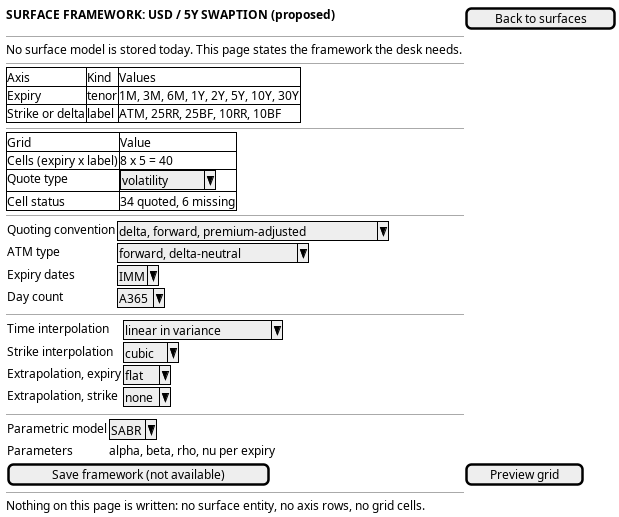
Figure 1: Surface framework: the expiry and strike axes, the grid, the quoting convention, the two interpolation axes, the extrapolation and the parametric model.
5. Prototype
A static page at doc/prototypes/market_data/author-a-surfaces-framework/index.html: mock data only, no backend,
no build step and no session. It argues that a surface is axes before it is numbers: the quoting convention and the two label ladders decide what the grid can hold.
- Variants
- a the two label ladders, b the full grid preview, c a convention-first form
- States
- proposed, nostrike (no strike-label vocabulary, so the grid cannot be laid out)
- Source
doc/prototypes/market_data/author-a-surfaces-framework/index.html- Open
/OreStudio/doc/prototypes/market_data/author-a-surfaces-framework/once the site is built, or the file directly
6. Entities composed
| Entity | What it contributes | Model |
|---|---|---|
market_series |
The surface's identity as a volatility series, by its oresmd URI and subclass | ores.marketdata.market_series |
market_observation |
The quoted cells: one point per oresmd URI under the surface's series | ores.marketdata.market_observation |
observation_lineage |
The provenance of a derived volatility point: which config and which source series produced it | ores.marketdata.observation_lineage |
series_classification_rule |
The rule that maps an ORE series key to its asset class and subclass | ores.marketdata.series_classification_rule |
market_series_asset_class |
The asset classes the surface's series belongs to | ores.marketdata.market_series_asset_class |
Only the generic market-data store exists. The surface's axes, its grid, its quoting convention and its model are not modelled anywhere; the screen stands in for them.
7. Operations and messages
| Step | Operation | Subject | Status |
|---|---|---|---|
| Find the surface | List the volatility series | marketdata.v1.market_series.list |
partial |
| Find the surface | List the asset classes | marketdata.v1.market_series_asset_classes.list_by_market_series_id |
exists |
| Open a framework | Read the surface framework | none | missing |
| Set the two axes | Fill the tenor picker | refdata.v1.tenors.list |
exists |
| Set the two axes | Read the strike or delta labels | none | missing |
| Define the grid | Read the quoted cells | marketdata.v1.market_observations.list_by_series_id |
exists |
| Define the grid | Read the expiry dates and the day count | refdata.v1.day_count_fraction_types.list |
exists |
| Set the quoting convention | Read or write the convention | none | missing |
| Set the interpolation | Read or write the two interpolation axes | none | missing |
| Set the extrapolation | Read or write the two extrapolations | none | missing |
| Choose a parametric model | Read or write the model and its parameters | none | missing |
| Read the current surface | Read a snapshot of the grid | marketdata.v1.curve_snapshot.get |
partial |
| Read the current surface | Read the grid over time | marketdata.v1.ops.get_series_evolution |
exists |
| Check the provenance | Read one point's lineage | marketdata.v1.observation_lineages.get |
exists |
| Save the framework | Write the surface framework | none | missing |
The snapshot reads take an oresmd URI and return one observation per point, so they read a surface's cells as a grid; they do not know that the points are a surface, and they carry no axis order, no label vocabulary and no as-of in the past.
8. What is missing
- There is no surface model. Nothing is keyed by a surface identity, and no
subject names one. There is no
marketdata.v1.surfaces.*or a surface config. The candidate is a surface entity with its axes, its grid and its quoting convention. Until then the screen shows the volatility series it can infer and states that no framework is stored. - There is no axis or grid storage. The expiries and the strike or delta
labels are not rows, and a grid cell is only an
oresmd_uripoint under the series. The candidate is an axis table and a grid-cell table, or a shape table the cells resolve against. Until then the screen decodes the point URIs throughoresmd_uri_codecand shows the distinct labels it finds; it cannot store them or fix their order. - There is no strike-label vocabulary. No code list or table names
ATM,25RRor25BF, so a label is free text inside a URI. The candidate is a reference-data strike or delta label list. Until then the screen names a label as the text it decoded and cannot validate or order it. - The quoting convention has no fields. Nothing records whether a label is a strike or a delta, the delta convention, the ATM type or the premium adjustment. The candidate is fields on the surface. Until then the screen lists the intended values and writes none of them.
- The parametric model has no storage. No model kind and no parameters are
stored, so a fitted
SABRorSVIsurface cannot be re-read. The candidate is a model kind and a parameter set per expiry. Until then the screen shows the choice and no fit. - No screen exists. No web page, HTTP route or shell verb reaches any surface operation. The candidate is a page and a route. Until then the journey runs only from the shell.
- A volatility series is not a typed surface scope.
market_series.listfilters generically; no operation lists surfaces by underlying, currency or asset class. The candidate is a typed scope. Until then the person picks a series from the series list.
An ORE volatility configuration family exists in ores.refdata (for example
curve_volatility_config, which carries ORE's own StrikeSurface and
DeltaSurface kinds). That is one ORE input document's settings, not a
market-data surface: it holds no market points, no identity in
ores.marketdata and no published object. This journey's screen does not read
or edit it.
9. Related journeys
- Calibrate or refresh a surface — fit a candidate surface from this framework and the day's quotes.
- Inspect a surface's slices — read the smiles and the mesh this framework produces.
- Manage a curve's blueprint — the curve-side equivalent, which does have a stored model today.