User Journey: Manage a curve's blueprint
Table of Contents
This page documents a user journey: A trader or quant defines a curve's blueprint for a currency: its identity and family role, its output series, its pillar list and order, and its bootstrap and tenor conventions.
A user journey describes what one person is trying to do, before anything is built. It is a design document that outlives any sprint, so it names the screens, the entity fields each screen shows, and the operations and messages each step needs.
1. Goal
"I want this curve to be built the way the desk agreed, so every bootstrap of it reads the same pillars and the same conventions." The journey is done when the blueprint is saved and reads back with its pillars in order, and with the discount curve set if the family role is PROJECTION.
2. Actor and trigger
The actor is a trader who holds the market-data management role, or a quant acting for the desk. The trader is the maker: the blueprint is theirs to author. The trigger is a new currency, a new curve the desk must publish, a changed pillar list, or a changed convention. The journey starts at the curve list for a currency and ends when the person leaves the saved blueprint.
A saved blueprint is a candidate. It changes nothing that pricing reads until a curve is bootstrapped from it and that output curve is published; the blueprint itself is never published. The model calls this record the IR curve bootstrap config, and the screen calls it the curve's blueprint.
3. Steps
- Find the currency's curves. The person opens Market data, then Curves, and chooses a currency. The system lists that currency's blueprints: the output series' oresmd URI, the family role, the discount curve, the interpolation method, the day count, the split tenor and the version. The person filters by URI or by family role.
- Open or start a blueprint. The person selects a row and the system shows the blueprint screen, or the person chooses New blueprint and the system shows the same screen empty. The currency comes from the list; it is not typed again.
- Set the identity and the family role. The person chooses the family role,
FUNDINGorPROJECTION, and names the output series. The output series is amarket_seriesrow: the person either links an existing one or the system mints a new one with the blueprint's oresmd URI. The series readsOBSERVEDuntil the first bootstrap stamps itIR_CURVE_BOOTSTRAPwith this blueprint's id and version. - Choose the discount curve for a projection. If the role is
PROJECTION, the person chooses theFUNDINGblueprint this curve discounts off. The system offers only this currency'sFUNDINGblueprints. The server refuses a projection that points at another projection, or at itself. - Define the pillars. The person adds, changes, removes and reorders pillar
rows. Each row carries a zero-based sequence, a start tenor, an end tenor and
a curve role (
DEPOSIT,FRAorSWAP). The system offers the tenor codes from the reference data and the curve roles from their code list, and it resolves each tenor label through the tenor machinery. - Set the bootstrap method and the conventions. The person chooses the
interpolation method (
LOG_LINEAR_DISCOUNT,CUBIC_SPLINEorFLAT_FORWARD_THEN_LOG_LINEAR), the day count, the tenor convention (RATES_SPOT_FORWARDorRATES_SPOT_FOMC) and the split tenor. For a single-segment method the split tenor is the last pillar's end tenor; the system offers it from the same tenor list. - Save the blueprint. The person chooses Save blueprint. The system writes the config, then the pillar rows, each as a new bitemporal version, and replies with the version it wrote. The screen shows the saved blueprint; a candidate that publishes nothing.
- Check the history. The person opens the history of the config or of one pillar. The system shows every version with the field-level difference from the one before. A revert is a new version, not a deletion.
- Leave. The person goes back to the curve list. Nothing has been published, and no curve has been built yet.
Steps 7 is two writes, not one: the config and its pillars are separate resources, so a failure between them leaves a config whose pillar list is partly updated; see What is missing.
4. Screens and wireframes
One screen. The blueprint's identity sits at the top, the pillars and the conventions that produce the curve sit in the middle, and the publication state sits at the bottom, so the person reads cause above effect.
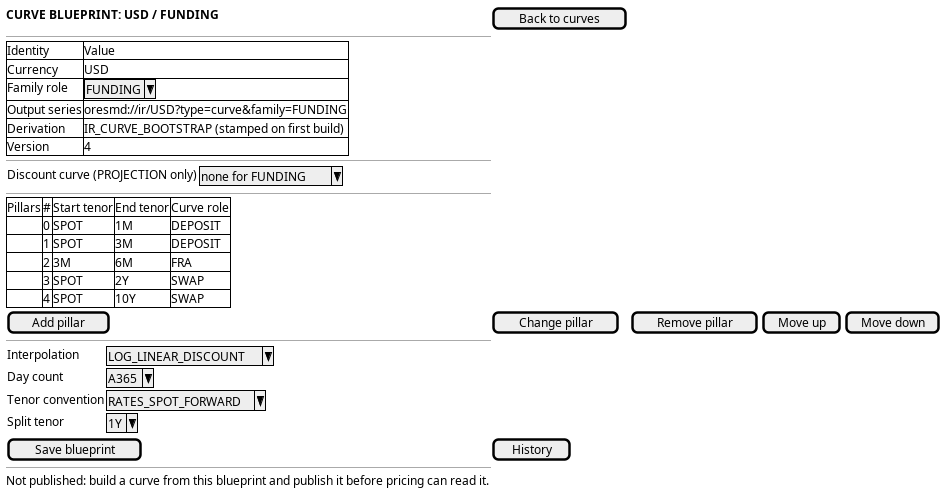
Figure 1: Curve blueprint: the curve's identity, its pillars and their order, and the bootstrap and tenor conventions.
5. Prototype
A static page at doc/prototypes/market_data/manage-a-curves-blueprint/index.html: mock data only, no backend,
no build step and no session. It argues that a curve's blueprint is its pillars and the method that joins them; the pillar editor is where the design question sits.
- Variants
- a flat pillared table, b grouped by instrument kind (deposit, future, swap), c a drag-ordered list
- States
- funding, projection (a projection with no discount curve, which the screen refuses), empty
- Source
doc/prototypes/market_data/manage-a-curves-blueprint/index.html- Open
/OreStudio/doc/prototypes/market_data/manage-a-curves-blueprint/once the site is built, or the file directly
6. Entities composed
| Entity | What it contributes | Model |
|---|---|---|
ir_curve_bootstrap_config |
The blueprint row: currency, output series, family role, discount curve, interpolation, day count, tenor convention, split tenor | ores.refdata.ir_curve_bootstrap_config |
ir_curve_bootstrap_pillar |
The pillar list and its order: sequence, start and end tenor, curve role | ores.refdata.ir_curve_bootstrap_pillar |
market_series |
The output series the blueprint publishes into, and its derivation stamp | ores.marketdata.market_series |
currency |
The currency the curve is quoted in, and the picker the list reads | ores.refdata.currency |
tenor |
The tenor labels the pillars and the split tenor pick from | ores.refdata.tenor |
tenor_convention |
The convention the pillars resolve their dates under | ores.refdata.tenor_convention |
curve_role |
The instrument-pricing role a pillar carries | ores.refdata.curve_role |
day_count_fraction_type |
The day count the bootstrap applies per pillar | ores.refdata.day_count_fraction_type |
derivation_kind |
The marker that says a series is derived, and by which mechanism | ores.refdata.derivation_kind |
The config and its pillars are versioned, so each has a history. The output
series is a market_series row; the blueprint references it softly, across
components, and never hard-links it.
7. Operations and messages
| Step | Operation | Subject | Status |
|---|---|---|---|
| Find the currency's curves | List the blueprints | refdata.v1.ir_curve_bootstrap_configs.list |
exists |
| Find the currency's curves | List the currencies | refdata.v1.currencies.list |
exists |
| Open or start a blueprint | Read one blueprint | refdata.v1.ir_curve_bootstrap_configs.get |
exists |
| Open or start a blueprint | List the blueprint's pillars | refdata.v1.ir_curve_bootstrap_pillars.list |
exists |
| Set the identity | List or mint the output series | marketdata.v1.market_series.list, .put |
exists |
| Choose the discount curve | List the currency's FUNDING blueprints | refdata.v1.ir_curve_bootstrap_configs.list |
exists |
| Define the pillars | Fill the tenor and curve-role pickers | refdata.v1.tenors.list, refdata.v1.curve_roles.list |
exists |
| Define the pillars | Write, reorder or remove pillars | refdata.v1.ir_curve_bootstrap_pillars.put, .put_many, .delete |
exists |
| Set the conventions | Fill the convention pickers | refdata.v1.tenor_conventions.list, refdata.v1.day_count_fraction_types.list |
exists |
| Save the blueprint | Write the config | refdata.v1.ir_curve_bootstrap_configs.put |
exists |
| Check the history | Read every version with its diff | refdata.v1.history.get |
exists |
| Check the history | Revert by writing the old values | the entity's put |
exists |
The history request is the generic one, with entity_type
ores.refdata.ir_curve_bootstrap_config or
ores.refdata.ir_curve_bootstrap_pillar; both register a history provider.
Saving the config and the pillars is two calls, not one: the subjects above are
the generated resource verbs, and no operation writes both together.
8. What is missing
- A blueprint has no name. The config carries an output series, a currency and a role, and no name or description column. The screen titles a blueprint by its output series' oresmd URI, which is long and identical for two currencies only in their URI text. The candidate is a name or a label column. Until then the screen shows the URI and the currency.
- A curve has no typed identity at the wire. The blueprint is keyed by the output series UUID, and every curve read is keyed by the oresmd URI. No subject names a curve by (currency, family role). The candidate is a typed curve identity. Until then the person matches on the URI.
- Saving a blueprint is not atomic. The config and its pillars are separate
generated resources with separate
putsubjects, and no operation writes both. A failure between the two writes leaves a config with a partly updated pillar list, and the save is a transaction the caller must compose. The candidate is an apply operation that writes the config and its pillars together. Until then the screen saves the config first, then the pillars, and says what it wrote. - No approval kind covers a blueprint change. The inbox models a generic
approval kind, but only
iam.role_grantis seeded. A blueprint change is written with no second pair of eyes, and no comment. The candidate is an approval kind for the blueprint, with its decide permission and its required approvals. Until then a save takes effect at once and the history names the writer alone. - The tenor references are undeclared. The pillar's start and end tenors, the split tenor and the tenor convention are soft references: the screen offers the reference-data list, but the database holds only text, and the application layer validates it. The screen cannot tell a stored code the list does not hold. The candidate is a declared reference. Until then the screen marks a value it cannot find in the list.
- No screen exists. No web page, HTTP route or shell verb reaches any curve operation. The generated detail dialog and controller for this config are disabled, and the hand-written workbench went with the removed desktop client. The candidate is a web page and a route. Until then the journey runs only from the shell.
- A currency's blueprints are not a typed scope. The list filter is generic; nothing names "the curves of this currency" as a scope the server resolves. The candidate is a filter on currency and family role, or a scoped read. Until then the screen lists all the tenant's blueprints and filters on the page.
9. Related journeys
- Maintain the curve blueprints — the record screen this blueprint is kept on, and the acts around it.
- Check that a curve blueprint builds — test the recipe this journey authors.
- Bootstrap or refresh a curve — build a candidate curve from this blueprint and the day's market.
- Calibrate or refresh a surface — the surface equivalent of this blueprint, once a surface model exists.
- Adjust a curve or surface by hand — correct a built curve when a pillar's market input is wrong or thin.
- Check a curve's fit — read the candidate against the quotes the pillars name.