User Journey: Bootstrap or refresh a curve
Table of Contents
This page documents a user journey: A trader builds or refreshes a candidate curve from the day's market, reads its points and its health, and leaves it unpublished.
A user journey describes what one person is trying to do, before anything is built. It is a design document that outlives any sprint, so it names the screens, the entity fields each screen shows, and the operations and messages each step needs.
1. Goal
"I want to turn today's market into a curve I can check before anyone publishes it." The journey is done when the candidate's points answer every pillar of the blueprint and the person can see which market points it read, and nothing has been published.
2. Actor and trigger
The actor is a trader who holds the market-data management role. The trigger is the start of a trading day, a material market move, or a correction to the curve's inputs. The journey starts at a blueprint and an as-of time, and ends with a candidate curve the person has read and not published.
The candidate is a proposal, not an object. It is what the person reads and tests before the publish journey asks a checker to approve it. Nothing the person sees here reaches pricing: pricing reads only a published curve.
3. Steps
- Find the blueprint. The person opens Market data, then Curves, chooses a currency and selects a blueprint. The system shows the blueprint: its family role, its output series, its discount curve and its pillars in order.
- Choose the as-of. The person names the snapshot time the build reads, with now as the default. The system shows what the market holds for the blueprint's pillars at that time: which points exist, their age and their source. It reads them by the as-of the person names. An observation may come from a market feed or from the synthetic generator; the build treats both as a point with a source, so a generated rate is marked generated rather than observed, and the same bootstrap serves either.
- Run the bootstrap. The person chooses Compute candidate. The system calls
marketdata.v1.ops.compute_curve, which bootstraps the config's pillars from the observations at that as-of and replies with the computed points: a point id, a date and a discount factor. Nothing is written. - Read the points. The system shows the computed pillars in short-to-long order with their discount factors, beside the market value each came from. The person checks the shape of the curve and the ends.
- Read the health. The system shows a health panel: how many pillars the build computed, which input points were missing, which were stale, and whether the discount curve a projection needs was present. The server returns no diagnostics, so the screen derives all of this from the point list and the pillars it read.
- Refresh. The person changes the as-of, or corrects an input and runs Compute candidate again. The compute is stateless, so a re-run replaces the points on the screen and writes nothing.
- Leave the candidate unpublished. The person leaves the screen without pressing anything that writes. The candidate exists on the screen only; see What is missing.
- The publish act, in a later journey. A publish is a named act with an
owner and, where the desk configures it, an approval. The operation that
exists today,
marketdata.v1.ops.republish_curve, writes the bootstrap's observations and lineage straight into the output series and stamps it. It has no candidate step and no approval gate, so this journey does not offer it.
4. Screens and wireframes
Three screens, one build. Result shows the observations the build read and the pillars it solved; Curves shows the input rate, the zero rate, the discount factor and the forward; Checks shows the reprice residual, the convergence, and the missing or stale inputs. All three read the same build, so the curve never differs between them — only the question the reader is asking does. The blueprint and the as-of sit above all three.
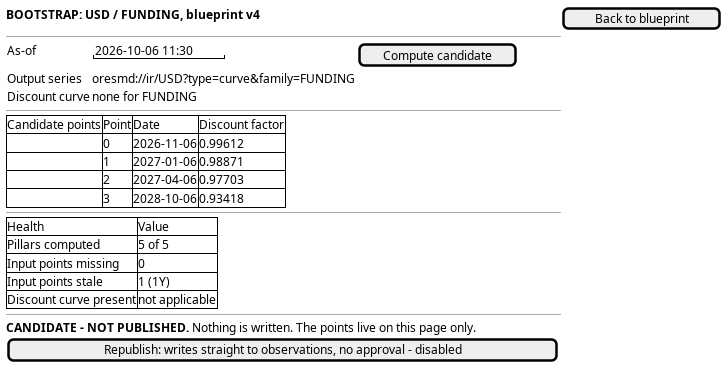
Figure 1: Curve bootstrap: the blueprint and as-of, the candidate points, and the health of the build, with the candidate unpublished.
5. Prototype
A static page at doc/prototypes/market_data/bootstrap-or-refresh-a-curve/index.html: mock data only, no backend,
no build step and no session. It argues that a build produces a candidate, not a curve the system uses: the observations, their provenance and the health read together, unpublished.
- Screens
?variant=aResult (observations and solved pillars),?variant=bCurves (the four curves),?variant=cChecks (residual, convergence, missing and stale)- Input source
?source=realmarket observations,?source=synthetica generated feed; the same bootstrap either way, so only the provenance differs- States
- clean, missing (inputs absent), projection (a projection whose discount curve is absent)
- Source
doc/prototypes/market_data/bootstrap-or-refresh-a-curve/index.html- Open
/OreStudio/doc/prototypes/market_data/bootstrap-or-refresh-a-curve/once the site is built, or the file directly
6. Entities composed
| Entity | What it contributes | Model |
|---|---|---|
ir_curve_bootstrap_config |
The recipe the build reads: currency, output series, family role, discount curve, interpolation, day count, split tenor | ores.refdata.ir_curve_bootstrap_config |
ir_curve_bootstrap_pillar |
The pillar list the build answers, and its order | ores.refdata.ir_curve_bootstrap_pillar |
market_observation |
The input market points at the as-of, and the rows a republish writes | ores.marketdata.market_observation |
market_series |
The output series, and the derivation stamp a republish writes on it | ores.marketdata.market_series |
observation_lineage |
The per-point provenance a republish writes: config, version, source as-of and source series | ores.marketdata.observation_lineage |
The computed candidate points are not an entity. They are a reply and a screen; the only curve the data can hold is the one a republish writes.
7. Operations and messages
| Step | Operation | Subject | Status |
|---|---|---|---|
| Find the blueprint | List or read a blueprint | refdata.v1.ir_curve_bootstrap_configs.list, .get |
exists |
| Find the blueprint | List its pillars | refdata.v1.ir_curve_bootstrap_pillars.list |
exists |
| Choose the as-of | Read observations at an as-of | marketdata.v1.market_observations.list |
exists |
| Choose the as-of | Read one series' observations | marketdata.v1.market_observations.list_by_series_id |
exists |
| Choose the as-of | Read a snapshot of the series | marketdata.v1.curve_snapshot.get |
exists |
| Run the bootstrap | Bootstrap the curve and echo its points | marketdata.v1.ops.compute_curve |
exists |
| Refresh | Bootstrap again at a new as-of | marketdata.v1.ops.compute_curve |
exists |
| Read the health | Read per-pillar diagnostics | none | missing |
| Read the evolution | Read the curve over a range | marketdata.v1.ops.get_series_evolution |
exists |
| Leave unpublished | Store the candidate | none | missing |
| Publish later | Bootstrap and publish the output | marketdata.v1.ops.republish_curve |
partial |
| Publish later | Ask for the publish to be approved | inbox.v1.ops.raise_approval |
partial |
| Read the trail | Read every version with its diff | marketdata.v1.history.get |
exists |
The two curve operations exist server-side: the handlers and the subjects are
in the tree. No caller sends them. The history request is the component's
generic one, marketdata.v1.history.get, with entity_type
ores.marketdata.market_series or ores.marketdata.observation_lineage; both
register a history provider. market_observation registers none, because it
carries no audit columns, so a point has no readable trail.
8. What is missing
- Nothing calls the curve operations.
marketdata.v1.ops.compute_curve,.republish,marketdata.v1.curve_snapshot.getand.bucketshave subjects and handlers, and no caller sends any of them. There is no web page, HTTP route or shell verb for a curve operation. The candidate is a page and a route, and a verb for the shell. Until then the whole journey runs only from the shell, and today no command reaches it. - There is no candidate curve.
computeechoes its points in the reply and touches no table;republishwrites the results straight tomarket_observation. Nothing sits between them: no candidate entity and no candidate state. So a candidate that is "not yet published" exists only on the screen, and the person cannot return to it, compare it, or hand it to a checker. The candidate is a candidate object, or a candidate state on the output series. Until then the screen holds the points for its own session and says so. republishpublishes with no approval and no named publisher. Its own model comment calls the review and approval gate "a separate, later layer on top of this always-auto-publishing mechanism". No approval kind covers a curve publish: the only concrete kind isiam.role_grant. Publishing is meant to be a named, attributable act; today the operation is anonymous and immediate. The candidate is a market-data approval kind, with how many approvals it needs, the group that decides and the comment it requires, and a publish that waits for it. Until then a screen must not offerrepublish.- A candidate has no marker.
market_seriescarriesderivation_kind,derivation_config_idandderivation_config_version, and a republish stamps them; before that the series readsOBSERVED, exactly like a series the market sent. Two series that differ only by being proposed or observed look the same. The candidate is a stamp at candidate creation, not at publish. Until then the screen labels the candidate itself. - The build reports no health.
computereturns success, a message and the points. It does not say which pillar failed, which input was missing or stale, or where it interpolated across a gap. The candidate is a diagnostic per pillar in the response. Until then the screen derives the health panel from the points it received and the pillars it read, and guesses at the causes. - The reads cannot name a time.
curve-snapshot.getis always now: it takes no as-of.curve-snapshot.bucketsis fixed at five half-hour buckets ending now, unaligned to any observation time. So the person can name a time on the compute and cannot read that time back. The candidate is an as-of parameter and a range on the read. Until then the screen shows only the compute's reply and the series' latest state. - The curve has no typed identity at the wire. The build is keyed by
bootstrap_config_idand the reads are keyed by the oresmd URI. Nothing names the curve itself. The candidate is a typed curve identity. Until then the screen joins the config to its output series by the id it read.
9. Related journeys
- Manage a curve's blueprint — author or amend the recipe this journey builds from.
- Watch the market and clear its exceptions — clear the inputs before the build reads them.
- Check a curve's fit — read the candidate against the quotes it came from.
- Ask for a publish to be approved — put the candidate to a second pair of eyes.
- Publish the approved set — make the candidate the curve the system uses.
10. Related knowledge
- Interest Rate Curves
- Funding and Projection Curves
- Curve Point Provenance
- Term Structures and Tenors
- Tenor and Curve Bootstrapping Architecture
- A pillar names the market series it reads — the input this journey builds from, and the decision that a pillar names its series rather than deriving it
- Data-Oriented Design in ORE Studio
11. See also
- Bootstrapping a curve: from quotes to a published set — the structure note that orders this cluster, and where to read this page in it.
- The market data path: a public fixing, a curve, a report — the structure note that orders this cluster, and where to read this page in it.
- Market data journeys
- User Journeys