Currency Pairs
Table of Contents
A currency on its own, as the previous chapter set out, is a self-contained identity: a code, a name, a set of display and rounding rules. The moment two currencies are set against one another, a second entity comes into being, one whose identity is relational rather than intrinsic. This chapter examines that entity, the currency pair, and the separate but tightly coupled record of market conventions that governs how quotes on that pair are read, rounded, and dated.
1. Overview
The chapter follows the same progression as the previous one, adapted to a case where two closely related entities, rather than one, share the stage. It opens with the domain foundation in Currency pairs and market conventions, distinguishing what a pair is from the market conventions layered on top of it, and setting out the classification scheme, the base/quote precedence rule, and the pip and tick mechanics that later sections draw on. It then turns to the first entity, walking from The Currency Pairs window through Currency Pair Details, editing, and history, in the same pattern the Currencies chapter established. It then does the same for the second entity in Currency Pair Conventions, and closes by explaining how the two windows are cross-navigable from one another. The Conclusion draws the pair of entities back together.
2. Currency pairs and market conventions
A currency pair names an exchange rate relationship between two
currencies rather than a currency itself: it answers the question of
how many units of one currency, the quote currency, are needed to
buy one unit of the other, the base currency. Market convention
writes this as CCY1/CCY2, base over quote, and, crucially, treats
the two directions as the same market rather than as independent
instruments: EUR/USD and USD/EUR are not two pairs but one pair
quoted two ways, and a well-behaved system permits only one canonical
direction to exist as a record. Which currency of the two takes the
base position is itself conventional rather than arbitrary, governed
by a fixed precedence order with the euro at its head, followed by
sterling, the Australian and New Zealand dollars, the US dollar, and
then the remaining currencies — so market participants write
EUR/USD, never USD/EUR, even though both describe the same
underlying rate.
Currency pairs are not a homogeneous population; the market
classifies them by liquidity and tradability, a taxonomy independent
of the mere fact that both legs are valid ISO 4217 currencies. A
major pairs the US dollar with one of the six other currencies with
the deepest global markets — the euro, sterling, the yen, the Swiss
franc, and the Australian, Canadian, and New Zealand dollars — and
carries the tightest spreads and the most continuous liquidity of any
pair in the market. A minor, sometimes called a cross, pairs two of
those major non-dollar currencies against one another with no dollar
leg at all, a pair such as EUR/GBP or GBP/JPY; because the dollar
is absent, such a rate is frequently derived by triangulating through
it rather than quoted directly. An exotic pairs a major currency
against the currency of a smaller or developing economy, carrying
markedly wider spreads, thinner liquidity, and greater sensitivity to
domestic political and economic events. A further distinct
classification exists alongside this one for commodity-backed
instruments, where one leg is not a sovereign currency at all but a
precious metal such as gold or silver traded under currency-like
conventions; ORE Studio labels this fourth case commodity. It is
worth noting explicitly that classification and raw trading volume
diverge in at least one well-known respect: the Scandinavian
currencies, the Danish krone, the Norwegian krone, and the Swedish
krona, trade in somewhat lower volume than the seven majors and are
sometimes loosely called exotic on that basis, yet institutionally
they belong to the same deep-liquidity tier as the majors and should
be classified as minors, not exotics, when paired with the dollar.
Once a pair's identity and classification are settled, a further set
of market conventions governs how its rate is actually quoted and
handled operationally, and these live on a separate record from the
pair itself. A pip is the standard unit of rate movement for a
pair, and its size is not universal: most pairs quote to four decimal
places, so that a single pip equals 0.0001 of the rate, while pairs
with a yen leg quote to only two decimal places, making a pip equal
to 0.01. The pip factor is this decimal scaling made explicit and
storable, the multiplier that converts a count of pips into an
absolute rate move, and getting it wrong does not produce a merely
inaccurate result but one whose sign and order of magnitude are both
wrong, since it governs how forward points are added to or subtracted
from a spot rate. Layered on top of the pip convention is the tick
size, the smallest increment by which a quoted rate is actually
permitted to move, stated in units of pips and capable of varying by
pair, by trading venue, and by instrument; a pip defines the
denomination, a tick defines the smallest coin in that denomination
actually in circulation. Finally, settlement timing follows its own
convention: an FX rate, notwithstanding the informal name spot
rate, is very rarely a rate for immediate delivery but rather a
forward rate for the earliest date on which funds can actually
settle, arrived at by advancing from today by the number of business
days each currency's home market needs to clear a payment, one day
for the US dollar and typically two for most other currencies, with
the pair as a whole taking the longer of its two legs' requirements —
which is why most pairs are conventionally said to settle two
business days after the trade date.
A word of scope is due before moving on. Real FX markets also distinguish pairs by deliverability — whether a trade in that pair settles through physical delivery of both currencies or, for currencies subject to capital controls, is instead settled in cash in a third currency against a published fixing, the non-deliverable forward arrangement. ORE Studio explored modelling this distinction directly on the currency pair record and withdrew it again during this development cycle: a single flag proved unable to express the reality that some pairs support more than one settlement arrangement, sometimes depending on the trading centre involved, and a proper treatment needs its own structure rather than a field bolted onto the pair. Deliverability and non-deliverable settlement are, at the time of writing, not represented anywhere in ORE Studio's reference data and are not described further in this chapter.
With the domain foundation in place, the base/quote relationship and its precedence rule, the classification taxonomy, and the pip, tick, and settlement-timing conventions that will recur throughout the entity descriptions below, the chapter turns from what these concepts mean to where a user goes to work with the records that carry them.
3. The Currency Pairs window
Open the Currency Pairs window from the Reference Data menu. It lists all currency pairs defined in the tenant, with one row per pair.
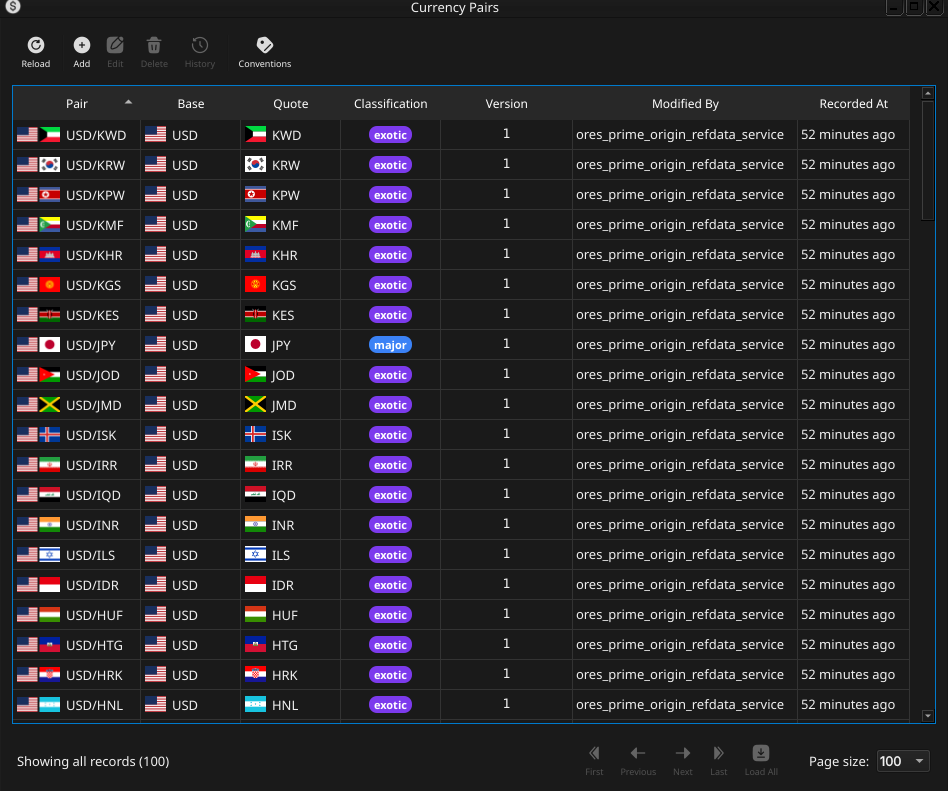
Figure 1: The Currency Pairs window, showing the full list of currency pairs in the tenant. Each row shows the composited base+quote flag, the individual Base and Quote codes, the Classification badge, version, and provenance columns.
Each row shows the pair code (with the base and quote currencies' flag icons composited into the same cell), the base and quote currency codes individually, the classification badge, the version number, the identity of the last modifier, and when the record was last recorded. The toolbar buttons reload the list and adjust the display; a further Conventions button, described in Currency Pair Conventions below, cross-navigates to the companion window. The list is paginated; use the page controls at the bottom right to navigate. Double-clicking a row opens the Currency Pair Details dialog.
4. Currency Pair Details
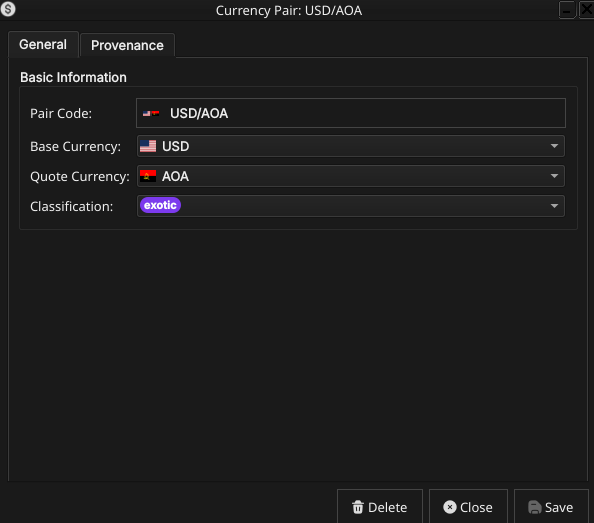
Figure 2: The Currency Pair Details dialog for USD/AOA, showing the Pair Code field with both flags, the locked Base and Quote Currency combos, and the Classification combo.
The dialog carries a compact set of fields. Pair Code is not typed directly; it is computed live from the Base Currency and Quote Currency combos while the record is still being created, and the field itself remains read-only throughout. Base Currency and Quote Currency are flagged combo boxes, each showing the relevant currency's flag alongside its ISO code, populated from the currencies already on file. Classification is a combo offering the four values described above — major, minor, exotic, and commodity.
Once a pair has been saved for the first time, its Base Currency and Quote Currency combos lock: the values remain visible, flags and all, but can no longer be changed, and Pair Code is therefore permanently fixed from the moment of creation onward. This reflects the domain reality that a currency pair's identity is its two legs; changing either leg would not modify the pair but create a different one under a different natural key.
Two checks run at creation time, both driven by the base-currency-
precedence rule described in Currency pairs and market conventions.
Attempting to create a pair whose code already exists is rejected
outright, since that would silently create a new version of the
existing record rather than a genuinely new one. Attempting to create
the inverse of a pair that already exists — for example, adding
USD/EUR when EUR/USD is already on file — is rejected for the
same underlying reason: the two directions describe one market, not
two, and only the canonically ordered direction may exist as a
record.
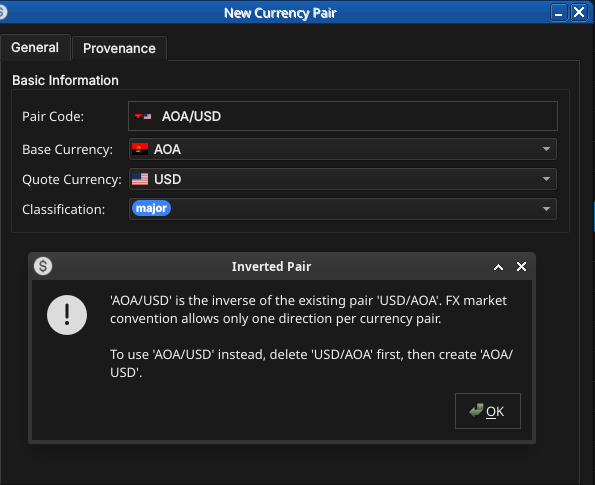
Figure 3: With USD/AOA already on file, attempting to create AOA/USD is rejected: the warning names both the rejected code and the existing pair it inverts, and explains the delete-then-recreate workaround for the rare case the direction genuinely needs to change.
The three action buttons at the bottom, Delete, Close, and Save, apply to the pair as a whole. The dialog also has a Provenance tab, read-only, showing the audit metadata for the current version; see the Reference Data — Provenance section for a full description of the fields common to all reference data entities.
5. Editing a currency pair
To edit a currency pair, open it in the Currency Pair Details dialog, change its Classification — the only field still open to editing once Base Currency and Quote Currency have locked — and click Save. As with every reference-data entity, ORE Studio prompts for a change reason before the record is written; select a Reason from the drop-down, add optional Commentary, and click Save to confirm. Every save creates a new version rather than overwriting the previous one.
6. Currency pair history
To view the full change history, open the details dialog and click the history icon in the title bar, or right-click the row and choose History. Select a version to populate the detail panel; the Changes tab shows which fields differ between the selected version and its predecessor, and the Revert button reinstates any historical version as a new version, preserving the full audit chain. The mechanics are identical to currency history, described in full in the previous chapter's Currency history section.
7. Currency Pair Conventions
Where the currency pair record establishes identity, base, quote, and classification, a second, separate record establishes the market conventions that govern how a pair's rate is quoted, rounded, and dated: pip factor, tick size, decimal places, the advancing calendar, the business day convention, and two boolean flags governing forward-date generation. The two records stand in a strict one-to-one relationship, keyed by the same pair code, and are kept as distinct entities rather than merged into one for the same reason the Currencies chapter kept Rounding Types and Market Tiers separate from the Currency record itself: identity and convention change at different rates and for different reasons, and separating them keeps each record's audit history meaningful on its own terms.
Open the Currency Pair Conventions window from the Reference Data menu, or from the Conventions toolbar button on the Currency Pairs window described above.
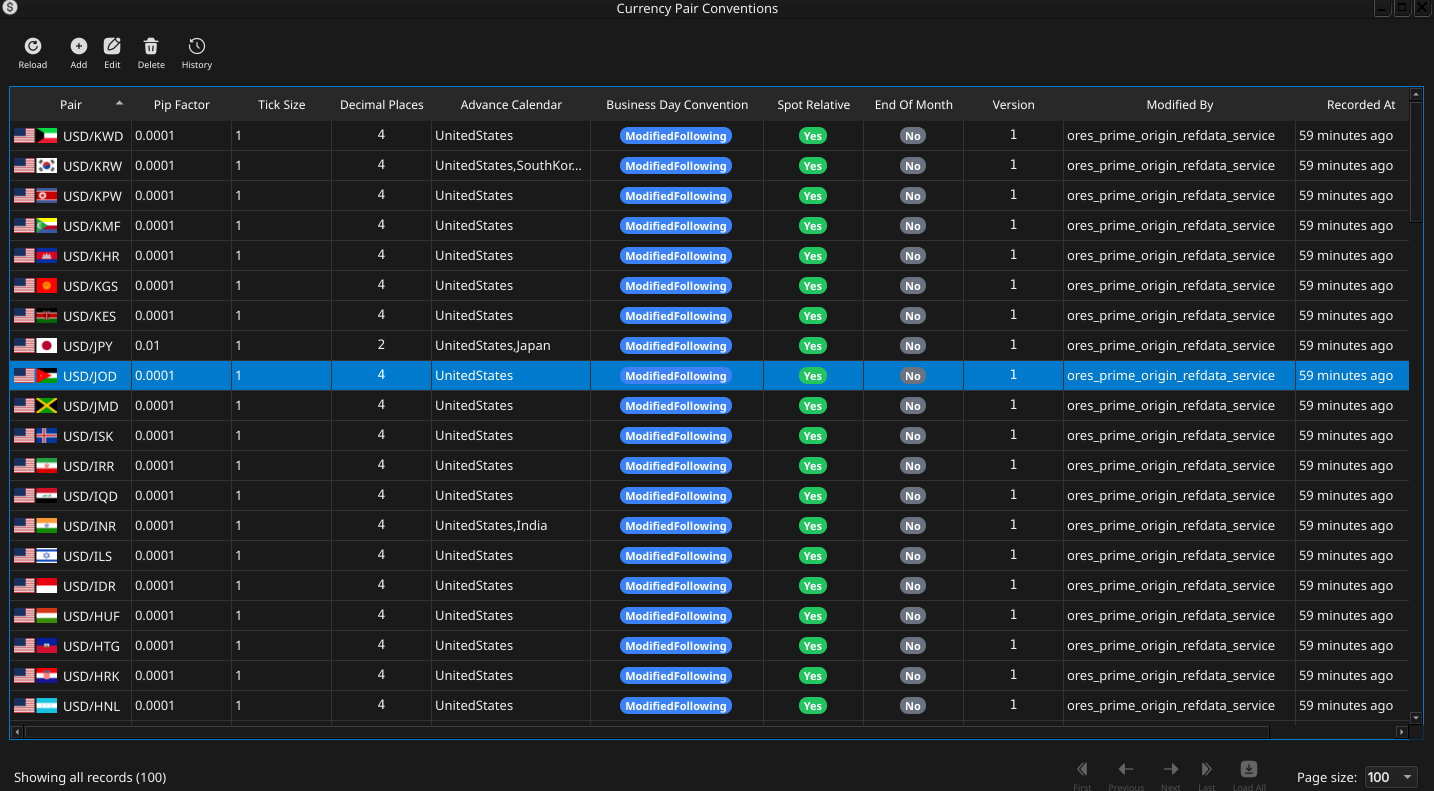
Figure 4: The Currency Pair Conventions window. USD/JPY (row eight) shows the JPY-cross convention — pip factor 0.01, two decimal places — contrasting with the =0.0001=/four-decimal-place convention every other row here shares.
Each row shows the pair code with its composited flag icons, pip factor, tick size, decimal places, advance calendar, business day convention badge, and the spot-relative and end-of-month flags rendered as Yes/No labels, followed by the usual version and provenance columns. Double-clicking a row opens the Currency Pair Convention Details dialog.
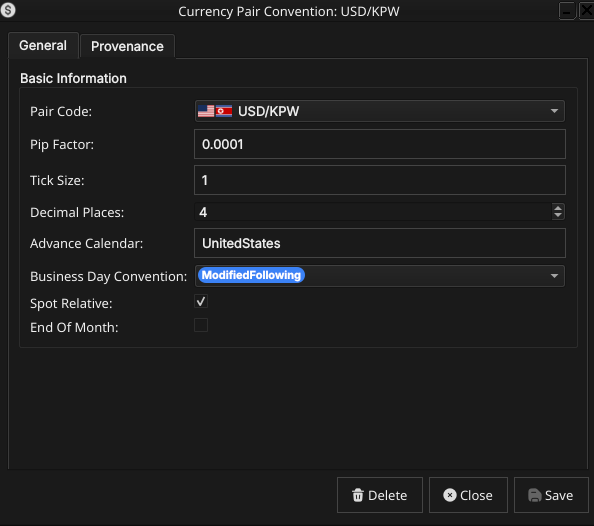
Figure 5: The Currency Pair Convention Details dialog for USD/KPW, showing the locked Pair Code combo with its flags, Pip Factor, Tick Size, Decimal Places, Advance Calendar, Business Day Convention, and the Spot Relative/End Of Month checkboxes.
Pair Code is a flagged combo, but unlike the Currency Pair Details dialog it does not derive its value from two separate legs; instead it lets the user pick directly from the pairs already on file, and, as with Base and Quote Currency above, is selectable only while creating the record and locks, still showing its flags, once saved. Attempting to create a second convention record for a pair code that already has one is rejected, on the same reasoning as the duplicate- pair check on the identity entity: a pair has at most one convention record, and the correct action is to edit the existing one rather than create a second.
The remaining fields follow directly from the domain concepts set
out earlier in the chapter. Pip Factor and Tick Size express the
pip and tick mechanics described in Currency pairs and market
conventions; a typical non-yen pair carries a pip factor of 0.0001,
a yen cross 0.01. Decimal Places fixes how many digits the rate
displays, consistent with the same pip convention — four for most
pairs, two for yen crosses. Advance Calendar names the calendar
used when advancing from the spot date to a forward date. Business
Day Convention selects among the standard date-rolling rules —
Following, Modified Following, Preceding, Modified Preceding,
Unadjusted, Half-Month Modified Following, and Nearest — that
determine how a date falling on a holiday is adjusted onto a business
day. Spot Relative indicates whether forward dates for this pair
are generated relative to the spot date rather than the trade date,
and End Of Month indicates whether the end-of-month date-rolling
convention applies.
8. Editing a currency pair convention
Editing follows the same pattern as every other reference-data entity in ORE Studio: open the record, change any field still open to editing once Pair Code has locked, and click Save. A change reason is required before the save is written, exactly as for currency pairs above.
9. Currency pair convention history
History and revert work identically to currency pair history: open the history icon or right-click and choose History, select a version, review the Changes tab, and use Revert to reinstate an earlier version as a new one.
10. Conclusion
The chapter set out to treat the currency pair as a relational entity distinct from, but built upon, the currencies documented in the previous chapter, and to separate that identity from the market conventions layered on top of it. The base-currency-precedence rule fixed how a pair's two legs are ordered and why only one of the two possible directions may ever be recorded; the major/minor/exotic/ commodity taxonomy classified the population of pairs by liquidity and tradability, independent of the raw fact that both legs are valid currencies; and the pip, tick, and settlement-timing conventions supplied the vocabulary the second entity's fields draw upon. The Qt interface then walked both entities from list to detail to history, in the pattern the previous chapter established, and showed how the two windows cross-navigate via the Conventions toolbar button. Unlike currencies, currency pairs and their conventions do not yet have shell or command-line equivalents; that gap is tracked as future work rather than glossed over here.
11. See also
- Currency pairs — the domain-knowledge hub this chapter draws on.
- Currencies — the previous chapter, covering the individual currency legs a pair is built from.
- Currency Pair (Investopedia) — an accessible introduction to currency pair quoting conventions.